

















Body
Body contouring after major weight loss in Thessaloniki and Athens, Greece
I have been planning and carrying out operations after major weight loss as a plastic surgeon since 2012. I split the corrections into stages so that each operation is safer.
Body contouring after major weight loss removes the excess skin and lifts the tissues once your weight has been stable for some time. It is usually done in 2 to 3 stages, 3 to 6 months apart, following a plan we set together at your consultation.

At a glance
What it corrects
Loose skin on the abdomen, flanks, buttocks, thighs, upper arms, chest and back after major weight loss; and on the thighs, arms and knees after liposuction for lipoedema (lipedema)
Anaesthesia
General, at every stage
Length
Usually 2 to 3 stages; each stage about 3 to 6 hours, with 3 to 6 months between stages
Hospital stay
2 to 3 nights (up to 4) after a body lift; fewer after the smaller stages
Back to work
After week 3 following a body lift; 1 to 2 weeks after the smaller stages
Exercise
After week 6 following each stage
Final result
About 6 months after each stage; the whole plan usually takes 1 to 2 years
Where
Interbalkan Medical Center, Thessaloniki · Athens Medical Center, Marousi
Medically reviewed by Dr Prodromos Papaioannou, Plastic Surgeon, HESPRAS member, ASPS International Member · Last reviewed:
What is body contouring after massive weight loss?
Body contouring after massive weight loss is a plan of operations rather than a single procedure. In stages, we remove the skin left loose after losing a lot of weight and lift the abdomen, buttocks, thighs, upper arms, chest and back, so that your body follows your new shape.
After major weight loss the skin loses its elasticity and does not shrink back enough. The laxity usually involves the whole trunk and the limbs, and it forms folds that make movement and hygiene harder. Some of the operations are similar to cosmetic procedures, while others, such as the body lift, are designed specifically for patients after major weight loss.
This page gives the overall picture of the plan and also covers loose skin after liposuction for lipoedema. For each individual operation, see the tummy tuck (abdominoplasty) page.
Am I a candidate for body contouring after weight loss?

You are a good candidate when your weight has been stable for 6 to 12 months, your health and nutrition are good, and you do not smoke. After bariatric surgery we usually wait 12 to 18 months. I confirm whether surgery is right for you when I examine you.
The wait is needed so that your body can recover, your weight can settle and your skin can shrink back as far as it is able to.
Who is typically suitable?
- People who have lost a lot of weight through diet and exercise, bariatric surgery or weight-loss medication, and have loose skin in several areas.
- A stable weight for at least 6 to 12 months, ideally close to a normal weight.
- People with skin folds that cause irritation, sweating, or difficulty moving and exercising.
- Good general health, adequate nutrition and normal blood tests, particularly iron and albumin.
- People who understand that the plan is carried out in stages and leaves long scars.
- Women with lipoedema who have completed liposuction, whose weight and result are stable, and who still have loose skin on the thighs, arms or knees. This is more common in stage 3 lipoedema, in older patients and in those with lax collagen.
When do I advise against it?
- When your weight is still falling or going up and down.
- Less than 12 to 18 months after bariatric surgery, so that your weight has time to stabilise.
- When anaemia, low albumin or another nutritional deficiency has not yet been corrected.
- In smokers who will not stop smoking for at least 4 weeks before and after surgery.
- When your BMI remains above about 32 or you have serious health problems that are not under control.
- When you are planning a pregnancy in the near future.
- In lipoedema that has not first been treated with liposuction: removing skin on its own often leads to disproportion and wide scars. In lipo-lymphoedema I take a more conservative approach.
What happens at the consultation and how do I prepare?
At the consultation I examine your whole body, review your weight loss, its stability and your medical history, and we agree the order of the stages. Before each stage you have blood tests, any deficiencies are corrected, and you stop smoking. The date of each stage is set only once this is complete.
What happens at the consultation?
At the consultation I examine your whole body, not only the area that bothers you most: the abdomen, flanks, buttocks, thighs, upper arms, chest and back. We discuss your weight loss, how stable it has been and your medical history, and together we decide the order of the stages. You receive a written plan.
Which tests and instructions apply before surgery?
After major weight loss I also check for anaemia, iron, ferritin, albumin, vitamin B12, folic acid and vitamin D. Deficiencies are common and affect healing, so they are corrected before surgery with your doctor or dietitian. You need enough protein (usually 70 to 100 g a day). For the larger stages I check your haematocrit.
Smoking greatly increases healing complications. Stop for at least 4 weeks before and 4 weeks after surgery; I do not operate on heavy smokers unless they stop. If you take anticoagulants or antiplatelet medicines, tell me; they are only stopped in agreement with the doctor who prescribes them. The date of each stage is set once your tests are complete and any deficiencies have been corrected.
How is body contouring after weight loss done?
The surgery is done in 2 to 3 stages under general anaesthesia. We almost always start with the trunk and correct the upper arms, chest, back and thighs at a later stage. We do not combine every area in one session, so that your body is not put under excessive strain.
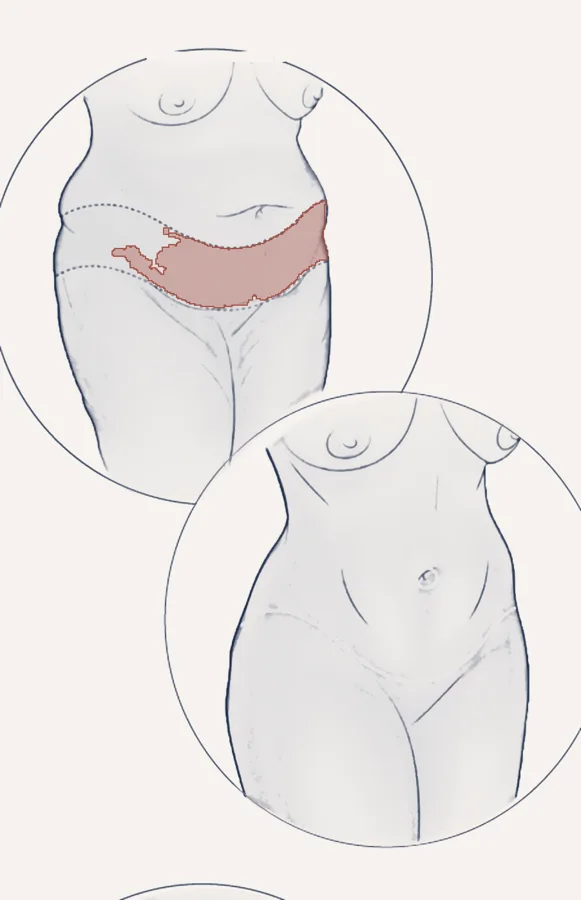
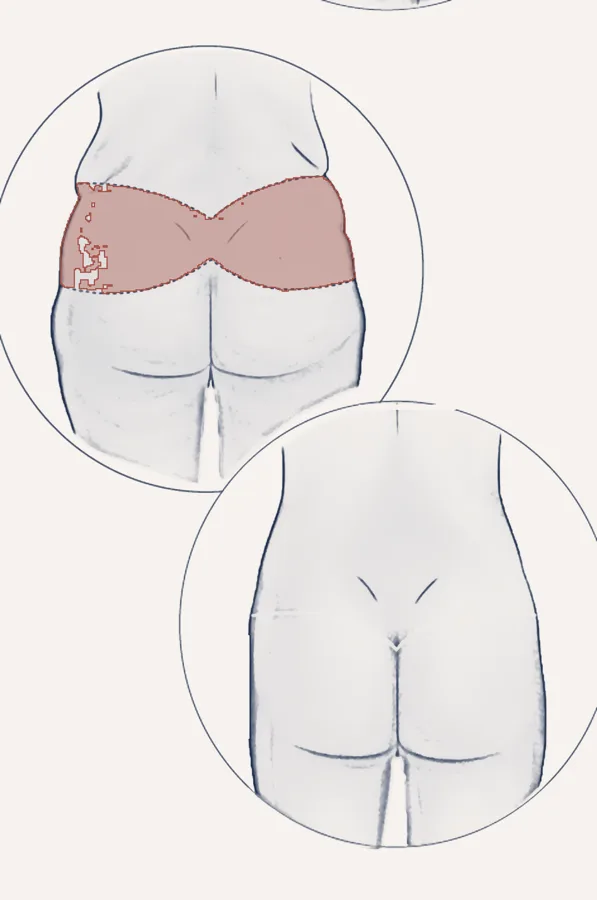
Each stage usually takes 3 to 6 hours, depending on the areas treated. We leave 3 to 6 months between stages so that your body can recover and the scars can mature.
In what order are the stages done?
- First stage, the trunk: a lower body lift or a fleur-de-lis abdominoplasty, for the abdomen, flanks, buttocks and outer thighs. When needed, an inner thigh lift is added, although this can also be done at a later stage.
- Second stage, the upper body: an arm lift (brachioplasty), a breast lift or restoration of breast volume, and correction of the back rolls.
- Third stage, where needed: a face and neck lift, liposuction or smaller refinements.
The order is adapted to what bothers you most. If, for example, your upper arms cause you the most difficulty, we can start there.
Lower body lift (belt lipectomy)
This is the classic operation after major weight loss. Through a circumferential incision, or a T-shaped incision, at the level of the buttocks and lower abdomen, the loose skin of the buttocks, outer thighs and hips is removed. The skin is lifted upwards and anchored to strong fascial layers, so that the result holds and the scar does not move.
Fleur-de-lis abdominoplasty
This is a variation of the tummy tuck for patients whose skin is loose vertically as well as horizontally. A vertical incision in the midline is added to the low horizontal incision on the abdomen, which narrows the waist and corrects the flanks. It leaves an additional vertical scar, but gives a better contour when the excess is large.
Upper body lift, back and breasts
With an additional excision at the level of the armpit and back, we correct pronounced back rolls. In women with marked loss of breast volume, we can use the excess skin and fat from the sides of the back to restore breast volume, with or without an implant. See the breast lift page for more on that operation.
Upper arms and thighs
The upper arms are corrected with an arm lift (brachioplasty) and the inner thighs with a thigh lift. When the excess is large, the incisions extend to the elbow or towards the knee.
Loose skin after liposuction for lipoedema
Liposuction done correctly rarely leaves loose skin in lipoedema; what looks like laxity is often the weight of the lipoedema tissue. When it is needed, an arm lift or thigh lift follows at a later stage; I explain this in detail on the page on loose skin in lipoedema.
Incisions and stitches
After major weight loss the scars are inevitably long, because a large amount of skin is removed. I plan them so that they are hidden as far as possible below the underwear or swimsuit line, on the inner side of the arms and thighs, and in the fold under the breasts. The stitches are mostly internal and dissolvable. Drains are often placed for a few days.
Combining procedures
In the same stage we combine areas that lie close together, such as the abdomen, buttocks and thighs, or the upper arms and chest, provided the total operating time remains safe. Liposuction is often added to smooth the contour. See also the liposuction page.
Hospital stay
After a body lift you stay in the hospital for 2 to 3 nights, and in some cases up to 4. After the smaller stages the stay is usually shorter. We fit a special compression garment before you leave, and you receive measures to prevent blood clots.
What is recovery like after body contouring surgery?
After a body lift you stay in hospital for 2 to 3 nights, wear a special compression garment and avoid sitting for 2 to 3 weeks. Most people return to work after week 3 and to exercise after week 6. The final result of each stage takes shape over about 6 months.
| When | How you feel | What you can do |
|---|---|---|
| Days 1–3 | Pain controlled with painkillers, a feeling of tightness, swelling | Stay in hospital; walk from the first day with your trunk slightly bent; compression garment |
| Week 1 | Tightness and bruising, which start to settle | Light activity at home; no sitting for long periods; drains removed when the fluid decreases |
| Weeks 2–3 | Less pain; your body is still swollen | Avoid sitting until 2–3 weeks; stitches removed where needed |
| After week 3 | You feel more comfortable in daily life | Back to work; keep wearing the compression garment |
| After week 6 | Swelling has gone down considerably | Gradual return to exercise and sport |
| Months 3–6 | Scars mature and the shape settles | Normal activity; planning the next stage |
| Month 6 | Final result of that stage | Review and decision on the next steps |
For the smaller stages, such as an arm lift or a breast lift, recovery is usually quicker; you will find their timings on the pages for those operations.
After lipoedema. Recovery after a thigh lift or arm lift takes about 10 days for the arms and 10 to 15 days for the thighs. You wear a compression garment for 4 to 6 weeks (a bolero with sleeves for the arms), with lymphatic drainage where needed, and afterwards you continue compression for lipoedema as I advise.
How long do I need to stay in Greece after body contouring surgery?
After a body lift you stay in hospital for 2 to 3 nights, sometimes up to 4, and fewer after the smaller stages. Plan to remain in Greece for 10 to 15 days in total, until your first check-up is done and you are cleared to fly.
Drains usually come out during the first week, once the fluid has decreased, and most stitches are internal and dissolvable; any external stitches come out at 5 to 7 days, at the practice. Because you should avoid sitting for long periods for the first 2 to 3 weeks, the flight home needs careful planning: you can usually fly from day 10, with flights of 3 hours at most in the first weeks.
Before you leave, you are fitted with your compression garment and given measures to prevent blood clots: early walking, compression stockings and, depending on your risk, blood-thinning protection. After you return home, follow-up continues by video call at 10 days, 1 month, 6 months and 1 year, and you come back to Greece for each later stage, 3 to 6 months apart.
At home, arrange help for the first weeks, a chair or bed setup that lets you avoid long periods of sitting, and time off work: most people return after week 3, and to exercise after week 6. Nursing care at home for dressing changes can be arranged if you need it.
How long do the results of body contouring last?
The laxity in the middle and lower body is removed straight away, and the final result of each stage settles at about 6 months. The result lasts for years as long as your weight stays stable. The scars are long, but they are planned to sit hidden under underwear or swimwear.
In the first months the scars move slightly downwards, but only a little, because the skin is anchored to deeper, stable structures. After body contouring most patients report a large improvement in quality of life, both in appearance and in function: walking, running, swimming and skin hygiene become easier, and their mood improves considerably. Your skin continues to age with time, and a new large change in weight or a pregnancy can affect the result.
What are the risks of body contouring after weight loss?
These are major operations, and healing complications are more common than after the equivalent cosmetic procedures. Most are minor, such as small wound openings or a fluid collection, and are treated without further surgery. The risk falls with a stable weight, good nutrition, stopping smoking and staged operations.
| Complication | How common | Prevention and treatment |
|---|---|---|
| Small wound openings | Not uncommon | Good nutrition, no smoking; they usually close with wound care |
| Fluid collection (seroma) | Not uncommon | Drains, compression garment; if it occurs, it is drained with a needle at the practice |
| Infection | Rare | Antibiotics and wound care |
| Haematoma | Rare | Review of medicines that affect clotting; if it occurs, it is drained |
| Anaemia or need for a blood transfusion | Not uncommon after a body lift | Correcting iron and haematocrit before surgery; staged operations |
| Deep vein thrombosis or pulmonary embolism | Rare, but serious | Anticoagulant prophylaxis, stockings and early mobilisation |
| Wide or stretched scars | Varies from person to person | Anchoring to deep fascial layers, scar care; correction with a minor procedure |
| Asymmetry or residual laxity | Not uncommon | Slight overcorrection; correction at a later stage |
| Change in skin sensation | Common, temporary | Usually returns within months |
| Swelling of the lower legs or hands (in lipoedema) | Common, temporary; rarely persists | Technique that protects the lymphatic vessels, surgery at a later stage, compression, lymphatic drainage |
Smoking. Stop for at least 4 weeks before and 4 weeks after each stage. In large skin excisions smoking considerably increases wound openings and skin necrosis, which is why I do not operate on heavy smokers unless they stop.
Blood thinners. Tell me if you take anticoagulants or antiplatelet medicines. They are always stopped in agreement with the doctor who prescribes them.
What affects the cost of body contouring after weight loss?
We do not publish prices. The cost depends on the number of stages, the areas treated at each stage, the length of the operation and the nights in hospital. Because every plan is different, you receive a quote for each stage separately after your consultation.
- The number of stages and the areas treated at each stage.
- The technique: body lift, fleur-de-lis abdominoplasty, upper body lift.
- The length of the operation and the anaesthesia.
- The nights in hospital.
- Combining with liposuction or a breast implant.
- Compression garments and follow-up visits.
Frequently asked questions
How long after bariatric surgery can I have skin removal surgery?
Usually 12 to 18 months after bariatric surgery, and always once your weight has been stable for 6 months to a year. This wait is not a formality. It gives your body time to recover, lets your weight settle without large swings and allows the loose skin to shrink as much as possible. If we operate earlier and you continue to lose weight, the skin can become loose again and you may need another operation. At the consultation we review your weight history and blood tests so that we can choose the right time together.
Can all the operations be done at once?
Usually not. Operations for loose skin on the face, upper arms or breasts, and other refinements, are done at a later stage to avoid putting a heavy load on your body. A very long operation increases blood loss, the risk of blood clots and healing complications. In the same stage we combine areas that lie close together, for example the abdomen, buttocks and thighs in a body lift. The stages are usually 3 to 6 months apart.
Which operation comes first after massive weight loss?
In most patients we start with the trunk, with a lower body lift or a fleur-de-lis abdominoplasty, because the laxity there is usually greatest and affects daily life the most. The upper arms, breasts and back follow, and smaller refinements to the thighs or face come last. The order is not fixed, though. If your upper arms or breasts trouble you most, we can start there. We decide the plan together at your consultation.
Will a body lift leave scars?
Yes. After major weight loss we remove a lot of skin, so the scars are long, for example around the waist in a body lift. I plan them to stay hidden below the underwear or swimsuit line. They are usually of good quality and fade with time, and their downward movement in the first months is small, because we anchor the skin to deep fascial layers. Most patients consider the scar a small price compared with the skin folds they had before.
When can I go back to work after a body lift?
Usually after week 3. For the first 2 to 3 weeks you avoid sitting so that the incision is not stretched, which makes desk work difficult. You wear a special compression garment, which helps healing and reduces bruising and swelling. If your work involves heavy physical activity, your return takes longer, and exercise starts after week 6. After the smaller stages, such as an arm lift, you go back to work sooner.
Do I need a special diet before body contouring surgery?
Yes, nutrition matters a great deal. After bariatric surgery anaemia and shortages of protein, iron, vitamin B12 and other vitamins are common, and they slow healing. Before each stage we check your haemoglobin, iron, proteins and vitamins with blood tests, and correct any deficiency together with your doctor or dietitian. Make sure you take enough protein and the supplements you have been advised to take, both before and after surgery.
When can I fly home after a body lift?
You can usually fly home from day 10, once your first check-up is done. You spend 2 to 3 nights in hospital, sometimes up to 4, and drains usually come out in the first week once the fluid has decreased. Because you should avoid sitting for long periods for the first 2 to 3 weeks, we plan the flight with care, and you leave with your compression garment and advice on preventing blood clots. After the smaller stages, such as an arm lift, the same rule applies: from day 10, with flights of 3 hours at most in the first weeks.
Can my follow-up be done at home?
Yes, much of it can. After you return home, we continue follow-up by video call at 10 days, 1 month, 6 months and 1 year. Most stitches are internal and dissolvable; any external stitches come out at 5 to 7 days, before you leave Greece. You return to Greece for each later stage of your plan, usually 3 to 6 months apart, and the review at about 6 months is when we decide on the next steps together.
References
- Lockwood T. Lower body lift with superficial fascial system suspension. Plast Reconstr Surg. 1993;92(6):1112–1122.
- Aly AS, Cram AE, Chao M, et al. Belt lipectomy for circumferential truncal excess: the University of Iowa experience. Plast Reconstr Surg. 2003;111(1):398–413.
- Song AY, Jean RD, Hurwitz DJ, et al. A classification of contour deformities after bariatric weight loss: the Pittsburgh Rating Scale. Plast Reconstr Surg. 2005;116(5):1535–1544.
- Friedman T, O’Brien Coon D, Michaels J, et al. Fleur-de-lis abdominoplasty: a safe alternative to traditional abdominoplasty for the massive weight loss patient. Plast Reconstr Surg. 2010;125(5):1525–1535.
- Coon D, Gusenoff JA, Kannan N, et al. Body mass and surgical complications in the postbariatric reconstructive patient: analysis of 511 cases. Ann Surg. 2009;249(3):397–401.
- Agha-Mohammadi S, Hurwitz DJ. Potential impacts of nutritional deficiency of postbariatric patients on body contouring surgery. Plast Reconstr Surg. 2008;122(6):1901–1914.
- van der Beek ES, van der Molen AM, van Ramshorst B. Complications after body contouring surgery in post-bariatric patients: the importance of a stable weight close to normal. Obes Facts. 2011;4(1):61–66.
- Schmeller W, Hueppe M, Meier-Vollrath I. Tumescent liposuction in lipoedema yields good long-term results. Br J Dermatol. 2012;166(1):161–168.
- Rapprich S, Dingler A, Podda M. Liposuction is an effective treatment for lipedema: results of a study with 25 patients. J Dtsch Dermatol Ges. 2011;9(1):33–40.
- Kruppa P, Georgiou I, Biermann N, et al. Lipedema: pathogenesis, diagnosis, and treatment options. Dtsch Arztebl Int. 2020;117(22–23):396–403.
- Herbst KL, Kahn LA, Iker E, et al. Standard of care for lipedema in the United States. Phlebology. 2021;36(10):779–796.
- Lockwood TE. Fascial anchoring technique in medial thigh lifts. Plast Reconstr Surg. 1988;82(2):299–304.
- Di Pietro V, Colicchia GM, Cervelli V, et al. Medial thigh contouring in massive weight loss: a liposuction-assisted medial thigh lift. World J Plast Surg. 2019;8(2):171–180.
- Knoetgen J 3rd, Moran SL. Long-term outcomes and complications associated with brachioplasty: a retrospective review and cadaveric study. Plast Reconstr Surg. 2006;117(7):2219-23. PMID: 16772920. doi:10.1097/01.prs.0000218707.95410.47.
Consultation
In Thessaloniki, in Athens or by video. Examination, options and a written plan.