














Breast
Breast malformation correction in Thessaloniki and Athens, Greece
Breast malformations are problems in how the breasts develop: tuberous breast, Poland syndrome, marked asymmetry and inverted nipples. Depending on the malformation, I correct them with an implant, a breast lift, a reduction or fat transfer. I perform about 5 such corrections a year, each with an individual plan that may combine these techniques.
about 5
operations a year

At a glance
What it treats
Tuberous breast, Poland syndrome, breast asymmetry, inverted nipples
Anaesthesia
General; local for inverted nipples
Operating time
Tuberous breast, Poland syndrome, asymmetry: about 1 to 3 hours, longer with a flap; inverted nipple: about 30 to 60 minutes
Hospital stay
No overnight stay in most cases
Back to work
Recovery 2 to 3 weeks; after nipple correction, usually 1 to 3 days
Exercise
With an implant: after 6 weeks; nipple correction: about 2 weeks; fat transfer: about 4 weeks
Final result
With an implant: at 3 to 4 months; fat transfer and nipple correction: at about 6 months
Where
Interbalkan Medical Center, Thessaloniki · Athens Medical Center, Marousi (Athens)
Medically reviewed by Dr Prodromos Papaioannou, Plastic Surgeon, HESPRAS member, ASPS International Member · Last reviewed:
What are breast malformations?
Breast malformations are problems in how the breasts develop, either before birth or during puberty, in one breast or both. The main types are tuberous breast, Poland syndrome, marked asymmetry and inverted nipples. Correction may be done for aesthetic reasons, medical reasons or both, and the right approach depends on which malformation you have.
| Malformation | What it is | Usual correction |
|---|---|---|
| Tuberous breast | A fibrous ring inside the breast stops the lower pole from developing; the areola is swollen and protrudes | Mild forms: an implant and/or fat transfer. Severe forms: release of the ring and redistribution of volume through an incision around the areola, with an implant, fat or a breast lift |
| Poland syndrome | Incomplete development of the breast, which may also involve the nipple, the pectoralis major muscle or the upper limb | Latissimus dorsi flap and an implant; in men, a flap or special male implants |
| Breast asymmetry | A large difference in size, shape or nipple height | Augmentation of the smaller breast, reduction or lift of the larger one, fat transfer |
| Inverted nipple | The nipple points inwards and is hidden, usually because of fibrous tissue | Minor surgical correction, under local or general anaesthesia |
An inverted nipple can make breastfeeding difficult and lead to inflammation. Poland syndrome can affect the chest muscle and the front wall of the armpit.
Treatment depends on the type of malformation. An inverted nipple can often be corrected with a minor operation under local anaesthesia, while a tuberous breast or Poland syndrome may need a larger operation or several stages.
Problems that appear after a previous breast operation, such as a double bubble, an implant that has dropped too low (bottoming out) or an implant that sits too high, are not congenital malformations. They are covered on the breast revision surgery page.
Who is a good candidate for breast malformation correction?

Good candidates are healthy adults whose breasts have finished developing and who have a tuberous breast, Poland syndrome, marked asymmetry or an inverted nipple. Severe forms may need more than one operation. Whether correction is right for you, and how it should be planned, is decided when I examine you.
Who typically comes for correction?
- Women with tuberous breasts, even a mild form, who come for breast augmentation without knowing it is a malformation.
- Women with a visible difference in size, shape or nipple height between the two breasts.
- Women and men with Poland syndrome.
- Anyone with an inverted nipple that bothers them aesthetically, makes breastfeeding difficult or causes inflammation.
When do I advise against it?
- Before the breasts have finished developing.
- During pregnancy or breastfeeding, and for the first 6 months afterwards.
- When there is an active infection or an untreated breast condition.
- For a nipple that has recently started to turn inwards on one side, until it has been checked for malignancy.
- In heavy smokers, when the correction includes a reduction or a breast lift, unless they stop smoking 4 weeks before and 4 weeks after.
What happens at the consultation, and how do I prepare?
At the consultation I examine both breasts and explain what can realistically be corrected, with which techniques and in how many operations, and you leave with a written plan. Before surgery you need blood tests and an anaesthetic assessment, and you must stop smoking 4 weeks before and 4 weeks after the operation.
What happens at the consultation?
I examine the shape, size and height of the breasts, the inframammary fold, the nipple, the areola and the quality of the skin and, in Poland syndrome, the chest muscle and the armpit. We discuss what can realistically be corrected, with an implant, fat, a breast lift or a reduction, in one or more operations. If you plan to breastfeed, this is taken into account. You receive a written plan.
What tests do I need before surgery?
You need blood tests, a pre-operative check for the anaesthetic and, where needed, a breast ultrasound. Stop smoking 4 weeks before and 4 weeks after surgery. If you take anticoagulants or antiplatelet medicines, tell me; they are stopped only with the agreement of the doctor who prescribes them.
How is a breast malformation corrected?
Most corrections are done under general anaesthesia; an inverted nipple can also be corrected under local anaesthesia. The technique depends on the malformation: an implant, fat transfer, release of the fibrous ring, a breast lift, a reduction or a latissimus dorsi flap. I often combine techniques, and severe forms are corrected in stages. The correction usually takes 1 to 3 hours, longer with a flap.
Each malformation is treated differently. I often combine techniques in the same operation, so that shape, volume and nipple position are corrected together. In severe forms the correction is done in stages.
Tuberous breast
This is one of the most common malformations, in one breast or both. A fibrous ring inside the breast stops the lower pole from developing and, in severe forms, the whole breast. In mild forms the breast is pear-shaped; in severe forms it is tube-shaped, with a swollen nipple that protrudes. Many women who come for breast augmentation have a mild form without knowing it.
In grade one, the lower pole has not developed, the breast is small and the inframammary fold sits higher than normal. Here the solution is an implant, fat transfer or both (see the breast augmentation page). In more severe forms, where the nipple is significantly affected, I release the ring that constricts the breast and redistribute the volume around the nipple, usually through an incision around the areola, combined with an implant, fat or a breast lift.
Poland syndrome
Poland syndrome is incomplete development of the breast, which may also involve the nipple, the pectoralis major muscle or even the upper limb. Depending on the aesthetic and functional deficit, I use the latissimus dorsi muscle as a rotational flap to rebuild the chest muscle and the front wall of the armpit, and a silicone implant for the missing volume.
It rarely affects both sides, and it can also occur in men. In men I use the latissimus dorsi flap or special male silicone implants.
Breast asymmetry
A small difference between the two breasts is normal. When the difference in size, shape or nipple height is large, I correct it with whatever combination is needed: augmentation of the smaller breast, reduction or a lift of the larger one, or fat transfer. For these operations, see also the breast lift and breast reduction pages.
Inverted nipple
With an inverted nipple, the nipple points inwards, usually because of fibrous tissue, on one side or both. Correction is surgical, under local or general anaesthesia. The milk ducts, and with them breastfeeding, are often preserved, but this is not guaranteed. Recurrence is rare.
If a nipple that used to be normal suddenly starts to turn inwards on one side, see a specialist straight away, because it may be a sign of malignancy.
Incisions and stitches
The incision depends on the technique: in the inframammary fold or around the areola for an implant, around the areola for releasing the ring, small incisions of a few millimetres for fat transfer, an incision on the back for the latissimus dorsi flap, and the breast lift or reduction incisions where these are needed. For an inverted nipple the incision is small, at the base of the nipple. The stitches are internal.
Hospital stay
In most cases no overnight stay is needed and you go home the same day, with someone to accompany you. You must not drive after a general anaesthetic. Correction of Poland syndrome with a flap may need an overnight stay.
What is recovery like after breast malformation correction?
Recovery depends on the operation and usually takes 2 to 3 weeks. After inverted nipple correction you are back to daily life almost immediately. With an implant, fat or a breast lift, recovery follows that of those operations, while a latissimus dorsi flap for Poland syndrome takes longer.
| When | How you feel | What you can do |
|---|---|---|
| Days 1–3 | Mild pain and swelling; minimal discomfort after nipple correction | Simple painkillers; a support bra where needed; after nipple correction, back to normal almost immediately |
| Week 1 | Discomfort decreases | Back to office work, usually at 5 to 7 days with an implant, fat or a lift; no lifting |
| Weeks 2–3 | Most of the recovery is complete | Normal daily life; for a Poland flap about 4 to 6 weeks |
| Week 6 | Almost normal sensation | Gradual return to exercise, especially after an implant or a flap |
| Months 3–6 | The breasts soften and take their final shape; the fat volume settles | Symmetry is assessed; if needed, a second operation or repeat fat transfer after 6 months |
How long do I need to stay in Greece after breast malformation correction?
How long you stay depends on the operation. Most corrections need no overnight stay, so you leave the hospital the same day; a latissimus dorsi flap for Poland syndrome may need one night in hospital. Plan to stay in Greece for 5 to 10 days before flying home.
Inverted nipple correction is a minor operation, often under local anaesthesia, and needs the shortest stay, from day 5. After an implant, fat transfer, a breast lift or a reduction, allow 5 to 10 days. After a flap for Poland syndrome, you can usually fly from about day 10.
The stitches are internal and absorbable, so nothing needs to be removed. I see you for a final check the day before your flight.
Follow-up once you are home: by video call at 10 days, 1 month, 6 months and 1 year, all done by me.
At home, arrange:
- someone to accompany you on the day of surgery, as you must not drive after a general anaesthetic;
- time off work, usually 1 to 3 days after nipple correction and 5 to 7 days after an implant, fat or a lift, with no heavy lifting in the first weeks;
- a support bra where needed;
- a gradual return to exercise from week 6, especially after an implant or a flap.
Symmetry is assessed at 3 to 6 months. If a second operation or a repeat fat transfer is needed, it is done after 6 months, which means a second trip.
How long do the results last?
In most cases the result is permanent, with a more natural shape and better symmetry. Mild forms usually need one operation; severe forms may need a second for refinement. Perfect symmetry does not exist even in breasts that developed normally, so the aim is a result that suits your body.
 Before
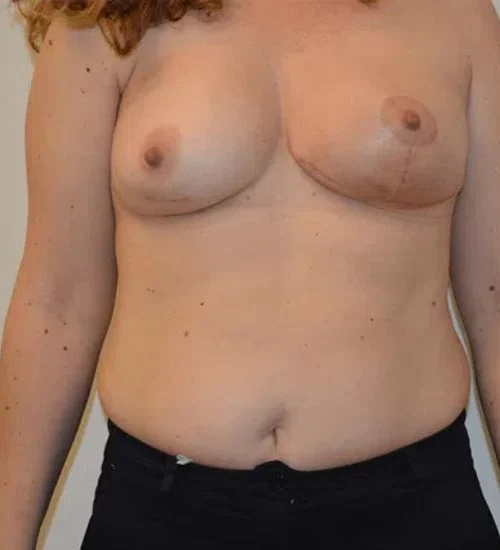 After
AfterThese photos include nudity.
Breast malformations
Woman, 25 · 12 months after
Front
Results vary from patient to patient.
Inverted nipple correction is permanent, with very few recurrences. Where an implant is used, the same applies as in breast augmentation: implants are very durable but not lifelong. Fat survival cannot be predicted, so a repeat session may be needed. A new pregnancy or a large change in weight can alter shape and symmetry. If a problem arises with an implant from a previous operation, see the breast revision surgery page.
What are the risks of breast malformation surgery?
The risks depend on the technique and are the same as those of breast augmentation, a breast lift, a reduction or fat transfer, and of the flap in Poland syndrome. Most are rare and can be treated. In severe malformations a second operation may be needed for better symmetry. I explain the risks for your own case at the consultation.
| Complication | How common | Prevention and management |
|---|---|---|
| Residual asymmetry | More likely in severe forms | Planning with measurements; a second operation or fat transfer for refinement |
| Haematoma | Rare, in the first few days | Review of medicines that affect clotting; drained if it occurs |
| Infection | Rare | Antibiotics; the implant rarely needs to be removed |
| Delayed healing | Rare; more common in smokers | Stopping smoking; local wound care |
| Change in nipple sensation | Usually temporary | Usually returns within months |
| Recurrence of nipple inversion | Rare | Repeat correction |
| Implant complications (capsular contracture, double bubble, displacement) | Not common | Releasing the ring in tuberous breasts, correct implant size and plane; correction by revision surgery |
| Fat resorption or fat necrosis | Partial resorption of the fat is expected; fat necrosis is rare | Injection in thin layers; repeat after 6 months |
| Seroma on the back (latissimus dorsi flap) | Relatively common after a flap | Monitoring; aspiration when needed |
Smoking. Stop at least 4 weeks before and 4 weeks after surgery: smoking increases healing complications and reduces the success of fat transfer. When the correction includes a reduction or a breast lift, I do not operate on heavy smokers unless they stop 4 weeks before and 4 weeks after.
Blood thinners. Tell me if you take anticoagulants or antiplatelet medicines. They are always stopped in agreement with the doctor who prescribes them.
What does the cost of breast malformation correction depend on?
I do not publish prices, because the cost varies widely with the malformation and the operation it needs, from a minor nipple correction under local anaesthesia to an operation with an implant, fat or a flap. You receive a quote after the consultation, once I have examined you and we have agreed on the plan together.
- The malformation and its severity.
- The technique: implant, fat transfer, breast lift, reduction or flap.
- Whether one or both breasts are corrected.
- The anaesthesia, general or local.
- The type of implant, where one is needed.
- Whether the correction is done in one operation or several.
Frequently asked questions
How can I tell if I have tuberous breasts?
Typical signs are an underdeveloped lower half of the breast, a narrow breast shape, a high inframammary fold and a swollen areola that protrudes. In mild forms many women do not know they have it and come simply for breast augmentation. The diagnosis is made clinically at the consultation, and it matters: a simple augmentation without releasing the fibrous ring can produce a double bubble shape.
Can I breastfeed after inverted nipple correction?
In most cases, yes. During the operation the continuity of the milk ducts is usually preserved, and with it the ability to breastfeed. In very severe forms, where the fibrous tissue involves the ducts, this ability may be reduced. If you plan to breastfeed, tell me at the consultation so that we choose the right technique. The result is permanent, and recurrence is rare.
What is the minimum age for breast malformation surgery?
We usually wait until the breasts have finished developing, so that the correction is stable. In marked asymmetry or Poland syndrome, where distress during adolescence can be intense, staged correction may be discussed earlier. This is always done with the written consent of both parents and after an individual assessment of the young person.
Is a tubular breast the same as a tuberous breast?
Yes. Tuberous, tubular and conical breast are different names for the same malformation. It is caused by a fibrous ring inside the breast that stops the lower pole from developing. Severity varies widely, from a breast that is simply small with a high fold to a narrow, tube-shaped breast with a protruding nipple, and the correction is adapted to that severity.
Can tuberous breasts be corrected with fat transfer alone?
In mild forms, yes. In grade one, where the lower pole is slightly underdeveloped and the breast is small, fat transfer can fill the lower pole without an implant, provided you have enough fat elsewhere on the body. Fat survival cannot be predicted, so a repeat session may be needed after 6 months. More severe forms usually also need release of the ring, and often an implant or a breast lift.
Is an inverted nipple a sign of breast cancer?
An inverted nipple that has been present since adolescence is usually a malformation, not a sign of disease. However, if a nipple that used to be normal suddenly starts to turn inwards on one side, see a specialist straight away, because it may be a sign of malignancy. In that case the breast is checked first, with imaging and any other tests your doctor considers necessary, and cosmetic correction is discussed only once any serious cause has been ruled out.
Is a problem with an old breast implant a malformation?
No. A double bubble, an implant that has dropped too low (bottoming out), an implant that sits too high or capsular contracture are not congenital malformations but problems after a previous breast operation. They are corrected surgically, with techniques such as surgery on the capsule, implant replacement, a breast lift or fat transfer, as described on the breast revision surgery page. If you also had an original malformation, such as a tuberous breast, we treat it in the same operation.
When can I fly home after breast malformation correction?
It depends on the operation. Most corrections are day surgery, while a latissimus dorsi flap for Poland syndrome may need one night in hospital. As a guide, you can fly from day 5 after inverted nipple correction or after an implant, fat transfer, a lift or a reduction, and from about day 10 after a flap. I see you for a final check the day before your flight; there is no limit on flight length.
Can my follow-up be done at home?
After you return home, follow-up is by video call at 10 days, 1 month, 6 months and 1 year. The stitches are internal and absorbable, so nothing needs to be removed, and all follow-up checks are done by me. Symmetry is assessed at 3 to 6 months. If a second operation or a repeat fat transfer is needed for refinement, it is done after 6 months, and that means another trip to Greece.
References
- Rees TD, Aston SJ. The tuberous breast. Clin Plast Surg. 1976;3(2):339–347.
- von Heimburg D, Exner K, Kruft S, et al. The tuberous breast deformity: classification and treatment. Br J Plast Surg. 1996;49(6):339–345.
- Grolleau JL, Lanfrey E, Lavigne B, et al. Breast base anomalies: treatment strategy for tuberous breasts, minor deformities, and asymmetry. Plast Reconstr Surg. 1999;104(7):2040–2048.
- Mandrekas AD, Zambacos GJ, Anastasopoulos A, et al. Aesthetic reconstruction of the tuberous breast deformity. Plast Reconstr Surg. 2003;112(4):1099-108. PMID: 12973230. doi:10.1097/01.PRS.0000076502.37081.28.
- Fokin AA, Robicsek F. Poland’s syndrome revisited. Ann Thorac Surg. 2002;74(6):2218–2225.
- Han S, Hong YG. The inverted nipple: its grading and surgical correction. Plast Reconstr Surg. 1999;104(2):389–395.
Consultation
In Thessaloniki, in Athens or by video. Examination, options and a written plan.