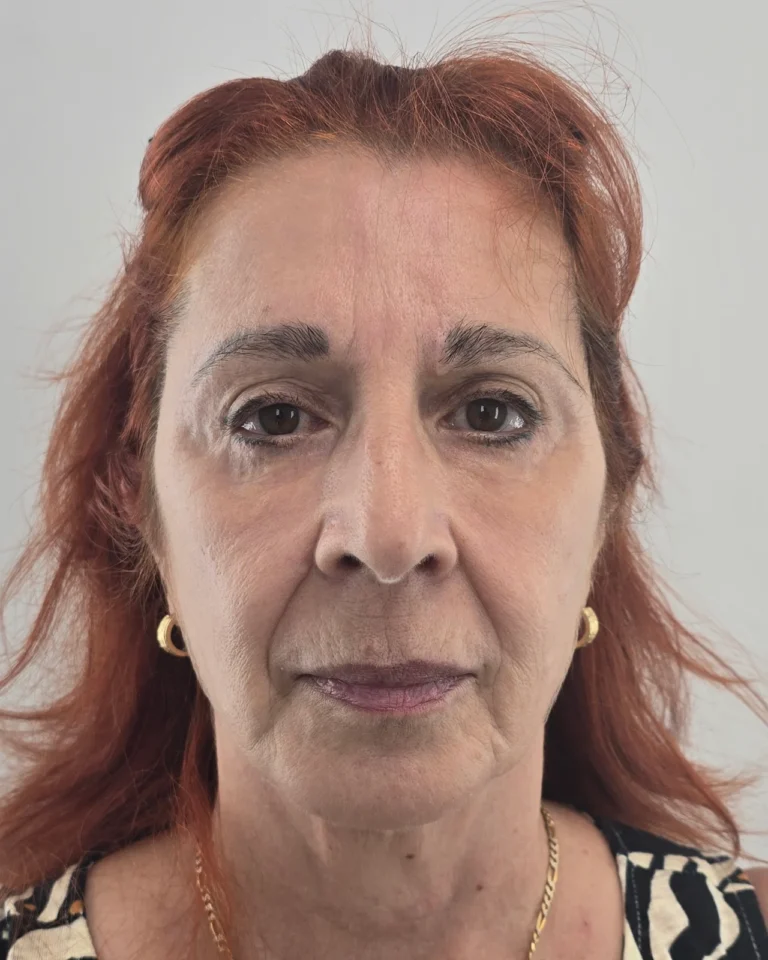
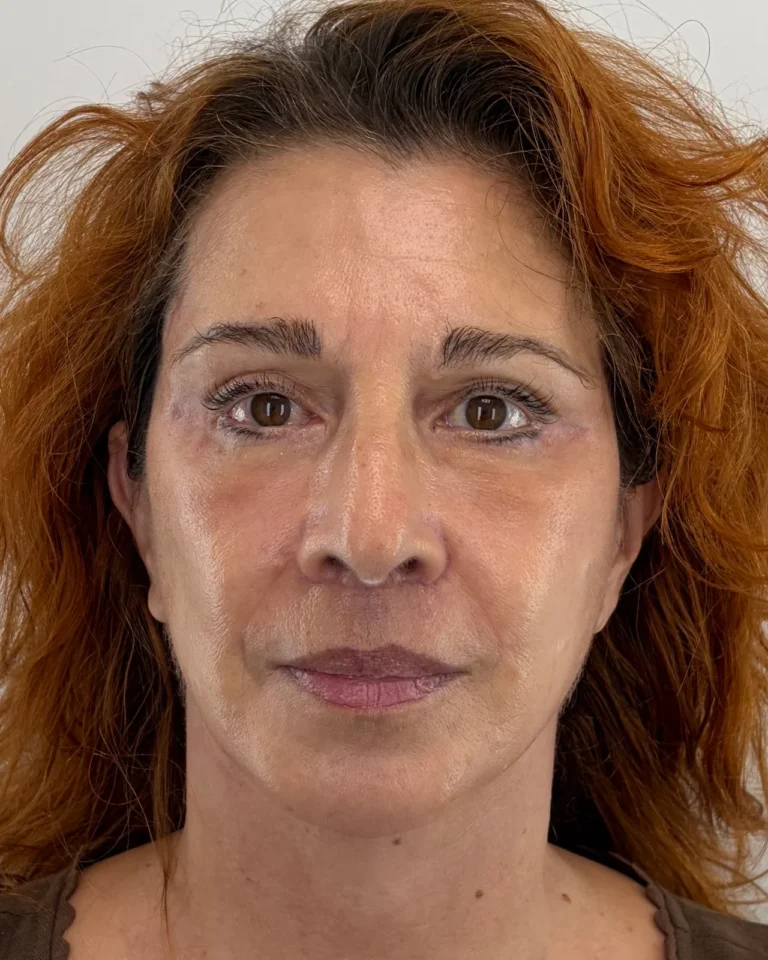






Face · Rejuvenation
Forehead and brow lift in Thessaloniki and Athens, Greece
I perform 40 to 50 brow lifts a year and have been a specialist plastic surgeon since 2012. The technique I recommend depends on what needs correcting, where your hairline sits and whether other procedures are planned at the same time.
A forehead and brow lift raises low or flat eyebrows, reshapes their arch and lifts the outer corner of the eye. Some techniques also shorten a high forehead. I choose between five techniques according to your hairline and the problem we are correcting, and you go home the same day, with no overnight hospital stay.
40–50
operations a year
At a glance
What it corrects
Low or flat brows, a heavy upper third of the face, a drooping outer corner of the eye, a high forehead
Anaesthesia
Local or general, depending on the technique
Operating time
45 minutes to 2 hours, depending on the technique
Hospital stay
None; you go home the same day
Back to work
About 1 month, depending on the technique
Exercise
After about 1 month
Final result
About 3 months; a hairline scar matures over a few months
Where
Interbalkan Medical Center, Thessaloniki · Athens Medical Center, Marousi
Medically reviewed by Dr Prodromos Papaioannou, Plastic Surgeon, HESPRAS member, ASPS International Member · Last reviewed:
What is a forehead and brow lift?
A forehead and brow lift is an operation that sets the eyebrows higher and improves their arch and the angle of the eye. Depending on the technique, it can also bring the hairline down to shorten the forehead. It can be done on its own or together with a facelift, and it often changes how the upper eyelids look.
In men, the forehead grows taller over the years as the hairline recedes. In women, a high forehead gives the face a more masculine look. Forehead lines and low brows give a tired expression, and they go hand in hand with loosening of the eyelids.
Lifting the brows takes weight off the area above the eye and changes the appearance of the upper eyelids. Some extended techniques also improve the midface.
Is a brow lift right for me?

A brow lift suits people with heaviness in the upper third of the face, low or flat brows, or a high forehead. There is no age limit. At examination I work out whether the heaviness comes from the brow or from the eyelid, because that decides which operation is right for you.
The position and shape of the eyebrows depend mainly on anatomy and genetics. That is why I see more and more younger patients who want a better arch and a more lifted outer corner of the eye, often described as a “cat eye” or “foxy eye” look.
Who is a typical candidate?
- Low or flat brows that make you look tired or sad.
- Drooping of the tail only, the outer part of the brow.
- A heavy upper eyelid caused by the brow, not only by eyelid skin.
- An overactive forehead muscle that keeps lifting the brow and creates forehead lines.
- A high forehead or receding hairline, mainly in women who would like a shorter forehead.
- Men with low brows, often with hair loss.
When do I not recommend it?
- When the heaviness around the eyes comes only from excess eyelid skin or eyelid bags; the answer then is blepharoplasty (see the upper eyelid surgery page).
- When the brows already sit well and lifting them would leave a permanently surprised look.
- With a high forehead, the endoscopic lift, which raises the hairline further; there I prefer the open lift with hairline advancement.
- When there is an active skin or scalp condition where the incisions would go, or a health problem that is not under control.
- When expectations are not realistic, for example a wish to change the character of the face completely.
Consultation and preparation
At consultation I assess where your brows sit in relation to the eyelids, forehead and hairline, and how active the forehead muscle is. Together we choose the shape, the technique and any procedures to combine with it. You leave with a written plan and a quote, so you can decide calmly before booking.
What happens at the consultation?
I examine the position of the brow against the eyelid, the forehead and the hairline, as well as the activity of the forehead muscle. By lifting the brow gently with my hand, I can show you how much of the heaviness over the eye comes from the brow and how much from the eyelid. We then agree on the shape, the technique and possible combinations, and you receive a written plan and quote.
What tests and instructions apply before surgery?
Before surgery you have the necessary pre-operative tests; if you live abroad, I accept tests done at home if they are no more than 1 month old. Stop smoking 4 weeks before and 4 weeks after surgery. If you take anticoagulants or antiplatelet medicines, tell me; they are only stopped in agreement with the doctor who prescribes them, and prevention of thrombosis is tailored to your individual risk.
How is a brow lift performed?
The operation is done under local or general anaesthesia and takes 45 minutes to 2 hours, depending on the technique. I use five: the temporal lift with the MORE technique (the one I perform most often), the endoscopic lift, the open lift with hairline advancement, the gliding brow lift and the direct brow lift.
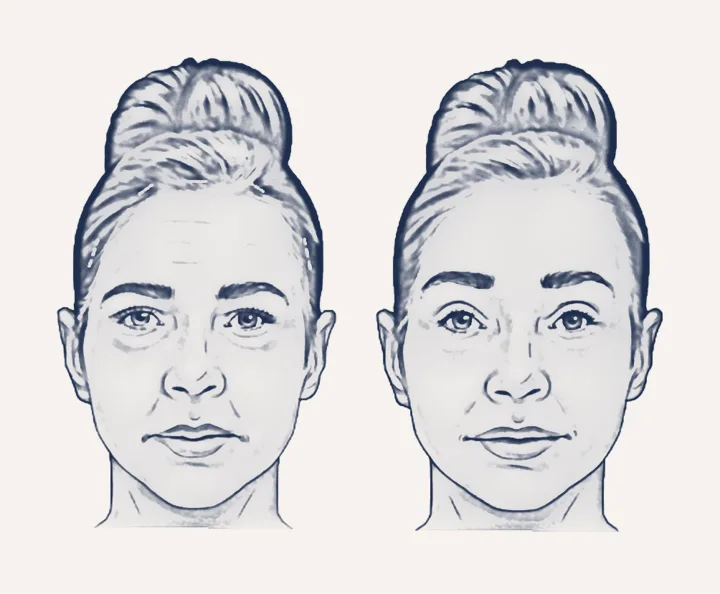
There is a wide range of operations for the forehead and brows. The five below are the ones I have settled on and perform routinely, and I choose between them according to the problem. When the distance between brow and hairline is large or the hairline has receded, I prefer the open lift with hairline advancement. When that distance is normal but the brow has dropped moderately, the endoscopic lift. When only the tail of the brow has dropped, the temporal lift. For men’s brows, the direct brow lift. For mild to moderate drooping, when you want a solution without visible scars, the gliding brow lift.
| Technique | When | Incisions | Anaesthesia | Operating time |
|---|---|---|---|---|
| Temporal (MORE technique) | Drooping of the brow tail only; the technique I use most often | Small incisions in the temple or at the hairline at the sides of the forehead | Local or general | About 1 hour |
| Endoscopic | Normal brow-to-hairline distance, moderate drooping | Small incisions within the hair | General | About 1.5 hours |
| Open, with hairline advancement | Large brow-to-hairline distance or a receding hairline | Along the hairline | General | About 2 hours |
| Gliding brow lift | Mild to moderate drooping, when you want no visible incisions | Very small incisions within the hair and external stitches | Local or general | About 45 minutes |
| Direct brow lift | Men’s brows, often with hair loss | Along the upper edge of the brow | Local | About 1 hour |
Temporal brow lift (mini temporal lift, MORE technique)
The temporal lift is a smaller version of the open lift, with incisions hidden in the temples or at the hairline at the sides of the forehead. It is the technique I use most often. With the MORE technique, the tail of the brow is repositioned together with the orbicularis oculi muscle around the eye, which is fixed to the fascia of the temple. It takes about 1 hour, under local anaesthesia, or general anaesthesia when combined with other procedures.
It lifts the outer part of the brow and improves the arch. Depending on your case, it can be extended to the corner of the eye, including canthopexy, or to the outer part of the upper eyelid. Of the five techniques, it usually has the shortest recovery.
Endoscopic brow lift (endo brow lift)
The endoscopic brow lift is done on its own or together with other lifts, such as the deep plane facelift. I perform it with an endoscopic camera through small incisions within the hair, in the subperiosteal plane with very little bleeding. It can be extended to the midface (extended endoscopic brow lift, or ponytail lift).
It has a marked effect on the position and shape of the brows, the angle of the eyes and the upper eyelid. It does not change the hairline or shorten the forehead, which is why I choose it when the distance between brow and hairline is normal. Fixation is with stitches to the temporal fascia or the periosteum, and less often to the bone. It is done under general anaesthesia and takes about 1.5 hours.
Open forehead lift with hairline advancement
The open forehead lift (hairline advancement) brings the hairline down and shortens the forehead while lifting the arch of the brows. I choose it when the distance between brow and hairline is large or the hairline has receded.
The drawback is the scar along the hairline at the top of the forehead, which takes a few months to become almost invisible. In some cases, when needed, the bones of the eye sockets and forehead can also be reshaped. It is done under general anaesthesia and takes about 2 hours.
Gliding brow lift
The gliding brow lift is a relatively new technique, a variation of the temporal lift that leaves no visible forehead scars. The skin is freed beneath the surface and the brow is held in its new position with external stitches, using the haemostatic net technique. Published results place it close to the temporal lift.
I suggest it for mild to moderate drooping when you want a solution without visible incisions. It is done under local or general anaesthesia and takes about 45 minutes. How long the result lasts has not yet been tested over time as thoroughly as with the classic techniques; the first published results are encouraging, and we discuss this openly at consultation.
Direct brow lift
The direct brow lift is best suited to men who, because of hair loss, have nowhere to hide the scars of a forehead lift well. It is done under local anaesthesia through a single incision just above the upper edge of the brow. The right amount of skin is removed through it, so that the whole brow and the upper eyelid are lifted. It takes about 1 hour.
Its advantages are simplicity and a scar that is fairly well hidden along the edge of the brow. It cannot, however, correct the angle of the eye or lift the temples, as the other techniques can.
Incisions and stitches
With the endoscopic, temporal and gliding brow lifts, the incisions are hidden within the hair or in the temples. With the open lift the scar lies right at the hairline and takes a few months to become almost invisible; with the direct lift it lies along the upper edge of the brow. Stitches or clips come out after 5 to 7 days, together with the dressing. With the gliding brow lift, the external stitches are also removed at 5 to 7 days.
Combining it with other procedures
A brow lift greatly improves loose upper eyelids, but it does not treat eyelid bags or excess skin. That is why I often combine it with upper eyelid surgery in the same operation: the brow goes up and the surplus eyelid skin is removed. With a midface lift, I pair the endoscopic brow lift with the endoscopic midface lift, and the temporal brow lift with the temporal midface lift (see the midface lift page). With a deep plane facelift, the brow lift completes the rejuvenation of the face and neck (see the deep plane facelift page).
Do I need to stay in hospital?
No hospital stay is needed. You go home the same day with someone to accompany you. After general anaesthesia or sedation you must not drive that day.
What is recovery like after a brow lift?
Recovery depends on the technique but is generally gentle. You go home the same day, stitches come out with the dressing at 5 to 7 days, and you return to work and exercise after about 1 month. Bruising ranges from minimal to none; moderate bruising of the upper eyelids is uncommon.
| When | How you feel | What you can do |
|---|---|---|
| Day 1 | A tight feeling in the forehead, mild pain controlled with ordinary painkillers | Go home with someone; rest with your head raised |
| Days 2–4 | Swelling of the forehead and around the eyes, which peaks and starts to settle | Light activity at home; cold compresses |
| Days 5–7 | Any bruising fades | Stitches or clips and dressing removed |
| Weeks 2–4 | Swelling has almost gone; the brow may look slightly high at first and then settles | Social activities; no strenuous exercise |
| About 1 month | Normal sensation with most techniques | Back to work and exercise |
| Month 3 onwards | Final brow position; a hairline scar (open technique) becomes almost invisible over a few months | Normal activity |
How long do I need to stay in Greece after a brow lift?
A brow lift needs no hospital stay: you go home, or back to your hotel, on the day of surgery. Plan to stay at least until your stitches or clips and dressing are removed at 5 to 7 days, and allow 5 to 10 days in total before your flight home.
On the day of surgery you need someone to accompany you, and you cannot drive after general anaesthesia or sedation. During the first days, swelling of the forehead and around the eyes peaks and then begins to settle, so a quiet first week near the practice is sensible. The earliest you can fly is day 5, once I have seen you at your final check the day before your flight; plan 5 to 10 days in Greece in total.
Once home, follow-up continues by video call at 10 days, 1 month, 6 months and 1 year. Arrange in advance for someone to help you for the first days, time off work (I generally advise about 1 month before returning to work and exercise) and, if you would like it, nursing care at home for dressing changes; all follow-up checks are done by me.
If you have a high forehead and the open technique is planned, remember that the hairline scar keeps maturing for a few months after you are home. Final brow position is reached at about 3 months.
What results can I expect, and how long do they last?
Unlike non-surgical options such as threads, the result of a surgical brow lift is very stable for many years, or almost for life. How much we correct depends on your anatomy and preferences, but we usually aim for subtle, natural change that keeps the face in harmony.
A successful brow lift is as valuable as a facelift: it brings freshness and brings out the natural contours of the face. Ageing continues, though, and your face and eyelids will keep changing over the years. With the gliding brow lift, how long the result lasts is less well documented over the long term than with the classic techniques.
What are the risks of a brow lift?
A forehead and brow lift is a well-studied operation, and serious complications are rare. Each technique has its own profile: scalp numbness affects only the open technique, while temporary weakness of the forehead muscles is rare. I explain the risks that apply to you at consultation.
| Complication | How common | Prevention and treatment |
|---|---|---|
| Bruising and swelling | Common, temporary | Usually minimal; occasionally moderate bruising of the upper eyelids that fades in 1 to 2 weeks |
| Temporary weakness of the forehead muscles (frontal nerve weakness) | Rare | Settles within a few days to a few weeks |
| Scalp numbness | Only with the open technique | Partly improves within 3 months |
| Hair loss near the incisions | Uncommon | Gentle handling of the scalp; usually grows back |
| Brow asymmetry | Not rare, mainly when it was present before | Recorded at consultation; small corrections when needed |
| Visible scar | Rare; mainly with the open technique and the direct lift | Choosing the right technique; the scar matures over a few months |
| Haematoma or infection | Rare | Review of medicines that affect clotting; treated promptly |
| Brow dropping again | Some settling is common; a marked drop is uncommon | Secure fixation; a further correction if needed |
Smoking. Stop 4 weeks before and 4 weeks after surgery; smoking increases healing complications, especially with techniques that free the skin.
Blood thinners. Tell me if you take anticoagulant or antiplatelet medicines. They are only ever stopped in agreement with the doctor who prescribed them.
How much does a brow lift cost?
We do not publish prices. The cost of a forehead and brow lift varies from person to person, depending on the technique, the anaesthesia and whether it is combined with eyelid surgery or a facelift. You receive a quote after your consultation, once I have examined you and we have agreed the plan that suits you.
- The technique: temporal, endoscopic, open, gliding brow lift or direct lift.
- The anaesthesia, local or general.
- The length of the operation.
- Combination with eyelid surgery, a midface lift or a deep plane facelift.
- The centre where you have surgery, Thessaloniki or Athens.
Frequently asked questions
What is the difference between a cat eye and a foxy eye lift?
Cat eye and foxy eye are commercial names, not medical terms, for procedures that change the shape of the brows and eyes. “Cat eye” usually means canthoplasty or canthopexy, done as part of eyelid surgery and often combined with lifting the tail of the brow. “Foxy eye” mainly concerns the brow and forehead, that is, lifting the outer part of the brow. The terms are used loosely and often describe the same operation. At consultation we do not start from the name but from what your face needs: a temporal brow lift, with or without canthopexy, covers most of these wishes.
Which brow lift has the shortest recovery?
The mini temporal brow lift usually has the shortest recovery. Because it is often done under local anaesthesia and the surgery is more limited, you get back to daily life quite quickly. Bruising is usually minimal and the stitches come out at 5 to 7 days. The gliding brow lift also has a gentle recovery. The endoscopic lift and especially the open lift, done under general anaesthesia with more extensive release of tissue, need a little more time. For work and exercise I generally advise about 1 month, whichever technique you have.
Can a brow lift be done at the same time as eyelid surgery?
Yes, and I often recommend it. A brow lift improves loose upper eyelids but does not correct eyelid bags or excess skin, so we combine it with blepharoplasty in the same operation. The order matters: the brow is lifted first, and only then do I work out how much eyelid skin to remove. Combining the two does not make recovery noticeably longer. If you are unsure whether your heaviness comes from the brow or the eyelid, lifting the brow by hand at consultation shows the difference.
Will a forehead lift change my hairline?
Only if we choose the open lift with hairline advancement, which deliberately brings the hairline down to shorten the forehead. The endoscopic lift does not change the hairline or shorten the forehead, which is why I choose it when the distance between brow and hairline is normal. The temporal lift, the gliding brow lift and the direct lift do not affect the hairline either. If you have a high forehead or a receding hairline, we discuss it at consultation, because it determines the technique.
Do thread lifts work as well as a brow lift?
No. Threads give a small, temporary lift. A surgical brow lift moves and fixes the tissues, so the result is more stable and lasts much longer. If you would like a gentler option with a short recovery, I suggest a temporal brow lift or a gliding brow lift under local anaesthesia. The incisions for both are hidden within the hair or in the temples, and the result is far more stable than anything threads can give.
Is there an age limit for a brow lift?
No. What matters is anatomy, not age: the position and shape of the eyebrows are set mainly by genetics. I see both older patients with low brows and younger patients who want a better arch. What counts is your general health and realistic expectations, which we go through together at consultation before deciding on a technique.
When can I fly home after a brow lift?
You go home on the day of surgery, with no hospital stay, and your stitches or clips come out with the dressing at 5 to 7 days. The earliest you can fly is day 5; plan 5 to 10 days in Greece in total. Stitch removal is done in person, so plan to be in Greece for it. Swelling around the forehead and eyes peaks in the first few days and then settles, which is worth bearing in mind when planning your flight.
Can my follow-up be done at home?
Yes. After you return home, follow-up is by video call at 10 days, 1 month, 6 months and 1 year. Stitch or clip removal at 5 to 7 days is done in person in Thessaloniki or Athens before you travel. After that, recovery is mostly gentle: you return to work and exercise after about 1 month, and the final brow position is reached at about 3 months. If you notice anything unexpected once home, message the practice on WhatsApp and you receive a reply the same day; in an emergency, call us, and for an acute problem go to the nearest hospital emergency department.
References
- Cho MJ, Carboy JA, Rohrich RJ. Complications in brow lifts: a systemic review of surgical and nonsurgical brow rejuvenations. Plast Reconstr Surg Glob Open. 2018;6(10):e1943. doi:10.1097/GOX.0000000000001943
- Marten TJ. Hairline lowering during foreheadplasty. Plast Reconstr Surg. 1999;103(1):224–236.
- Viterbo F, Auersvald A, O’Daniel TG. Gliding brow lift (GBL): a new concept. Aesthetic Plast Surg. 2019;43(6):1536–1546. doi:10.1007/s00266-019-01486-3
- Ramirez OM. Anchor subperiosteal forehead lift: from open to endoscopic. Plast Reconstr Surg. 2001;107(3):868–871.
- Pascali M, et al. The temporal subcutaneous brow lift with orbicularis oculi muscle elastic flap: technical considerations, systematic review, and terminology standardization. Facial Plast Surg. 2023;39(6):691–702. doi:10.1055/a-1953-2304
- Şibar S, Erdal AI. The gliding brow lift. Ann Plast Surg. 2024;93(3):397–401. doi:10.1097/SAP.0000000000004050
Consultation
In Thessaloniki, in Athens or by video. Examination, options and a written plan.