Breast
Breast augmentation in Thessaloniki and Athens, Greece
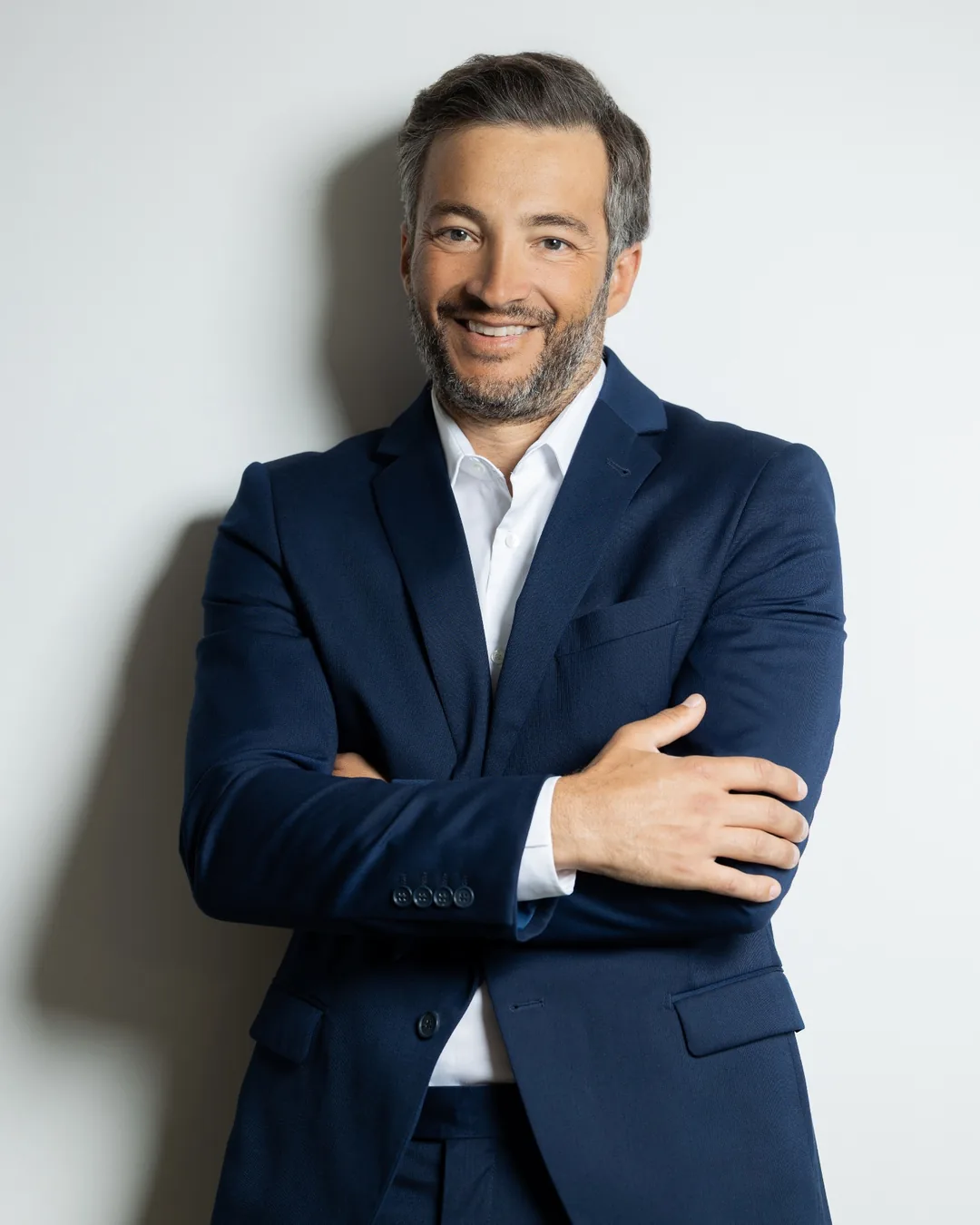
I perform 30 to 50 breast augmentations a year and have been a specialist in plastic surgery since 2012. At the consultation we choose the size and shape of the implant together, according to your build.
Dr Prodromos Papaioannou
30–50
operations a year
At a glance
What it treats
Small or uneven breasts, loss of volume after pregnancy or weight loss
Anaesthesia
General, or local with the Preservé technique
Operating time
Up to 40 minutes
Hospital stay
None; you go home the same day, with someone to accompany you
Back to work
3 to 5 days for desk work
Exercise
After 6 weeks
Final result
Final shape at 3 to 4 months
Where
Interbalkan Medical Center, Thessaloniki · Athens Medical Center, Marousi
Medically reviewed by Dr Prodromos Papaioannou, Plastic Surgeon, HESPRAS member, ASPS International Member · Last reviewed:
Breast augmentation increases the volume and improves the shape of the breasts, using a silicone implant or a transfer of your own fat. It is for women whose breasts are small or uneven, or have lost volume after pregnancy or weight loss. You go home on the same day.
What is breast augmentation?
Breast augmentation makes the breasts larger and corrects their shape, either with a silicone implant placed behind the breast or by moving fat from another part of your body. The aim is a size that suits your proportions. The plan is tailored to each woman.
I choose the implant, the plane in which it sits and the incision according to your breasts, and the operation can be combined with a breast lift or fat transfer.
Augmentation also corrects asymmetry, developmental breast deformities such as tuberous breasts, and the loss of breast volume (atrophy) that follows pregnancy or weight loss. Where the breast droops only slightly, the implant itself can raise the nipple a little, by about 1 to 2 centimetres.
Is breast augmentation right for me?

Breast augmentation suits healthy adults with a stable weight and realistic expectations who want larger or fuller breasts. If the breasts have dropped significantly, an implant on its own is not enough, and augmentation needs to be combined with a breast lift. I confirm whether it suits you when I examine you at the consultation.
Who is a typical candidate?
- Breasts that have not developed fully (breast hypoplasia).
- A wish for a larger size.
- Breasts of different sizes.
- Tuberous breasts or another developmental deformity.
- Loss of volume after pregnancy, breastfeeding or weight loss.
- Reconstruction after surgery for breast cancer.
When do I not recommend it?
- During pregnancy or breastfeeding, and for the first 6 months afterwards.
- When there is an active infection or an untreated condition of the breast.
- Before the breasts have finished developing, usually before the age of 18.
- When your weight has not yet settled.
- When the breasts have dropped a great deal and an implant alone would not be enough; in that case I suggest augmentation with a lift (augmentation mastopexy).
What happens at the consultation and before surgery?
At the consultation I examine you, take measurements and try sizer implants with you, so that we agree on a size, shape, incision and implant position. You leave with a written plan and a quote. Before the operation you need blood tests and a check for general anaesthesia, and you must stop smoking for at least 4 weeks.
What happens at the consultation?
I examine your breasts and chest, the quality of your skin, the position of the nipple and the breast gland. I take measurements and use an algorithm to work out the range of implants that suit your build. We then try sizer implants together in a special bra, so that the choice matches what you have in mind. We discuss shape, incision and implant position, and whether an implant or fat suits you better. You leave with a written plan and a quote.
What tests and instructions apply before surgery?
You will need pre-operative blood tests and an assessment for general anaesthesia. Smoking raises the risk of complications, so stop for at least 4 weeks before and 4 weeks after surgery. If you take anticoagulants or antiplatelet medicines, tell me; they are only ever stopped in agreement with the doctor who prescribes them. The date of surgery is set once your tests are complete.
How is breast augmentation performed?
Breast augmentation is usually done under general anaesthesia, or under local anaesthesia when the Preservé technique is used, and takes up to 40 minutes. The implant goes in through a small incision, usually in the fold beneath the breast, and my most frequent choice is the dual plane position, partly beneath the chest muscle.
During the operation I infiltrate the area with a long-acting local anaesthetic, so that pain in the first days is minimal. No drains are used. I use Motiva and Mentor implants.
Should the implant go above or below the muscle?
There are four positions for the implant: fully beneath the pectoralis major muscle (submuscular), partly beneath the muscle (dual plane), above the muscle (subglandular) and beneath the muscle’s fascia (subfascial). In a fairly slim woman without particularly large breasts, I prefer to place the implant beneath the muscle: it is better camouflaged, especially in the upper part of the breast, and better supported against the chest wall over the years. Above the muscle, the implant is easier to feel, but the breasts sit closer to the centre and the upper part of the breast is more pronounced.
In practice, my most frequent choice is the dual plane no touch technique. It suits most women, who want a natural result. Where there is mild sagging (pseudoptosis), it also lifts the breast at the same time, without extra scars and with less pain.
Which implant is right for me?
Round implants give more fullness in the cleavage and the upper part of the breast. Anatomical implants give a teardrop shape, with the greatest projection at the level of the nipple, as in a natural breast. Ergonomic implants change shape with your posture. For a first augmentation I usually recommend an ergonomic or a round implant with a smooth surface.
Where are the incisions, and do stitches need removing?
An incision in the fold beneath the breast (inframammary fold) is the most common and my preference. Studies show it carries a lower bacterial load than an incision at the nipple or in the armpit, and therefore a lower risk of capsular contracture, and it allows every implant position, dual plane included. The scar is hidden in the fold.
An incision around the nipple does not allow dual plane placement and needs a large area of tissue to be freed, which over the years can lead to the implant sitting too low (bottoming out) or to visible rippling. An incision in the armpit leaves no scar on the breast, but it is done with an endoscope, allows the implant only fully beneath the muscle and usually only smaller implants.
The stitches are internal and do not need to be removed.
Can breast augmentation be combined with other procedures?
When the breasts have dropped more, augmentation is combined with a breast lift (augmentation mastopexy): the loose skin is removed, the nipple is moved to the right position and the implant fills the upper part of the breast. Fat transfer together with an implant is a hybrid technique that, in some cases, corrects a wide gap between the breasts and rippling.
What is the Preservé technique?
Preservé is an implant placement technique from Establishment Labs (Motiva) that aims to preserve the natural tissue of the breast, with a smaller incision and a faster recovery, and it can be done under local anaesthesia. I have trained in the technique.
Natural breast augmentation with fat transfer
I suggest natural augmentation with fat for women who have fat to spare elsewhere and do not want an implant; the best results are in young women aged 20 to 30 who do not smoke. The fat is harvested and injected with the MicroAire system through incisions of 2 to 3 millimetres. At least 200 to 300 cc per breast is needed, and up to 400 to 500 cc, and each session adds roughly one bra size. How much of the fat survives cannot be predicted, so a second session may be needed after 6 months. You wear a support bra for 2 to 3 weeks, return to work in 2 to 3 days and to sport after 1 month.
Do I need to stay in hospital?
No overnight stay is needed. You go home the same day, with someone to accompany you, wearing a special support band. You must not drive after a general anaesthetic.
How long is recovery after breast augmentation?
The first 1 to 2 days are almost painless, thanks to the long-acting local anaesthetic. Most women return to desk work in 3 to 5 days and to exercise at 6 weeks, while exercises that work the chest muscle wait until 6 months. The breasts reach their final shape at 3 to 4 months.
| When | How you feel | What you can do |
|---|---|---|
| Days 1–2 | Minimal pain, thanks to the long-acting local anaesthetic | Move around wearing the support band; avoid sudden arm movements and lifting |
| Days 3–7 | Mild pain, like muscle soreness after a workout; stronger with large implants or a tight breast | Ordinary painkillers; desk work at 3–5 days, light physical work at 1 week |
| Weeks 2–6 | Discomfort eases gradually and is gone by 4–6 weeks | Walking; heavy physical work after 1 month; no weightlifting |
| Week 6 | Almost back to normal | Gradual return to exercise |
| Months 3–4 | The breasts soften and take their final shape | Normal activity |
| Month 6 | The scar in the fold is no longer noticeable | Chest-muscle exercises |
How long do I need to stay in Greece after breast augmentation?
Breast augmentation needs no overnight hospital stay: you leave the hospital on the same day with someone to accompany you. Plan to stay in Greece for 5 to 10 days before flying home. The stitches are internal, so there is no appointment to remove them.
Your stay usually looks like this:
- Day of surgery. You go home the same day wearing a support band. You must not drive after a general anaesthetic, so arrange a companion and transport.
- Before you fly. I check you in person the day before your flight. The earliest point at which you can fly home is day 5, with no limit on flight length after that.
- Stitches. They are internal and do not need to be removed.
- Follow-up once home. By video call at 10 days, 1 month, 6 months and 1 year.
- At home. Plan for 3 to 5 days off desk work, avoid lifting and sudden arm movements, and do not return to exercise until 6 weeks. Exercises that work the chest muscle wait until 6 months. Bring the support bra I recommend; nursing care at home can be arranged if you would like it.
How long do breast augmentation results last?
The breasts reach their final shape at 3 to 4 months, and the scar in the fold beneath the breast fades after about 6 months. Implants are not lifelong, and your breasts keep changing with age and weight, so the result changes with them over the years.
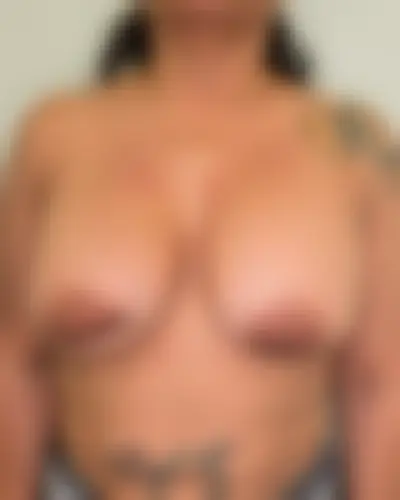
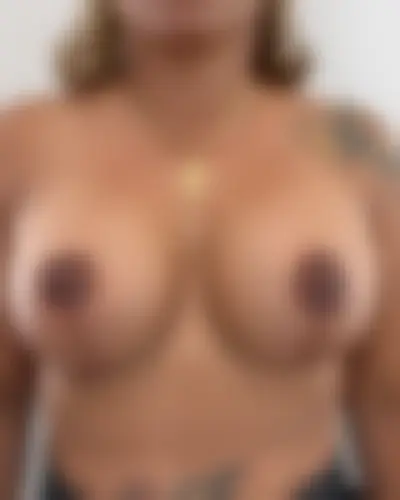
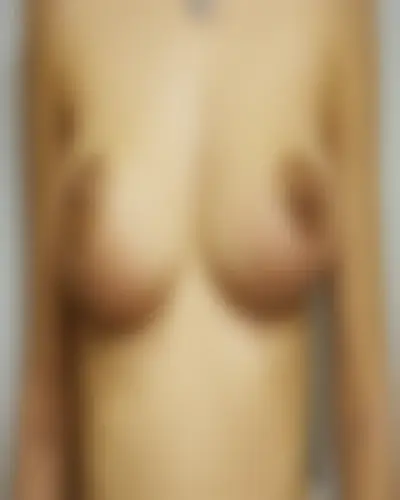
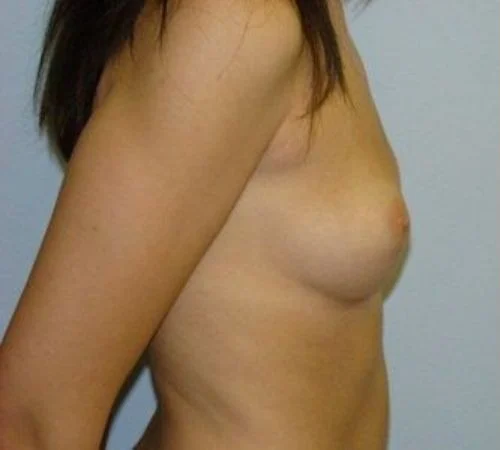 Before
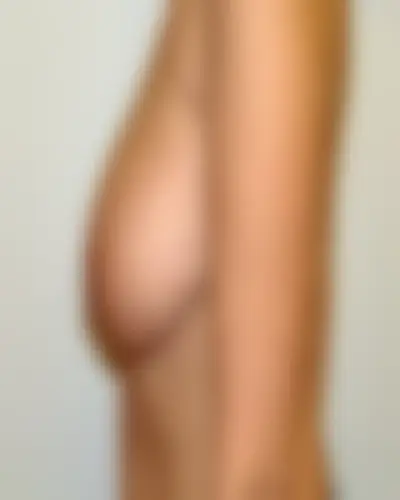
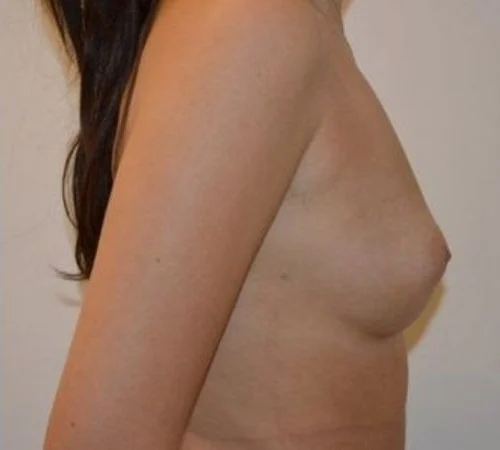 After
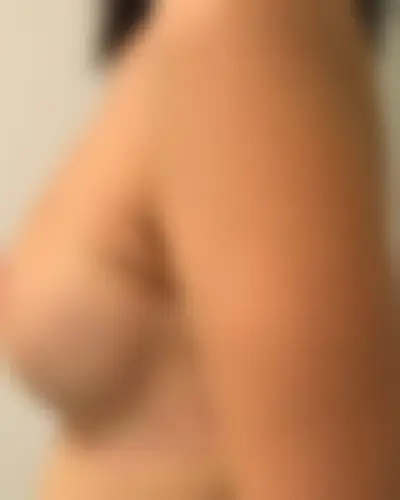
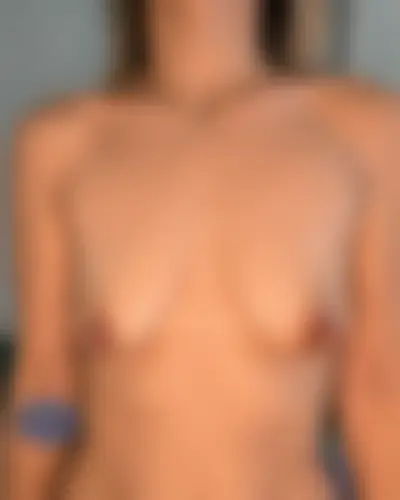
These photos include nudity.
Breast augmentation
Woman, 25 · 12 months after
Profile right
Results vary from patient to patient.
Nipple sensation and breast function usually stay normal. There is no fixed time to change implants: they are replaced when a problem appears, and after 15 to 20 years we discuss changing them preventively. A pregnancy or a large change in weight can alter the shape.
What are the risks of breast augmentation?
Serious complications after breast augmentation are rare. The most common reason for further surgery over the years is capsular contracture, a tightening of the scar tissue around the implant. The table shows each risk and how I reduce it; I explain the risks that apply to you at the consultation.
| Complication | How common | Prevention and treatment |
|---|---|---|
| Capsular contracture | The most common complication over the years | An incision in the breast fold and placement beneath the muscle reduce it; treated with revision surgery |
| Haematoma (hematoma) | Rare, in the first days | Medicines that affect blood clotting are checked beforehand; if it occurs, it is drained |
| Infection | Rare | No touch technique and antibiotics; removal of the implant is rarely needed |
| Implant shifting or sitting too low | Uncommon | Correct size and position, and no chest exercises for the period I advise; corrected with revision surgery |
| Rippling | More likely with thin skin and little breast tissue | Placement beneath the muscle; corrected with fat transfer |
| Implant rupture | Rare, usually after many years | Checked with an MRI scan; the implant is replaced |
| Change in nipple sensation | Usually temporary | Usually returns within months |
| BIA-ALCL lymphoma | Very rare, mainly with textured implants | I usually use smooth implants; swelling years later is investigated; treated by removing the implant and capsule |
| Fat absorption or fat necrosis (fat transfer) | Some of the fat is expected to be absorbed; fat necrosis is rare | Fat injected in thin layers; a second session after 6 months |
Smoking. Stop for at least 4 weeks before and 4 weeks after surgery; smoking increases healing complications and lowers the success of fat transfer.
Blood thinners. Tell me if you take anticoagulants or antiplatelet medicines. They are only ever stopped in agreement with the doctor who prescribes them.
What affects the cost of breast augmentation?
The cost depends on the method, the implant and whether augmentation is combined with another procedure. I give you a written quote after the consultation and examination, once we have agreed the plan that suits you, so the figure reflects your own operation rather than a general price.
- The method: implant, fat transfer or Preservé.
- The type of implant.
- The anaesthetic, general or local.
- Combining it with a breast lift or fat transfer.
- The amount of fat harvested, for natural augmentation.
Frequently asked questions
Will my breast implants look obvious?
Not if the size, profile and position are chosen correctly; breast augmentation then gives a natural projection. An implant placed beneath the muscle is better covered, especially with thin skin or little breast tissue, where otherwise its edges or rippling may show. An implant that is much too large for your chest makes the result more noticeable. At the consultation we choose the size and plan from your measurements and your goal, so that the result suits your body.
Can I breastfeed after breast augmentation?
Usually, yes. Breastfeeding remains possible after augmentation with implants, especially when the incision is in the breast fold or the armpit, because these do not affect the milk ducts. An incision around the areola can affect the ducts and nerves. After natural augmentation with fat, breastfeeding is usually not affected. If you plan to breastfeed, tell me at the consultation so that we choose the approach accordingly.
When can I exercise after breast augmentation?
You can return to exercise after 6 weeks. In the first days you go back to light everyday activities, and desk work usually after 3 to 5 days. Walking is allowed early on. Lifting weights, chest exercises and strenuous activity are avoided until 6 weeks, because they can affect the position of the implant and healing. The return is gradual, following the instructions I give you at your check-up.
Do breast implants need to be replaced?
There is no set time to replace them. Modern implants have a very long expected lifespan. Replacement is needed when a problem appears, such as capsular contracture, rupture, rippling or the implant shifting, or when you want a different size; the diagnosis is confirmed with an MRI scan. After 15 to 20 years it is worth discussing a preventive change, especially with older-generation implants. After natural augmentation with fat there is no implant, so replacement does not arise.
When can I go back to work after breast augmentation?
It depends on your job. With desk work you usually return in 3 to 5 days. With work that involves light physical activity, such as dentistry, hairdressing or beauty therapy, it is better to take 1 week off. With heavy physical work, as a nurse or fitness instructor for example, I recommend returning after 1 month. At your check-up after surgery I give you instructions tailored to how you are recovering.
Is it safe to fly with breast implants?
Yes. Silicone implants are not affected by the cabin pressure on a plane. The concern comes from older saline implants, where an air bubble in the fluid could expand at low pressure. This does not apply to silicone gel implants, which are used almost exclusively in Europe. If you want to travel in the first days after surgery, ask me about it at the consultation.
When can I fly home after breast augmentation?
You leave the hospital on the same day as surgery. Plan to fly no sooner than day 5, once I have checked you in person the day before your flight. The stitches are internal and do not need removing, so there is no stitch appointment to wait for. The implants themselves are not affected by cabin pressure, as silicone gel implants do not expand at altitude. Ask me at the consultation so that we can plan your dates around your flights.
Can my follow-up be done at home?
Yes. After you return home, follow-up is by video call at 10 days, 1 month, 6 months and 1 year. Your recovery milestones are the same wherever you are: desk work at 3 to 5 days, exercise at 6 weeks, chest-muscle exercises at 6 months, and the final shape at 3 to 4 months. At your check-ups I give you instructions tailored to how you are recovering. If something worries you, message the practice on WhatsApp and you receive a reply the same day; in an emergency, call us, and for an acute problem go to the nearest hospital emergency department.
Does breast augmentation hurt?
Less than most women fear. During the operation I infiltrate the area with a long-acting local anaesthetic, so pain in the first 1 to 2 days is minimal. After that it feels like strong muscle soreness after a workout, mainly when you move your arms or get out of bed, and ordinary painkillers control it. It is stronger with larger implants or when the breast is tight. The discomfort is completely gone within 4 to 6 weeks.
Can I have a mammogram with breast implants?
Yes. Mammography is done as normal, with the first 6 to 12 months after surgery. Always tell the radiographer that you have implants, so that special views are taken to show the breast better. To check the implants themselves, the best test is an MRI scan, which, together with ultrasound, examination and mammography, gives a complete picture. Continue routine breast screening as your doctor advises.
References
- Tebbetts JB. Dual plane breast augmentation: optimizing implant-soft-tissue relationships in a wide range of breast types. Plast Reconstr Surg. 2001;107(5):1255–1272.
- Wiener TC. Relationship of incision choice to capsular contracture. Aesthetic Plast Surg. 2008;32(2):303–306.
- Haas E, Christodoulou N, Secanho M, et al. Capsular contracture after breast augmentation: a systematic review and meta-analysis. Aesthet Surg J Open Forum. 2025;7:ojaf003.
- Groen JW, Negenborn VL, Twisk JWR, et al. Autologous fat grafting in cosmetic breast augmentation: a systematic review on radiological safety, complications, volume retention, and patient/surgeon satisfaction. Aesthet Surg J. 2016;36(9):993–1007.
- Wang CL, Luan SS, Panayi AC, et al. Methods used for evaluation of volume retention rate in autologous fat grafting for breast augmentation: a systematic review. Chin Med J (Engl). 2019;132(18):2223–2228.
- Chen J, Zhu XM, Huynh MNQ, McRae M. Breastfeeding outcome and complications in females with breast implants: a systematic review and meta-analysis. Aesthet Surg J. 2023;43(7):731-40. PMID: 36752943. doi:10.1093/asj/sjad027.
- Cordeiro PG, Ghione P, Ni A, et al. Risk of breast implant associated anaplastic large cell lymphoma (BIA-ALCL) in a cohort of 3546 women prospectively followed long term after reconstruction with textured breast implants. J Plast Reconstr Aesthet Surg. 2020;73(5):841–846.
- Clemens MW, Jacobsen ED, Horwitz SM. 2019 NCCN consensus guidelines on the diagnosis and treatment of breast implant-associated anaplastic large cell lymphoma (BIA-ALCL). Aesthet Surg J. 2019;39(Suppl 1):S3–S13.
Consultation
In Thessaloniki, in Athens or by video. Examination, options and a written plan.