
Breast
Breast reconstruction after mastectomy in Thessaloniki and Athens, Greece
I perform 10 to 15 breast reconstructions a year, both immediate and delayed. I trained in breast reconstruction after cancer in Germany, where I worked as deputy director at the hospital in Braunschweig.
Breast reconstruction rebuilds the breast after a total or partial mastectomy for cancer, or after a prophylactic (risk-reducing) mastectomy. It can be done with implants, with tissue from your abdomen or back, or with fat transfer, either in the same operation as the mastectomy or at a later date.
10–15
operations a year
At a glance
What it treats
Loss or deformity of the breast after a total or partial mastectomy, and the nipple
Anaesthesia
General
Operation time
About 1–2 hours with an implant or expander; 3–4 hours with a latissimus dorsi flap; 5–8 hours with a DIEP flap
Hospital stay
1 to 2 nights with implants; longer with a flap
Back to work
About 2–4 weeks with an implant; 6–8 weeks with a flap
Exercise
Usually after 3 months; exact timing depends on the method
Final result
Final shape in 3 to 6 months
Where
Interbalkan Medical Center, Thessaloniki
Medically reviewed by Dr Prodromos Papaioannou, Plastic Surgeon, HESPRAS member, ASPS International Member · Last reviewed:
What is breast reconstruction?
Breast reconstruction is surgery that recreates the breast after a mastectomy, using either a silicone implant (often after a tissue expander) or your own body tissue. The aim is a breast that sits in balance with the other one. It can be done at the time of the mastectomy or months or years afterwards.
Immediate reconstruction takes place in the same operation as the mastectomy, so you wake up with a breast. Delayed reconstruction is done months or years later, usually once treatment is complete. I offer both, and the timing is agreed with your breast surgeon and oncologist.
The decision belongs to you, once we have gone through together every technique that suits your case.
Am I a candidate for breast reconstruction?

You are likely to be a candidate if you have had, or are about to have, a mastectomy, or if you are choosing a prophylactic mastectomy because of high risk. The right method depends on your skin, any radiotherapy, the size of the other breast, the tissue available and your own preference.
Who are typical candidates?
- Women about to have a mastectomy who want immediate reconstruction.
- Women who had a mastectomy in the past and want delayed reconstruction.
- Women with a positive genetic test or a very strong family history who choose a prophylactic mastectomy.
- Women with a deformed breast after partial mastectomy and radiotherapy.
- Women who need nipple reconstruction after a previous reconstruction.
When do I not recommend it?
- When cancer treatment does not yet allow surgery; the timing is always coordinated with the oncologist and the breast surgeon.
- When there is an active infection or a serious illness that makes general anaesthesia unsafe.
- After radiotherapy, I do not recommend an implant without reinforcing the skin; I usually prefer your own tissue.
- In smokers who cannot stop, especially when a flap is planned.
What happens at the consultation, and how do I prepare?
At the consultation I review your history, the radiotherapy you have had or will have, the skin of your chest and the areas that could supply tissue. Before surgery you need routine tests for general anaesthesia and any imaging your oncology team requests, and you must stop smoking for 4 weeks before and after.
What happens at the consultation?
I review your medical history, any radiotherapy you have had or will need, the skin of your chest and the possible donor areas (abdomen and back). I explain the methods that suit you, with their advantages and drawbacks, and whether the other breast needs surgery for symmetry. You receive a written plan and quote.
What tests and instructions apply before surgery?
You need pre-operative tests for general anaesthesia and the imaging your oncology team asks for. For an abdominal flap, imaging of the blood vessels may be needed, usually a CT angiogram,. Stop smoking 4 weeks before and 4 weeks after surgery. If you take blood thinners (anticoagulants or antiplatelet medicines), they are stopped only with the agreement of the doctor who prescribes them.
How is breast reconstruction performed?
Breast reconstruction is performed under general anaesthesia, at the time of the mastectomy or later. There are two main routes: silicone implants, often after a tissue expander, and your own tissue, using a flap from the abdomen or back or fat transfer. The two are often combined, over more than one stage.
The operation takes place at Interbalkan Medical Center in Thessaloniki. Reconstruction with an implant or expander usually takes 1 to 2 hours, a latissimus dorsi flap 3 to 4 hours and a microsurgical abdominal flap 5 to 8 hours. The choice depends on your skin, radiotherapy, the tissue available, the other breast and your preference.
Implants and tissue expanders
When the skin quality allows, the breast is reconstructed with silicone implants, with or without tissue expanders. An expander is a silicone device that is gradually filled with saline over 8 to 12 weeks, to create space for the final implant at a second operation. The implant usually sits under the pectoralis major muscle for better cover, and its volume is chosen to match the size and shape of the healthy breast.
Radiotherapy affects the skin, so an implant or expander carries a higher risk afterwards. In that case I reinforce the skin with a biocompatible mesh, which becomes incorporated into the tissues in about 3 months, to lower the risk of capsular contracture, wound breakdown or implant displacement.
Abdominal tissue: DIEP and TRAM flaps
Using microsurgery, we move skin and fat from the lower abdomen, together with their blood vessels, to rebuild the volume and skin of the breast. No implant is used, and the new breast follows changes in your weight. The lower abdomen is reshaped as in an abdominoplasty (tummy tuck).
In the DIEP flap only skin and fat are moved, without the abdominal muscle, and the vessels are joined microsurgically to vessels in the chest. No mesh is needed in the abdomen. The drawbacks are a longer operation and recovery, and a risk of problems with the flap’s blood supply.
In the TRAM flap the tissue is moved together with the rectus abdominis muscle, without cutting off its blood supply, so blood-supply complications are fewer. A biocompatible mesh is placed to support the abdominal wall.
Back muscle and skin: latissimus dorsi flap
We move the latissimus dorsi muscle, with its blood supply and an island of skin from the back, to the chest wall. It is useful when radiotherapy has damaged the skin and new skin is needed, not only volume. It has a low complication rate and a shorter operating time. For a larger breast, an implant is added under the muscle.
Fat transfer
Fat is taken with a modified liposuction from the abdomen, flanks or buttocks, processed and injected into the breast. Several sessions are needed, on average 3 to 4. There are no large incisions or foreign materials, but how much fat survives is not predictable. It suits relatively small breasts and often requires adjustment of the healthy breast. Fat is also used alongside other methods to refine the contour.
Nipple reconstruction
The nipple has to be removed in many mastectomies, especially when the tumour is close to it. My most common technique is to take part of the nipple and areola from the healthy breast as a free graft. When this is not possible, the areola is made with a skin graft from the labia majora, and the nipple’s projection with a cartilage or dermal graft or with small local flaps. Nipple reconstruction is usually done as a second stage, 3 to 6 months later.
Prophylactic mastectomy with immediate reconstruction
Prophylactic mastectomy removes the breast gland before cancer develops, in women at high risk, usually with immediate reconstruction. Mutations in BRCA1, BRCA2 and, more rarely, PALB2 raise the risk considerably. With a positive test, we decide together with a geneticist and an oncologist. With a strong family history but a negative test, it can be discussed.
Planning always follows oncological criteria and takes the aesthetic result into account. The incision is made under the breast or near the nipple. The breast gland is removed and sent for histology. Whether the nipple is kept is decided with you, based on your anatomy. The implant is placed under the pectoralis major muscle and, when needed, a biocompatible mesh or biological material is added to support the lower pole. The hospital stay is 1 to 2 nights.
Incisions and scars
On the breast, the incision is usually the mastectomy scar. An abdominal flap leaves a low horizontal scar on the abdomen, and the latissimus dorsi a scar on the back. Stitches: internal and absorbable with every method, so none need removing.
Combining procedures
To match the two breasts, I often suggest surgery on the healthy breast as well, in the same or a later operation: augmentation, a breast lift or a reduction. Fat transfer can be combined with any method to refine the contour.
Hospital stay
With implants or an expander, you stay 1 to 2 nights and the drains usually come out the next day. With an abdominal or back flap the stay is longer, usually 3 to 5 nights with an abdominal flap and 2 to 4 with the latissimus dorsi, because the operation is bigger and the flap is monitored closely.
How long is recovery after breast reconstruction?
Recovery depends on the method. With implants you go home after 1 to 2 nights, while an abdominal or back flap means a longer hospital stay and a longer recovery. The final shape develops over 2 to 3 months as the swelling settles, and nipple reconstruction follows 3 to 6 months later.
| When | How you feel | What you can do |
|---|---|---|
| Days 1–2 | Pain controlled with painkillers; drains | In hospital; with implants, home after 1 to 2 nights |
| First weeks | Swelling and discomfort, more at the donor site with a flap | Walking; no lifting and no sudden arm movements; back to work depending on the method |
| Weeks 6–10 | Discomfort settles | Gradual return to exercise, depending on the method |
| Weeks 8–12 (expander) | With an expander: gradual filling at the practice | Second operation for the final implant once expansion is complete |
| Months 2–3 | Swelling settles and the breast takes its final shape | Normal activity |
| Months 3–6 | The shape has settled | Nipple reconstruction and, if needed, adjustment of the other breast |
How long do I need to stay in Greece after breast reconstruction?
How long you stay depends on the method. After reconstruction with implants or an expander, you spend 1 to 2 nights in hospital at Interbalkan Medical Center in Thessaloniki. After an abdominal (DIEP or TRAM) or latissimus dorsi flap you stay in hospital longer, usually 3 to 5 nights with an abdominal flap and 2 to 4 with the latissimus dorsi, because the flap is monitored closely.
With implants, the drains usually come out the next day. After discharge, plan to stay in Greece for 5 to 10 days with implants, and after a flap, usually until about day 10. The stitches are internal and absorbable, so none need removing. Your follow-up after you return home is by video call at 10 days, 1 month, 6 months and 1 year.
Reconstruction often takes more than one trip. With a tissue expander, the expander is filled gradually at the practice over 8 to 12 weeks before a second operation for the final implant. Nipple reconstruction and any adjustment of the other breast usually follow 3 to 6 months later.
At home, arrange help for the first weeks, as you should avoid lifting and sudden arm movements. Your cancer follow-up continues with your own oncology team as usual.
What results can I expect, and how long do they last?
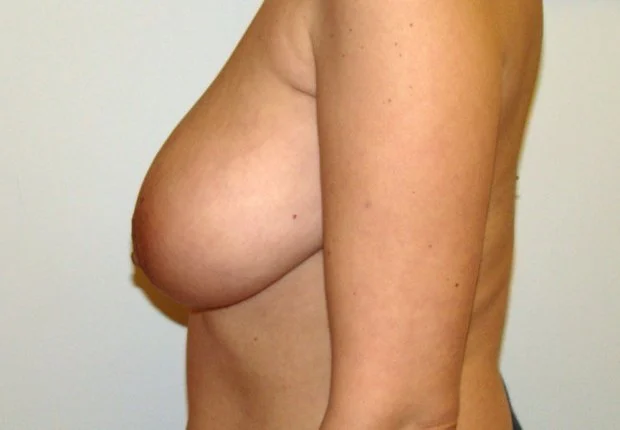
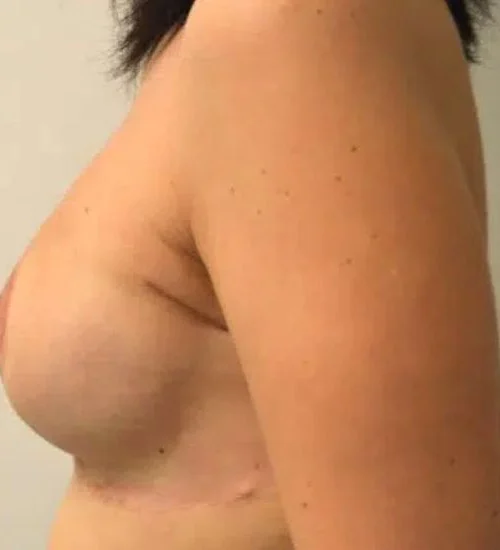
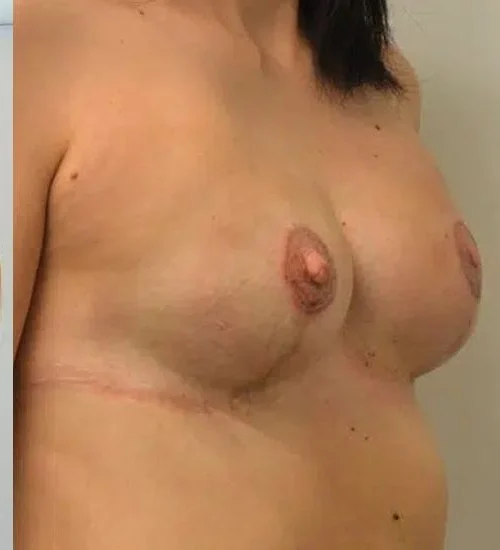
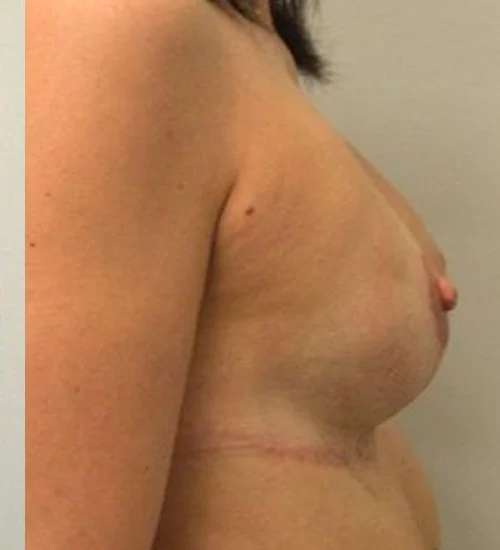
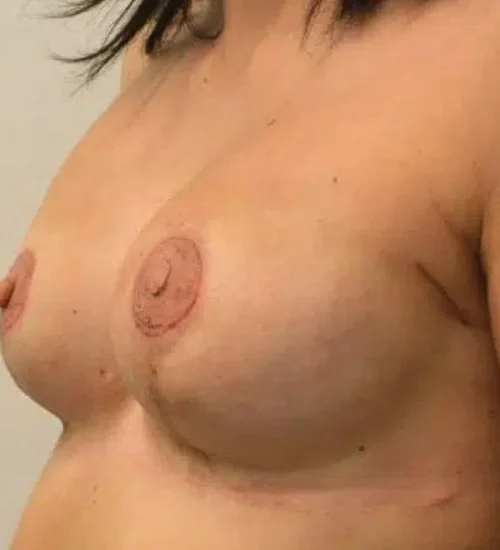
When the nipple is preserved, the result is visible straight away, and the final shape develops over 2 to 3 months as the swelling settles. With expanders, the final result comes after the second operation. Nipple reconstruction, usually 3 to 6 months later, completes the reconstruction.
 Before
 After
After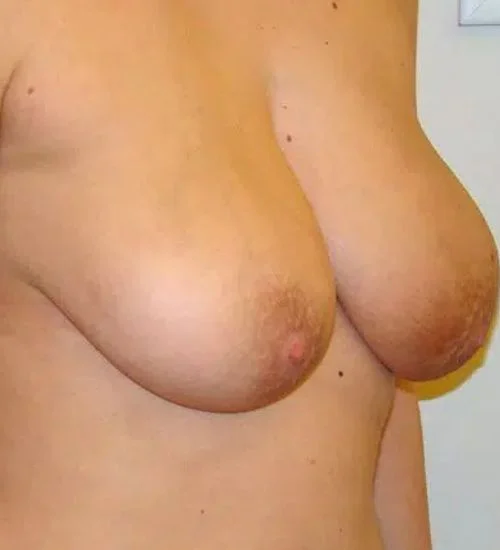 Before
 After
After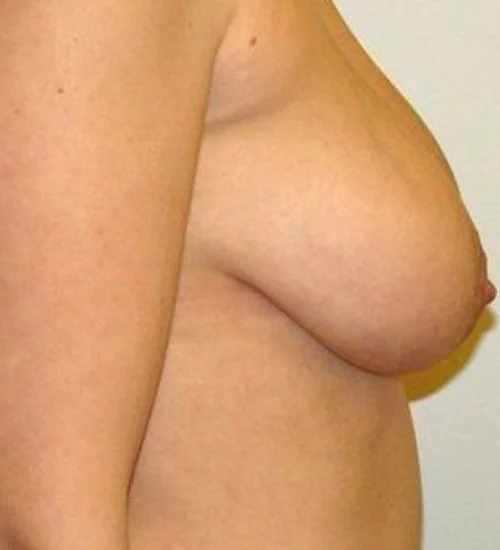 Before
 After
After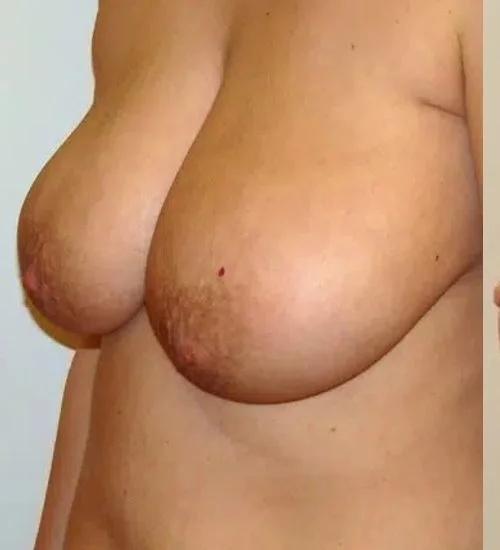 Before
 After
AfterThese photos include nudity.
Breast reconstruction
Woman, 45 · 6 months after
Front
Results vary from patient to patient.
A breast made from your own tissue changes with your weight, as a natural breast does, and contains no foreign material. Implants are not lifelong and may need replacing over the years. The new breast does not have the sensation of a natural breast. In prophylactic mastectomy, because planning is based on the final result, the conditions for a good aesthetic result are at their best. Cancer follow-up continues as your oncology team advises.
What are the risks of breast reconstruction?
Breast reconstruction is a bigger operation than cosmetic breast surgery, and the risks depend on the method, any radiotherapy and your general health. Most complications are uncommon and treatable, although some need further surgery. I go through the risks for your own case in detail at the consultation.
| Complication | How common | Prevention and treatment |
|---|---|---|
| Haematoma or fluid collection | Uncommon, in the first days | Drains and review of medicines that affect clotting; if it occurs, it is drained |
| Infection | Rare | Antibiotics; rarely the implant has to be removed |
| Delayed healing or wound breakdown | More common after radiotherapy and in smokers | Stopping smoking; reinforcing the skin with collagen or your own tissue |
| Capsular contracture or implant displacement | More common after radiotherapy | Placement under the muscle, biological matrix; correction with further surgery |
| Problems with the flap’s blood supply | Rarely leads to partial or total loss of the flap | Close monitoring in the first days; immediate return to theatre if needed |
| Discomfort at the donor site | Varies with the method | On the abdomen, mesh with TRAM; on the back, physiotherapy |
| Fat necrosis or fat resorption | Some loss of transferred fat is expected | Injection in thin layers; repeat session |
| Asymmetry | A small correction is often needed | Fat transfer or adjustment of the other breast |
Smoking. Stop at least 4 weeks before and 4 weeks after surgery. Smoking greatly increases healing complications, especially with flaps, and reduces the success of fat transfer.
Blood thinners. Tell me if you take anticoagulants or antiplatelet medicines. They are always stopped in agreement with the doctor who prescribes them.
How much does breast reconstruction cost?
We do not publish prices. The cost of breast reconstruction differs from one woman to another, depending on the method, the number of stages, nipple reconstruction and any surgery on the other breast. You receive a quote after the consultation, once you have been examined.
- The method: implant, expander then implant, abdominal or back flap, fat transfer.
- The number of stages and operations.
- The length of the hospital stay.
- Materials, such as the implant, expander or biological matrix.
- Nipple reconstruction.
- Surgery on the other breast for symmetry.
If you hope to claim part of the cost from your own health insurer, check your policy before booking; the practice provides a medical letter for your insurer.
Frequently asked questions
Can breast reconstruction be done at the same time as a mastectomy?
Yes, in many cases. In immediate reconstruction the breast is rebuilt in the same operation as the mastectomy, with an implant, an expander or your own tissue, so you wake up with a breast. Whether reconstruction is done immediately or later depends on the treatment you need, especially whether radiotherapy will follow. We decide this together with your breast surgeon and oncologist before the operation.
Which is better for breast reconstruction: implants or your own tissue?
There is no single best method for every woman. Implants mean a smaller operation and a quicker recovery, but they are not always suitable after radiotherapy. Your own tissue, such as a DIEP flap, feels more natural and changes with your weight, but the operation is bigger. At the consultation we go through the pros and cons for your case, and the decision is yours.
Can I have breast reconstruction years after a mastectomy?
Yes. Delayed reconstruction can be done months or even years after the mastectomy, once treatment is complete. After radiotherapy the skin has lost elasticity, so I often prefer your own tissue, such as a back or abdominal flap, or reinforcing the skin with fat. The method is chosen after I have examined your chest.
Can the nipple be reconstructed after a mastectomy?
Yes. Nipple reconstruction is usually done as a second stage, 3 to 6 months after the breast reconstruction, once the shape has settled. My most common technique is a graft from the nipple and areola of the healthy breast. When that is not possible, I use a skin graft for the areola and a cartilage or dermal graft, or small local flaps, for the nipple’s projection.
What is DIEP flap breast reconstruction?
The DIEP flap rebuilds the breast with skin and fat from the lower abdomen, together with the blood vessels that supply them, without removing the abdominal muscle. The vessels are joined microsurgically to vessels in the chest. No foreign materials are used, and the new breast changes with your weight, as a natural breast does. An abdominoplasty is done at the same time. The operation and recovery take longer than with implants, and there is a small risk of problems with the flap’s blood supply.
How long is the hospital stay after breast reconstruction?
It depends on the method. With implants or an expander, you usually stay 1 to 2 nights, and the drains usually come out the next day. With an abdominal flap, such as DIEP or TRAM, or with the latissimus dorsi, you stay longer, usually 3 to 5 nights with an abdominal flap and 2 to 4 with the latissimus dorsi, because the operation is bigger and the flap is monitored closely. The operation takes place at Interbalkan Medical Center in Thessaloniki.
When is a prophylactic mastectomy recommended for BRCA carriers?
Prophylactic mastectomy is discussed mainly when genetic testing shows an inherited mutation that greatly raises the risk of breast cancer, usually in BRCA1 or BRCA2 and more rarely in PALB2. It can also be discussed in women with a very strong family history. The decision is made together with a geneticist and an oncologist. It is usually combined with immediate reconstruction using an implant under the chest muscle, and the nipple is kept when the anatomy allows.
When can I fly home after breast reconstruction?
After reconstruction with implants or an expander, you spend 1 to 2 nights in hospital, and you can usually fly home from day 5. After a DIEP, TRAM or latissimus dorsi flap the hospital stay is longer, and after a flap you can usually fly from about day 10. Keep in mind that reconstruction may need further stages, such as expander filling, the final implant or nipple reconstruction, which can mean another trip.
Can my follow-up be done at home?
Yes, for most of the follow-up. After you return home, follow-up is by video call at 10 days, 1 month, 6 months and 1 year, and you can send photos if anything concerns you. Some stages need you in Thessaloniki: expander filling at the practice over 8 to 12 weeks, and any later operation, such as the final implant, nipple reconstruction or adjustment of the other breast. Your cancer follow-up continues with your own oncology team.
References
- Allen RJ, Treece P. Deep inferior epigastric perforator flap for breast reconstruction. Ann Plast Surg. 1994;32(1):32–38.
- Hartrampf CR, Scheflan M, Black PW. Breast reconstruction with a transverse abdominal island flap. Plast Reconstr Surg. 1982;69(2):216–225.
- Bostwick J 3rd, Vasconez LO, Jurkiewicz MJ. Breast reconstruction after a radical mastectomy. Plast Reconstr Surg. 1978;61(5):682-93. PMID: 347475.
- Perdikis G, Koonce S, Collis G, Eck D. Latissimus dorsi myocutaneous flap for breast reconstruction: bad rap or good flap? Eplasty. 2011;11:e39.
- Agha RA, Fowler AJ, Herlin C, et al. Use of autologous fat grafting for breast reconstruction: a systematic review with meta-analysis of oncological outcomes. J Plast Reconstr Aesthet Surg. 2015;68(2):143–161.
- Hartmann LC, Schaid DJ, Woods JE, et al. Efficacy of bilateral prophylactic mastectomy in women with a family history of breast cancer. N Engl J Med. 1999;340(2):77–84.
Consultation
In Thessaloniki, in Athens or by video. Examination, options and a written plan.