
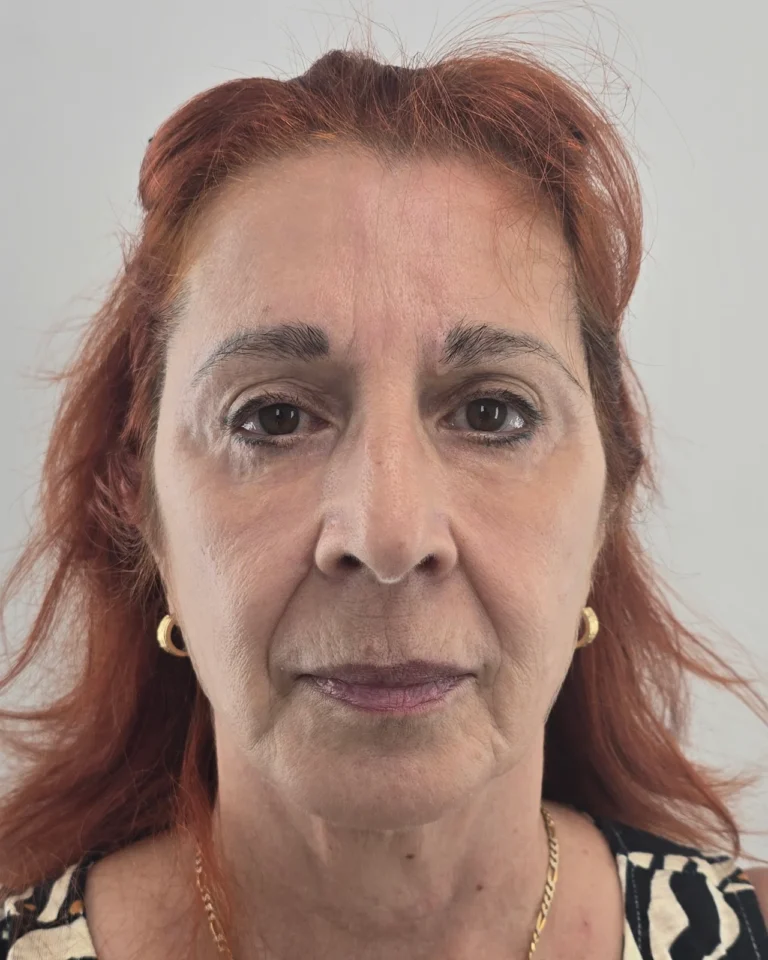
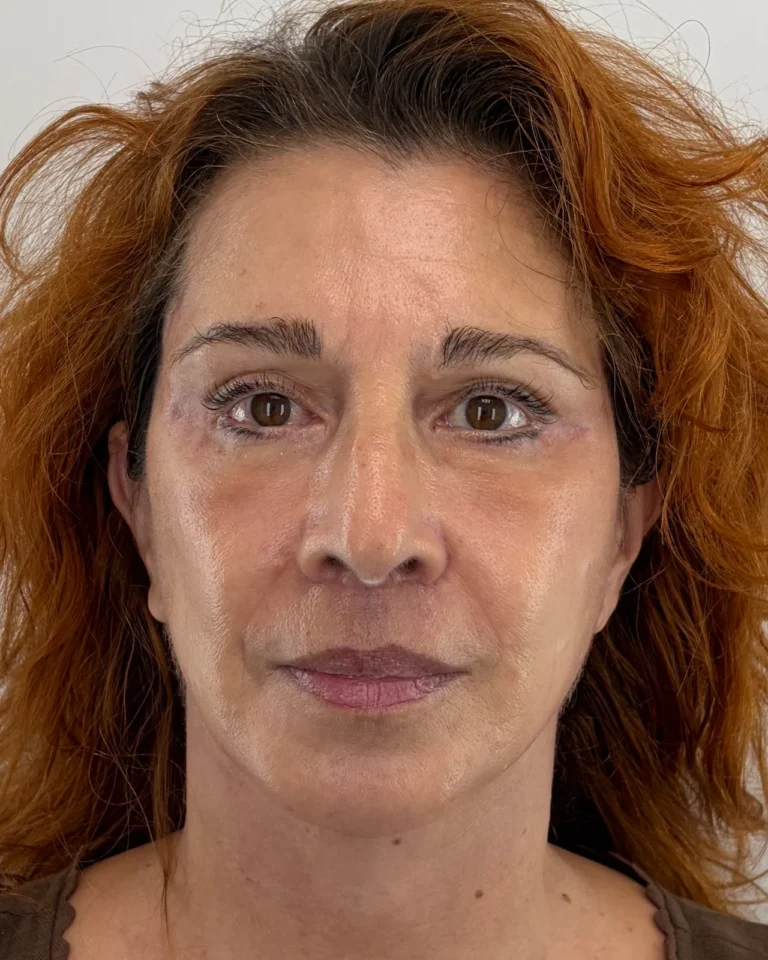
Gender-affirming
Facial feminisation surgery (FFS) in Thessaloniki and Athens, Greece
I perform 10–15 facial feminisation operations a year and have been a specialist plastic surgeon since 2012. I carry out the extensive chin surgery together with a maxillofacial surgeon , with planning based on a CT scan.
Facial feminisation surgery (facial feminization surgery, FFS) is a set of gender-affirming operations, from the forehead to the neck, for trans women and non-binary people. Its core is forehead reconstruction (Type 1, 2 or 3), combined with whichever other procedures you need.
10–15
operations a year

At a glance
What it changes
Prominent brow ridge, high hairline, nose, chin, Adam’s apple and full neck
Anaesthesia
General; local with sedation only for single, smaller procedures
Operating time
2–5 hours, depending on the combination of areas
Hospital stay
1 night after forehead surgery · smaller procedures without an overnight stay
Back to work
2 to 3 weeks for desk work
Exercise
Light from week 4, full from week 6
Final result
6 to 12 months
Where
Interbalkan Medical Center, Thessaloniki · Athens Medical Center, Marousi
Medically reviewed by Dr Prodromos Papaioannou, Plastic Surgeon, HESPRAS member, ASPS International Member · Last reviewed:
What is facial feminisation surgery?
Facial feminisation surgery is a personalised plan of bone and soft-tissue operations that changes the features through which a face is read as male: the brow ridge, hairline, nose, chin and neck. It is planned around your own proportions, not a template, and can be done in one operation or in stages.
The differences between a male and a female face lie mainly in the skeleton, so they do not change with hormone therapy or hair removal. The brow ridge and the shape of the forehead are among the strongest markers of sex, which is why forehead reconstruction is at the centre of this page.
Some patients need one feature changed, others several; the operations are done in the same session or in two stages. The accurate term for what is sometimes searched as a “sex change of the face” is gender-affirming surgery.
Am I a candidate for facial feminisation surgery?

Facial feminisation surgery suits adult trans women and non-binary people with marked and persistent gender incongruence who can give informed consent and have realistic expectations. I follow the WPATH Standards of Care, Version 8 (SOC8): one assessment by a suitably qualified health professional is enough, and hormone therapy is not required for facial surgery.
Who is a typical candidate?
- A prominent brow ridge, a flat or sloping forehead, and low, straight eyebrows.
- A high hairline or receding temples at the front.
- A large or wide nose, with a hump or a heavy tip.
- A long, wide or projecting chin.
- A visible Adam’s apple.
- A full neck below the jawline, from low-lying (ptotic) submandibular glands or fat beneath the muscle.
What do the WPATH SOC8 standards require?
The WPATH Standards of Care, Version 8 (Coleman 2022), ask the following for adults:
- Gender incongruence that is marked and sustained, with a diagnosis only where one is needed to access care.
- The capacity to give informed consent to the specific operation.
- Assessment and management of any other mental or physical health conditions that could affect the outcome.
- One assessment by a health professional experienced in gender incongruence; two letters are no longer needed.
For facial surgery, SOC8 does not set a minimum period of hormone therapy. If you take hormones, your plan takes them into account.
When do I not recommend it?
- Under the age of 18; this page refers only to adults.
- When the expectations cannot be met with surgery.
- When an uncontrolled mental or physical health condition raises the risk of the operation.
- In an active smoker who cannot stop before and after surgery.
- When the assessment SOC8 asks for has not been done.
What happens at the consultation and how do I prepare?
The first consultation can be by video call, wherever you live. We agree which features matter most to you, I assess your facial proportions, and a CT scan guides forehead and chin planning. Before surgery you need blood tests, a check for general anaesthesia, and a plan for hormones, smoking and blood thinners.
What happens at the consultation?
The first meeting can take place by video call, wherever you are. Beforehand you send me three photographs of your face, guided by the camera app we give you. We discuss which features bother you most and in what order of priority; I assess the proportions of your face and explain what can change in each area. For the forehead and the chin I ask for a CT scan, which shows the thickness of the bone and the position of the frontal sinus. After the consultation you receive a written, personalised plan and quotation, in one stage or two.
What tests and instructions apply before surgery?
You need pre-operative blood tests and a check for general anaesthesia, as well as a CT scan of the face. Tell me about your hormone therapy (which medicine, the dose and since when) and about any previous facial surgery. Oestrogens increase the risk of thrombosis; whether and when they are paused before surgery we decide together with your endocrinologist. Smoking stops at least 4 weeks before and 4 weeks after surgery. If you take anticoagulants or antiplatelet medicines, they are stopped only in agreement with the doctor who prescribes them. The date of surgery is set once the tests are complete.
How is facial feminisation surgery performed?
Facial feminisation surgery is done under general anaesthesia and planned area by area, with a CT scan for the forehead and chin. The core is forehead reconstruction, Type 1, 2 or 3, together with contouring of the eye-socket rims and a brow lift. The other procedures are added in the same operation or at a second stage.
Operating time depends on the number of areas. When jaw surgery with osteotomies of the lower jaw is needed, I perform the operation with a consultant oral and maxillofacial surgeon. Smaller procedures, such as Adam’s apple reduction, can also be done on their own.
Forehead reconstruction: how the type is chosen
The choice follows Ousterhout’s classification and is decided by the CT scan: how far the brow ridge projects, how thick the bone in front of the frontal sinus is, and the shape of the forehead above it. In every type I also reshape the upper and outer rim of the eye sockets, so the eyes look more open, and lift the eyebrows into a gentle arch.
| Type | When | What is done | Frontal sinus |
|---|---|---|---|
| Type 1 | Mild ridge, thick front wall | Bone contouring with a burr | Not opened |
| Type 2 | Ridge that cannot be reduced enough by burring, with a flat forehead above | Burring plus augmentation of the forehead above the ridge | Not opened |
| Type 3 | Prominent ridge, thin wall in front of a large sinus | Osteotomy, reshaping and setback of the front wall | Opened and closed again with the patient’s own bone |
Type 1: bone contouring
When the ridge is mild and the bone in front of the sinus is thick, I smooth it down with a fine burr. Only the surface is reduced, so the wall of the sinus stays intact.
Type 2: contouring and forehead augmentation
When the ridge cannot be reduced enough without opening the sinus, and the forehead above it is flat or slightly hollow, I burr the ridge as far as the bone allows and fill the forehead above it with a graft, so that the transition from brow to forehead becomes smooth and curved.
Type 3: osteotomy and setback
This is the most common type when the ridge is prominent. The front wall of the frontal sinus is removed in one piece, reshaped and placed back further and flatter, where it is fixed with small plates or sutures. This reduces the forehead more than burring can, without leaving the sinus open.
Eyebrows and the outer corner of the eye
The brow lift is done through the same incision as the forehead. When needed, I also gently lift the outer corner of the eye (canthopexy). It is often combined with a midface lift; see the midface lift page.
Hairline advancement
A high or receding hairline makes the forehead look longer. Through the same incision as the forehead reconstruction, I release the scalp, bring it forward and fix it to the bone so that it does not slip back. In most cases the hairline moves forward by 1 to 2 cm in one operation. The temple recessions do not move much; if they are high, a hair transplant can improve them later. If your hair is still thinning, we discuss the right timing together.
Feminising rhinoplasty
I lower the hump, narrow the bridge with controlled osteotomies, refine the tip and turn it up slightly with sutures in the cartilage, and, when needed, narrow the base of the nostrils. Where the nose needs support, I use cartilage from the septum. The nose is planned together with the forehead, because a flatter brow ridge changes how the bridge looks. See also the rhinoplasty page.
Chin: contouring or sliding genioplasty
With CT planning, and together with the consultant oral and maxillofacial surgeon, small changes are made by contouring the bone directly. For larger changes, the chin bone is cut, a central wedge is removed to narrow it, and the segment is moved forward, back or up and fixed with a small titanium plate (sliding genioplasty). The nerve that gives feeling to the lower lip and chin is identified and protected throughout the operation.
Adam’s apple: chondrolaryngoplasty
Adam’s apple reduction (also known as a tracheal shave) reduces the projecting part of the thyroid cartilage. The incision, 2 to 3 cm, sits in a natural crease of the neck. The thin muscles in the midline are moved aside without being cut, and the cartilage is reduced step by step, protecting the point where the vocal cords attach on the inside. The operation does not change the pitch of the voice; voice feminisation is a separate operation. It is done under general anaesthesia or local anaesthesia with sedation, without an overnight stay.
Neck and submandibular glands
Fullness below the jaw is often caused by low-lying submandibular glands or by fat beneath the platysma muscle, neither of which liposuction can correct. Through a small incision in the crease under the chin, I reduce the part of each gland that projects below the jawline using LigaSure, a bipolar device that seals the vessels and cuts only once bleeding is controlled. The rest of the gland keeps working. The fat beneath the muscle is also reduced and the front belly of the digastric muscle thinned, and the platysma is tightened in the midline like a sling, so the angle between jaw and neck becomes cleaner. The nerve that moves the corner of the mouth is identified and protected. I have performed more than 80 submandibular gland reductions in neck surgery. Whether this step suits you is decided at the examination; see also the neck lift page.
Cheekbones and other options
When the cheekbones are flat, we can add a silicone cheek implant or fat from your own body. In a round lower face, conservative buccal fat removal is an option. A long upper lip can be shortened with a lip lift. See the buccal fat removal, lip lift and facial contouring pages.
Incisions and stitches
- Forehead and hairline: an incision at the hairline, bevelled so that hair grows through the scar, or 3 to 5 cm behind it when the hairline height is already right. Stitches or clips come out at 10 to 14 days.
- Nose: usually from the inside, with no scar on the face; the open technique leaves a small scar under the tip. A splint for 7 days.
- Chin: an incision inside the mouth, with dissolvable stitches.
- Adam’s apple: 2 to 3 cm in a natural crease of the neck.
- Neck: a small incision in the crease under the chin.
Combining procedures and staging
Several areas can be treated under one anaesthetic: forehead, hairline and nose are often combined, and Adam’s apple reduction is easily added to any other step. If you prefer, or if the overall plan is large, we divide it into two stages, with the areas that matter most to you first.
Hospital stay
After forehead or chin surgery you stay 1 to 2 nights in hospital, with a head dressing for 1 to 2 days. Submandibular gland reduction needs one night. Rhinoplasty needs no overnight stay or one night, and Adam’s apple reduction no overnight stay. Patients from abroad stay in Thessaloniki until the final check before their flight.
What is recovery like after facial feminisation surgery?
In most cases you can travel home at 10 to 14 days and return to desk work at 2 to 3 weeks, depending on how many areas were treated. Swelling peaks around day 3, light exercise starts from week 4, and the final result shows at 6 to 12 months, once the swelling in the bone has settled.
| When | How you feel | What you can do |
|---|---|---|
| Days 1–2 | In hospital after forehead or chin surgery; head dressing, swelling increases, pain controlled with medication | Rest with your head raised, cold compresses, short walks; soft or liquid diet after chin surgery |
| Days 3–7 | Swelling peaks on day 3 and then settles; bruising around the eyes | Walks, lymphatic taping; the nasal splint stays on; a light neck dressing for one week after submandibular gland reduction |
| Days 7–10 | The splint comes off; most bruising fades | Short outings; final check before your flight |
| Weeks 2–3 | Swelling is much less visible; the face stays tight and numb in places | Flight home · desk work and social life; no sport or lifting |
| Weeks 4–6 | Brows and neck have settled; the chin is still slightly full | Light exercise from week 4, full exercise from week 6 with my approval |
| Months 3–6 | Swelling in the bone settles; feeling returns to the scalp, lip and chin | Normal life; online check-up |
| Months 6–12 | Final result, including the fine shape of the nose; scars fade | Final follow-up photographs |
How long do I need to stay in Greece after facial feminisation surgery?
Plan to stay in Greece until the final check before your flight, about [FILL: days before flying] after surgery, depending on how many areas are treated. You spend 1 to 2 nights in hospital after forehead or chin surgery, and stitches or clips at the hairline come out at 10 to 14 days.
Your stay is built around three steps. First, the hospital: 1 to 2 nights after forehead or chin surgery, one night after submandibular gland reduction, none or one night after rhinoplasty, and none after Adam’s apple reduction. Second, the days in Thessaloniki near the practice while the swelling peaks and settles: the nasal splint comes off at 7 days and stitches or clips at the hairline at 10 to 14 days. Third, the final check before your flight, after which I confirm you are fit to fly [FILL: days before flying].
Follow-up then continues online with photographs, and at months 3–6 we have an online check-up [FILL: video follow-up schedule after you return home]. At home, arrange [FILL: what to arrange at home, e.g. GP contact, time off work] and plan for desk work from 2 to 3 weeks, light exercise from week 4 and full exercise from week 6. If the plan is divided into two stages, each stage needs its own stay [FILL: interval between stages].
How long do the results of facial feminisation surgery last?
The changes to the bone are permanent: the brow ridge, chin and thyroid cartilage do not grow back. Most of the swelling settles in the first 3 months, but the final contour, especially of the nose and chin, shows at 6 to 12 months. The soft tissues continue to age naturally over the years.
The aim is not a different face, but your own face with softer features. Results vary from person to person, depending on anatomy, skin and the areas treated. Small revisions may be needed, usually once the swelling has fully settled.
What are the risks of facial feminisation surgery?
Facial feminisation surgery is major surgery and, like any operation, carries risks. The most common are temporary: swelling, bruising and numbness of the scalp or lower lip. Serious complications are rare and are reduced by CT-based planning and protection of the nerves. I explain the risks for your own case at the consultation.
| Complication | How common | Prevention and treatment |
|---|---|---|
| Swelling and bruising | Common, temporary | Head raised, cold compresses, lymphatic taping |
| Numbness of the scalp | Common, temporary | Settles gradually over months |
| Numbness of the lower lip and chin | Common after genioplasty, usually temporary | Nerve protection; usually settles in 8 to 12 weeks |
| Temporary hair thinning around the scar | Not uncommon | Bevelled incision at the hairline; hair usually regrows within months |
| Haematoma | Rare | Review of medicines that affect clotting; drained if it occurs |
| Infection, including around plates or an implant | Rare | Antibiotics, oral hygiene after incisions inside the mouth; removal rarely needed |
| Frontal sinus problem (Type 3) | Rare | CT planning, stable fixation of the bone |
| Weakness of a facial nerve branch (brow or corner of the mouth) | Rare, usually temporary | Nerve identified and protected throughout the operation |
| Sialocele after submandibular gland reduction | Rare | Haemostasis and precise reduction with LigaSure; treated by needle aspiration |
| Voice change after Adam’s apple reduction | Rare | Protection of the vocal cord attachment, step-by-step reduction of the cartilage |
| Asymmetry or need for revision | Not uncommon | CT planning; revision once the swelling has settled |
| Thrombosis | Rare | Early mobilisation, prevention where needed, coordination with your endocrinologist on oestrogens |
Smoking. Stop at least 4 weeks before and 4 weeks after surgery; smoking, including nicotine e-cigarettes, increases healing complications, especially in the scalp and inside the mouth.
Blood thinners. Tell me if you take anticoagulants or antiplatelet medicines. They are always stopped in agreement with the doctor who prescribes them.
How much does facial feminisation surgery cost?
We do not publish prices. The cost of facial feminisation surgery depends on the areas treated, the type of forehead reconstruction and whether the plan is done in one stage or two. You receive a written quotation after the consultation, once we have reviewed your photographs, examination and CT scan together.
- The areas in the plan, including the number of bone procedures.
- The type of forehead reconstruction (1, 2 or 3).
- The involvement of the oral and maxillofacial surgeon in the bone surgery.
- The nights in hospital and the anaesthesia.
- One or two stages; two operations carry separate hospital costs.
- Your stay in Thessaloniki during recovery, if you are travelling from elsewhere.
Frequently asked questions
Do I need to be on hormones before facial feminisation surgery?
Not necessarily. WPATH SOC8 does not set a minimum duration of hormone therapy for facial surgery [TO CHECK], because hormones do not change the skeleton. If you take oestrogens, we discuss with your endocrinologist whether they should be paused before surgery, because of the risk of thrombosis. Hormone therapy does change the soft tissues a little, such as the fat in the cheeks, and I take this into account when planning your surgery.
Do I need a letter from a psychologist for facial feminisation surgery?
Under WPATH SOC8, adults need one assessment by a health professional experienced in gender incongruence, not two letters. The assessment confirms that your gender incongruence is sustained, that you can give informed consent, and that any other health issues have been considered. If you do not have someone, we can suggest a professional [TO CHECK: partner professionals].
How long does swelling last after facial feminisation surgery?
Swelling peaks around day 3 and then settles. By 2 to 3 weeks other people find it hard to notice, and most of it has gone by 3 months. After chin surgery, the swelling in the bone takes 3 to 6 months, and the fine shape of the nose keeps improving for up to 12 months. This is why we judge the final result at 6 to 12 months.
Can all the FFS procedures be done at the same time?
Several areas can be treated under one anaesthetic. The forehead, hairline and nose are often combined, because the nose is planned around the new forehead, and Adam’s apple reduction is easily added to any step. When the overall plan is large, or if you prefer, we divide it into two stages, with the areas that matter most to you first. We make this decision together at the consultation, guided by safety and your own priorities.
Does a tracheal shave change your voice?
No. Adam’s apple reduction removes only the front, projecting part of the thyroid cartilage, and the point where the vocal cords attach on the inside is protected throughout the operation. That is why the pitch of your voice does not change. For the first few days swallowing may be slightly uncomfortable. If you want a higher voice, this is achieved with speech therapy or with a separate operation on the vocal cords by an ENT surgeon.
Will the forehead scar be visible?
The incision is made either at the hairline or 3 to 5 cm behind it, when the hairline height is already right. At the hairline the incision is irregular and bevelled, so that hair grows through the scar and hides it. For the first few months the scar is pink, and then it fades. Hair around the scar may thin temporarily, but it usually grows back within months.
When can I fly home after facial feminisation surgery?
In most cases you can fly home [FILL: days before flying] after surgery, once the nasal splint is out, the stitches or clips have been removed (10 to 14 days at the hairline) and we have done the final check. Until then you stay in Thessaloniki, close to the practice. The exact timing depends on how many areas were treated. After you return home, follow-up continues online with photographs.
Can my follow-up be done at home?
Yes. After you return home, follow-up continues online with photographs, and we have an online check-up at months 3–6 and final follow-up photographs at 6 to 12 months [FILL: video follow-up schedule]. You send me photographs at each stage, and I tell you when you can return to light exercise (week 4) and full exercise (week 6). If anything worries you between check-ups, you can contact us directly [FILL: how patients abroad contact the practice].
References
- Ousterhout DK. Feminization of the forehead: contour changing to improve female aesthetics. Plast Reconstr Surg. 1987;79(5):701–713.
- Spiegel JH. Facial determinants of female gender and feminizing forehead cranioplasty. Laryngoscope. 2011;121(2):250–261.
- Altman K. Facial feminization surgery: current state of the art. Int J Oral Maxillofac Surg. 2012;41[TO CHECK: issue]:885–894.
- Morrison SD, Vyas KS, Motakef S, et al. Facial feminization: systematic review of the literature. Plast Reconstr Surg. 2016;137(6):1759–1770.
- Wolfort FG, Dejerine ES, Ramos DJ, et al. Chondrolaryngoplasty for appearance. Plast Reconstr Surg. 1990;86[TO CHECK: issue]:464–470.
- Singer DP, Sullivan PK. Submandibular gland I: an anatomic evaluation and surgical approach to submandibular gland resection for facial rejuvenation. Plast Reconstr Surg. 2003;112(4):1150–1154.
- Mendelson BC, Tutino R. Submandibular gland reduction in aesthetic surgery of the neck: review of 112 consecutive cases. Plast Reconstr Surg. 2015;136(3):463–471.
- Coleman E, Radix AE, Bouman WP, et al. Standards of Care for the Health of Transgender and Gender Diverse People, Version 8. Int J Transgend Health. 2022;23(Suppl 1):S1–S259.
Consultation
In Thessaloniki, in Athens or by video. Examination, options and a written plan.