
Breast
Gynaecomastia surgery in Thessaloniki and Athens, Greece
I perform 10 to 15 gynaecomastia operations a year. I choose the technique after assessing how much of the swelling is gland and how much is fat, so that the scars are as small as possible.
Gynaecomastia surgery removes the enlarged breast gland and the excess fat of the male chest. It is for men whose swelling persists after puberty or at a stable weight. It is done under general anaesthesia, with no overnight stay in hospital, once hormonal causes have been ruled out.
10–15
operations a year

At a glance
What it treats
Enlargement of the male breast caused by gland, fat or both
Anaesthesia
General
Duration
About 1 hour
Hospital stay
No overnight stay; you go home the same day, with someone to accompany you
Back to work
About 5 days for office work
Exercise
After 6 weeks; after 3 weeks with liposuction alone
Final result
3 to 6 months
Where
Interbalkan Medical Center, Thessaloniki · Athens Medical Center, Marousi
Medically reviewed by Dr Prodromos Papaioannou, Plastic Surgeon, HESPRAS member, ASPS International Member · Last reviewed:
What is gynaecomastia?
Gynaecomastia (gynecomastia) is enlargement of the male breast caused by overgrowth of the breast gland, of fat, or of both. It usually starts in adolescence and is rarely caused by an organic hormonal disorder. When the swelling is fat alone, it is called lipomastia and is treated with liposuction.
It is often a temporary hormonal imbalance of puberty. Many boys gain weight to camouflage the swelling; when they lose that weight later, loose skin is added to the problem.
Surgery removes the gland, the fat or both, and in the severe grades it also tightens the skin. I choose the technique according to the grade and the make-up of the swelling. If fat is the main component, see the liposuction page.
What types of gynaecomastia are there?
- Adolescent gynaecomastia: appears during puberty and often resolves in adulthood.
- Gynaecomastia with obesity: usually with a body mass index (BMI) above 30, often with a large fat component.
- Idiopathic gynaecomastia: the most common type, with no apparent cause, often hereditary.
- Gynaecomastia in older men: caused by hormonal changes.
- Pathological gynaecomastia: caused by hormonal disorders, medicines or underlying diseases.
- Rarely, breast cancer presents as swelling of one side only and needs immediate investigation.
How is gynaecomastia graded?
| Grade | What we see | Usual treatment |
|---|---|---|
| Grade 1 | Slight enlargement of the gland and fat, without a female breast appearance; very common and often not an aesthetic concern | Often none; when it bothers you, MicroAire liposuction, with or without removal of a small gland |
| Grade 2 | Greater enlargement of the gland, which often pushes the nipple forward so that it shows through clothing; the most common case for surgical correction | Removal of the gland through a semicircular incision at the lower edge of the areola, with liposuction around it |
| Grade 3 | The chest resembles a female breast, with marked nipple projection and a defined fold under the breast, far from the nipple | Removal of the gland through a circular incision around the nipple, with periareolar skin tightening; can also be done in adolescence |
| Grade 4 | Marked enlargement, usually with loose skin, mainly with obesity or after major weight loss | Periareolar tightening or incisions extended on both sides of the nipple; in very large gynaecomastia, a modified mastectomy or breast reduction technique |
Am I a good candidate for gynaecomastia surgery?

Gynaecomastia surgery suits healthy men at a stable weight whose breast swelling persists after puberty and bothers them. A hormonal, medication-related or other cause that needs treating first must have been ruled out. The correction is then purely surgical, and the grade of gynaecomastia determines the technique.
Who is a typical candidate?
- Men with idiopathic gynaecomastia, or adolescent gynaecomastia that has not resolved.
- A nipple that projects or shows through clothing.
- Lipomastia that does not improve at a stable weight.
- Loose chest skin after weight loss.
- Asymmetry between the two sides.
- Teenagers with grade 3 or 4 gynaecomastia and marked distress.
When do I advise against it?
- While a hormonal or medication-related cause has not been ruled out or treated, because the gynaecomastia may come back.
- For grade 1 or 2 gynaecomastia in adolescence; I prefer to wait until the age of 22 to 24.
- When your weight has not yet stabilised.
- When the swelling affects one side only or there is a suspicious finding, until imaging has been completed.
- When there is an active infection.
What happens at the consultation, and how do I prepare?
Preparation starts with a hormonal assessment by an endocrinologist, because a hormonal or medication-related cause must be ruled out first. At the consultation I examine your chest, assess the grade and how much of the swelling is gland or fat, and explain the technique, the incisions and the recovery. You receive a written plan and quote.
What happens at the consultation?
I examine the chest and, by feeling it, I judge how much of the swelling is gland and how much is fat; when confirmation is needed, I ask for an ultrasound scan. I assess the grade of gynaecomastia, the position of the nipple, the quality and laxity of the skin, and symmetry. We discuss the technique that suits you, where the incisions will be and what recovery will be like. You receive a written plan and quote.
Which tests do I need before surgery?
First comes a hormonal assessment by an endocrinologist and, where needed, an andrological assessment. When another breast condition is suspected, an ultrasound scan or mammogram is done. Pre-operative blood tests and an assessment for general anaesthesia follow. Smoking increases the risk of complications: stop at least 4 weeks before and 4 weeks after surgery. If you take anticoagulants or antiplatelet medicines, tell me; they are stopped only in agreement with the doctor who prescribes them. The date of surgery is set once these tests are complete.
How is gynaecomastia surgery performed?
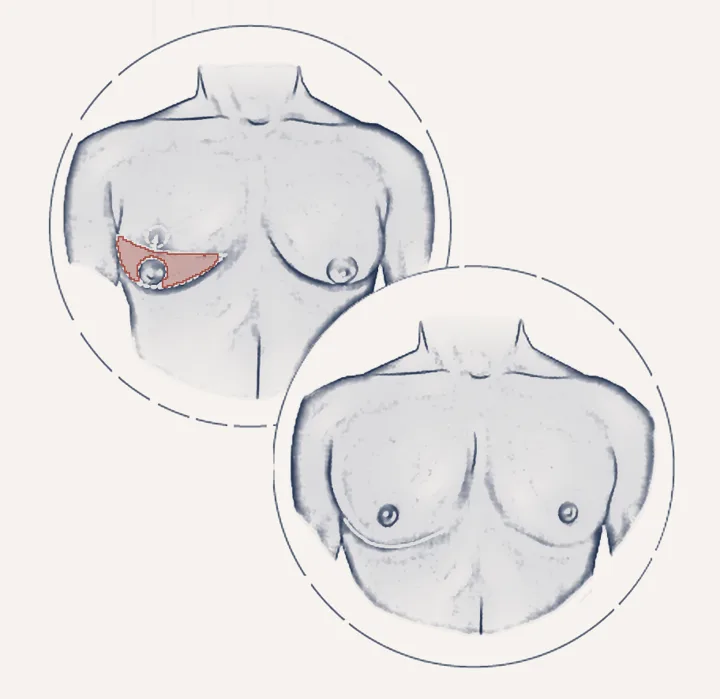
Gynaecomastia surgery takes about an hour under general anaesthesia. There are three main approaches, often combined in the same operation. In all of them I use tumescent solution, which reduces bleeding and usually makes drains unnecessary. The aim is a flat chest with a smooth transition from the nipple to the rest of the chest.
Power-assisted liposuction (MicroAire)
This is the method of choice when the breast gland is not enlarged, that is, in lipomastia. It is also used as a complement towards the armpits and around the edge of the breast, to refine the contour. Because conventional liposuction does not remove the firmer parts, I use power-assisted liposuction (MicroAire), which breaks up the connective tissue around the gland and can also remove a small gland. Its advantages are very small scars and a faster recovery. You will find more about the technique on the liposuction page.
Gland removal through an incision under the nipple
When the gland is large or there is little fat, I remove the gland surgically through a small semicircular incision at the lower edge of the areola (the Webster incision). I remove almost all of it, but I keep a small portion directly under the nipple so that the nipple does not sink. Where needed, liposuction around the area follows to give a smooth surface.
Correcting grade 3 and grade 4 gynaecomastia
When there is also loose skin, I make a circular incision around the nipple, through which I remove the gland and at the same time tighten the skin around the areola (periareolar tightening). If the laxity is extensive, the incisions extend on both sides of the nipple. In very large gynaecomastia, a modified mastectomy or breast reduction technique may be needed.
Incisions and stitches
In grades 1 and 2 the incision is small and crescent-shaped, at the lower edge of the areola, and the scar usually becomes almost invisible within a few months. Liposuction needs only small entry points; often one entry point at the breastbone is enough for both sides. In grades 3 and 4 the incisions around the nipple, and on both sides when needed, are more visible and take longer to mature. All stitches are absorbable and do not need to be removed.
Combining techniques
Liposuction and gland removal are often combined in the same operation, because in most cases gland and fat coexist. Liposuction can be extended towards the armpits or the sides of the chest, for a more even contour.
Do I need to stay in hospital?
No overnight stay is needed. You go home the same day, with someone to accompany you, wearing the compression vest. You must not drive after general anaesthesia.
How long is recovery after gynaecomastia surgery?
Discomfort after gynaecomastia surgery is usually mild, and you can return to office work in about 5 days. You wear a compression vest for 2 to 3 weeks after liposuction and for up to 6 weeks after gland removal. Exercise starts after 6 weeks, or after 3 weeks with liposuction alone.
| When | How you feel | What you can do |
|---|---|---|
| Day 1 | Mild pain; almost none after gland removal | Go home with someone to accompany you, wearing the compression vest; walking at home |
| Days 2–4 | Bruising and mild pain, more marked after liposuction | Painkillers I prescribe; vest day and night; no lifting |
| Day 5 | Discomfort settles | Back to office work |
| Weeks 2–3 | Bruising fades; mild swelling remains | Liposuction alone: vest off and back to exercise after week 3 |
| Week 6 | Feeling almost normal | Gland removal: vest off, gradual return to exercise and chest workouts |
| Months 2–3 | Grade 3 and 4 scars mature | Grades 3 and 4: back to the gym, usually at 2 to 3 months |
| Months 3–6 | Swelling settles completely | The contour becomes final |
How long do I need to stay in Greece after gynaecomastia surgery?
Gynaecomastia surgery needs no overnight stay in hospital: you go home the same day. The stitches are absorbable, so there is no appointment to remove them. Plan to stay in Greece for 5 to 10 days, until I have checked your chest and confirmed that you are ready to fly.
On the day of surgery you leave with someone to accompany you, wearing the compression vest, and you must not drive after general anaesthesia. Bruising and mild pain are most noticeable on days 2 to 4, more so after liposuction, and are controlled with the painkillers I prescribe. I see you in person the day before you travel.
Once you are home, follow-up continues by video call at 10 days, 1 month, 6 months and 1 year. At home you keep wearing the vest for 2 to 3 weeks after liposuction or up to 6 weeks after gland removal, avoid lifting, and plan about 5 days off office work. Exercise resumes after 3 weeks with liposuction alone and after 6 weeks with gland removal; in grades 3 and 4, allow 2 to 3 months before returning to the gym. All follow-up checks are done by me; nursing care at home can be arranged if you would like it.
What results can I expect, and are they permanent?
The result of gynaecomastia surgery is visible straight away, while healing completes and the contour settles over 3 to 6 months. The gland that is removed does not grow back, so the result is permanent, provided there is no ongoing hormonal cause. Significant weight gain or certain medicines can affect it.
In grades 1 and 2 the scar under the nipple becomes almost invisible. In the severe forms the scars may stay visible in places, but they fade with time, and chest hair helps to camouflage them. Because gynaecomastia often has a strong psychological impact, its correction usually brings great relief and self-confidence.
What are the risks of gynaecomastia surgery?
Gynaecomastia surgery carries risks related to general anaesthesia and to the technique. Most are rare and can be treated. The most typical are a collection of blood or fluid and a hollow under the nipple, both prevented with careful technique. I explain the risks for your own case at the consultation.
| Complication | How common | Prevention and management |
|---|---|---|
| Haematoma | Rare, in the first few days | Atraumatic, “dry” technique with tumescent solution, review of medicines that affect clotting; if it occurs, it is drained |
| Fluid collection (seroma) | Not common | Compression vest for the first weeks; if needed, the fluid is drawn off with a needle |
| Wound infection | Rare | Wound care; treated with antibiotics |
| Inverted or sunken nipple | Rare, when not enough tissue is left under the nipple | I keep a small portion of the gland under the nipple and smooth the surrounding area with liposuction |
| Contour irregularities or asymmetry | Not common | Liposuction around the area; a small revision procedure if needed |
| Scar tissue under the nipple | Rare, usually after a haematoma | Mimics the feel of the gland; treated with a small procedure or injection treatments |
| Change in nipple sensation | Usually temporary | Usually returns within months |
| Residual loose skin | Mainly in grades 3 and 4 | Periareolar tightening or incisions extended on both sides of the nipple |
| Recurrence | Rare, mainly when a hormonal cause persists | Hormonal assessment by an endocrinologist before surgery |
Smoking. Stop at least 4 weeks before and 4 weeks after surgery; smoking increases healing complications.
Blood thinners. Tell me if you take anticoagulants or antiplatelet medicines. They are always stopped in agreement with the doctor who prescribes them.
How much does gynaecomastia surgery cost?
I do not publish prices, because the cost depends on the grade, the ratio of fat to gland and whether the skin needs tightening. You receive a written quote after I have examined you at the consultation. These are the factors that shape it:
- The grade of gynaecomastia.
- The technique: liposuction alone, gland removal or a combination of the two.
- The need for skin tightening or skin removal, in grades 3 and 4.
- The extent of liposuction, for example towards the armpits.
Frequently asked questions
Should gynaecomastia in teenagers be treated with surgery?
Not always. Many cases of gynaecomastia in teenagers resolve in adulthood and never need surgical correction. For grade 1 or 2 gynaecomastia it is better to wait until the age of 22 to 24. For grade 3 and 4 gynaecomastia, however, correction can also be done in adolescence, because the distress is marked: many boys feel ashamed of their bodies and often gain weight to hide the problem. Every case is assessed individually, together with a hormonal assessment.
Can gynaecomastia come back after surgery?
Rarely, and mainly when a hormonal cause persists; that is why I recommend an assessment by an endocrinologist before surgery. In rare cases, a haematoma under the nipple leaves scar tissue that feels like gland tissue; it is treated with a small procedure or with injections. An atraumatic, “dry” technique and following the aftercare instructions reduce the risk. Significant weight gain or certain medicines can also affect the result.
How can I tell whether it is gynaecomastia or just chest fat?
The distinction is made mainly by clinical examination, with an experienced plastic surgeon feeling the chest. In true gynaecomastia, firm glandular tissue can be felt under the nipple, while in lipomastia (pseudogynaecomastia) the swelling is soft and caused by fat. When confirmation is needed, an ultrasound scan is added. The distinction matters because it determines the technique: lipomastia is usually treated with liposuction alone, while the gland needs surgical removal. In most cases the two coexist.
Where are the incisions, and will the scars show?
In grade 1 and 2 gynaecomastia the incision is small and crescent-shaped, at the lower edge of the areola (the Webster incision). Because it follows the edge of the areola, the scar usually becomes almost invisible within a few months. Liposuction needs only small entry points, and often one entry point at the breastbone is enough for both sides. In grade 3 and 4 gynaecomastia, where there is loose skin, the incision is made around the nipple and may extend on both sides, so the scars are more visible and take longer to mature.
Can the nipple sink after gynaecomastia surgery?
It can, if all the tissue under the nipple is removed, which is why I avoid doing so. To prevent an inverted or sunken nipple, I keep a small portion of the gland directly under the nipple, so that there is enough support. I also smooth the surrounding area with liposuction, so that the transition from the nipple to the rest of the chest is even. Compression with a vest in the first weeks helps the tissues settle correctly and reduces the risk of a fluid collection, which can also distort the contour.
Can men get breast cancer?
Yes, but much more rarely than women. When there is marked gynaecomastia and a family history of breast cancer, regular checks with ultrasound and/or mammography are recommended. Immediate investigation is needed when the swelling affects one side only, or when there is fluid discharge from the nipple, an inverted nipple or a hard lump. In these cases imaging is done before any surgery, to rule out malignancy.
Can diet and exercise get rid of gynaecomastia?
Only partly. Weight loss reduces the fat on the chest, so lipomastia can improve. The enlarged breast gland, however, does not shrink with diet or exercise, and chest workouts do not make it disappear. In fact, after major weight loss, loose skin may be added. That is why I recommend stabilising your weight first and then assessing at the consultation how much of the swelling is gland and how much is fat, so that the right technique can be chosen.
Does gynaecomastia surgery hurt?
Usually only a little. After gland removal for grade 1 or 2 gynaecomastia, pain is minimal. When liposuction is done, there is more bruising and mild pain for 3 to 4 days, controlled with the painkillers I prescribe. The compression vest also helps with pain, because it stabilises the tissues. In the severe grades, with skin tightening, recovery takes longer, but discomfort usually remains mild. You can return to office work in about 5 days.
When can I go back to the gym after gynaecomastia surgery?
Exercise is usually allowed after 6 weeks when the gland has been removed, and after week 3 when only liposuction has been done. Walking is allowed from the first days. Chest workouts, weightlifting and strenuous activity have to wait, because they increase the risk of fluid or blood collecting under the skin. In grade 3 and 4 gynaecomastia, where the skin is also tightened, you usually stay away from the gym for 2 to 3 months. The return is gradual, following the instructions I give you at your check-up.
When can I fly home after gynaecomastia surgery?
You can usually fly home from day 5, once I have checked your chest in person the day before your flight. There is no hospital night to plan for, as you go home the same day, and the stitches are absorbable, so you do not need to wait for them to be removed. Bruising and mild pain peak on days 2 to 4. You wear the compression vest day and night in the first days and should not lift heavy luggage.
Can my follow-up be done at home?
Yes. After you return home, follow-up is by video call at 10 days, 1 month, 6 months and 1 year. The milestones we follow are the same as for patients who live in Greece: back to office work at about 5 days, the vest off at 2 to 3 weeks after liposuction or up to 6 weeks after gland removal, and a return to exercise at 3 or 6 weeks. The scars of grades 3 and 4 mature over 2 to 3 months, and the final contour settles in 3 to 6 months.
References
- Webster JP. Mastectomy for gynecomastia through a semicircular intra-areolar incision. Ann Surg. 1946;124(3):557–575.
- Simon BE, Hoffman S, Kahn S. Classification and surgical correction of gynecomastia. Plast Reconstr Surg. 1973;51(1):48–52.
- Rohrich RJ, Ha RY, Kenkel JM, Adams WP Jr. Classification and management of gynecomastia: defining the role of ultrasound-assisted liposuction. Plast Reconstr Surg. 2003;111(2):909–923.
- Fagerlund A, Lewin R, Rufolo G, et al. Gynecomastia: a systematic review. J Plast Surg Hand Surg. 2015;49(6):311–318.
- Prasetyono TOH, Budhipramono AG, Andromeda I. Liposuction assisted gynecomastia surgery with minimal periareolar incision: a systematic review. Aesthetic Plast Surg. 2021.
Consultation
In Thessaloniki, in Athens or by video. Examination, options and a written plan.