
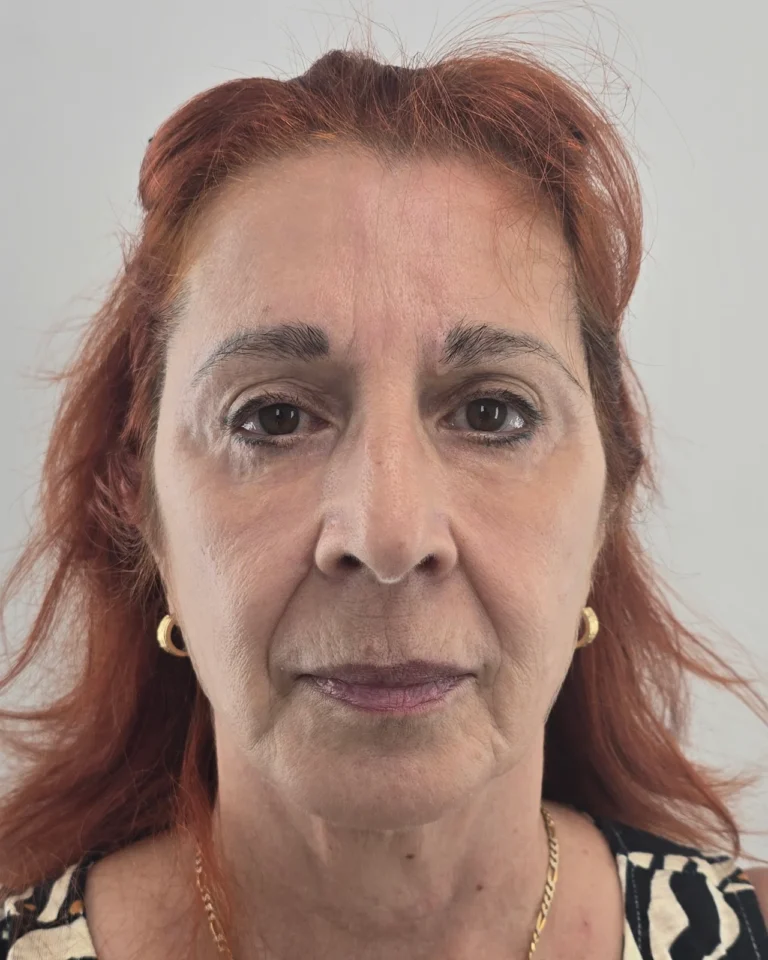
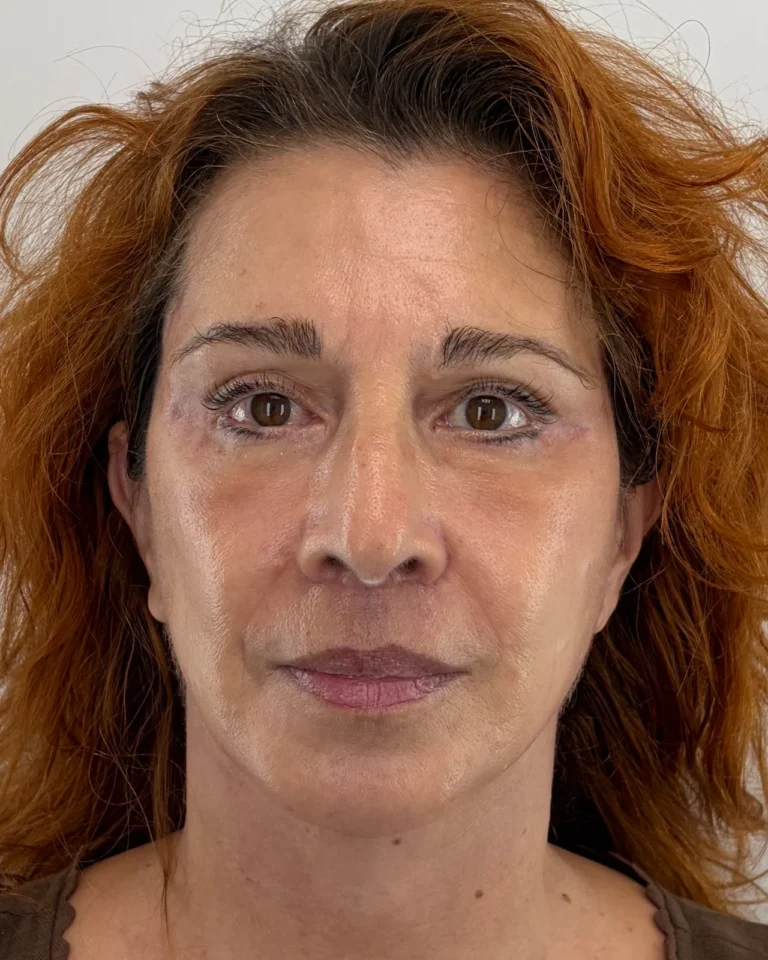
Face · Rejuvenation
Lower Blepharoplasty (Lower Eyelid Surgery) in Thessaloniki and Athens, Greece
Blepharoplasty is one of the operations I perform most often, more than 50 a year. I choose the technique for each eye separately, following one rule: remove as little skin as possible and give as much support as possible to the midface and the outer corner of the eye (the canthus).
Lower blepharoplasty removes or repositions the bags of fat under the eyes, fills the hollow along the tear trough, tightens loose skin and supports the lower eyelid. It is usually done under local anaesthesia or sedation, and you go home the same day.
50+
operations a year

At a glance
What it treats
Fat bags, a hollow along the tear trough, loose skin, a lax lower lid and outer corner of the eye
Anaesthesia
Local; sedation when needed, or general if you prefer
Duration
20 minutes to 1 hour, depending on the technique
Hospital stay
None; you go home the same day
Back to work
About 1 week; make-up after 2 weeks
Exercise
After about 1 month
Final result
Swelling: settles in 2 to 6 weeks. Scar: inconspicuous in about 1 year.
Where
Interbalkan Medical Center, Thessaloniki · Athens Medical Center, Marousi (Athens)
Medically reviewed by Dr Prodromos Papaioannou, Plastic Surgeon, HESPRAS member, ASPS International Member · Last reviewed:
What is lower blepharoplasty?
Lower blepharoplasty is not a single operation but a set of techniques, combined differently for each eye. Together they deal with the bag of fat, the hollow along the tear trough, loose skin and the support of the lower lid. Which techniques each eye needs is decided by a careful examination before surgery.
In the lower lids, correct assessment and the choice of technique are the key point [1]. When there is only a bag, removing or repositioning it from inside the lid is often enough. When the skin, the muscle or the tendon at the outer corner of the eye is also lax, further steps are needed.
I do not remove a large amount of fat. I move it into the hollow directly below, to smooth the transition from the lid to the cheek [4, 5]. This can also improve dark circles caused by the shadow of that hollow.
The operation can be extended lower, to treat a deep tear trough or a low bag where the lid meets the cheekbone (malar bag, festoon), and in selected cases it is combined with a midface lift. Injectable materials and laser cannot remove or reposition fat.
My approach: less skin, more support
Removing too much skin is a common cause of a pulled-down lower lid. That is why I am conservative with skin:
- I remove skin extensively only when an extensive facelift or midface lift leaves genuine excess tissue.
- When the indication is borderline, I either leave the skin alone, remove a minimal strip (skin pinch), or lift the lower lid indirectly from the temple with Pascali’s temporal MORE technique: I fully release the orbicularis oculi muscle from the ligaments of the lower lid and reposition it, so that the skin and muscle of the lower lid are lifted without a major fixation of the canthus.
- Always with strong support of the midface and of the structures at the outer corner of the eye [3, 6].
Am I a good candidate for lower eyelid surgery?

Lower blepharoplasty suits healthy adults with bags, a hollow or loose skin under the eyes that give them a tired look. The degree of laxity and the anatomy of your eyelids matter more than your age, and lower lid surgery can be done at a younger age than upper lid surgery.
Who are the typical candidates?
- People with fat bags under the eyes, often inherited, even at a young age.
- People with a hollow along the tear trough and dark circles.
- People with loose or wrinkled skin on the lower lid.
- People with a lax lower lid or a sad, downturned outer corner of the eye.
- People with a low bag where the lid meets the cheekbone (festoon).
- People having a facelift or midface lift who want their lower lids corrected in the same operation.
When do I not recommend it?
- When there is severe, uncontrolled dry eye or active inflammation of the eye; this is treated first.
- When the problem is mainly loss of volume in the midface without a bag; fat transfer or a midface lift may then suit you better.
- When the skin laxity is very mild.
- When a general condition, such as high blood pressure or a bleeding disorder, is not under control.
- When expectations do not match what the operation can give, for example changing the character of your gaze.
What happens at the consultation, and how do I prepare?
At the consultation I examine each eye separately and we decide together which techniques it needs and whether to combine the operation with other facial surgery. You receive a written plan and cost. The tests you need beforehand depend on the type of anaesthesia and on whether you are prone to dry eye.
What happens at the consultation?
I examine each eye on its own: the fat bags, the hollow along the tear trough, the skin, the position and tone of the lower lid, the tone of the canthus and the support of the midface. I ask about dry eye and check the conjunctiva for signs of irritation. I also assess the rest of your face, because a tired look comes not only from the eyelids but also from the brows, the forehead and the midface. We then decide together which techniques each eye needs and whether the operation should be combined with other facial procedures. You receive a written plan and cost.
What tests and instructions apply before surgery?
Under local anaesthesia no special tests are usually needed; with sedation or general anaesthesia you need pre-operative blood tests. If you are prone to dry eye, we assess it beforehand and plan your aftercare in advance. Stop smoking 4 weeks before and 4 weeks after the operation. If you take anticoagulants or antiplatelet medicines (blood thinners), tell me; they are stopped only in agreement with the doctor who prescribes them. The date of surgery is set once these checks are complete.
How is lower blepharoplasty performed?
Lower blepharoplasty is usually done under local anaesthesia, with sedation when needed or general anaesthesia if you prefer, and takes 20 minutes to 1 hour. The bag is removed or repositioned either from inside the lid or through an incision just below the lashes. I often combine two or three techniques in the same eye.
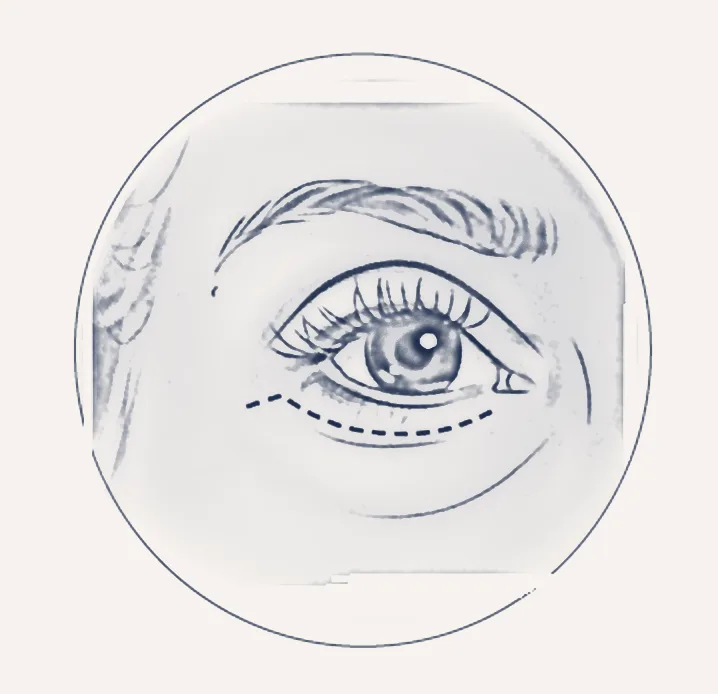
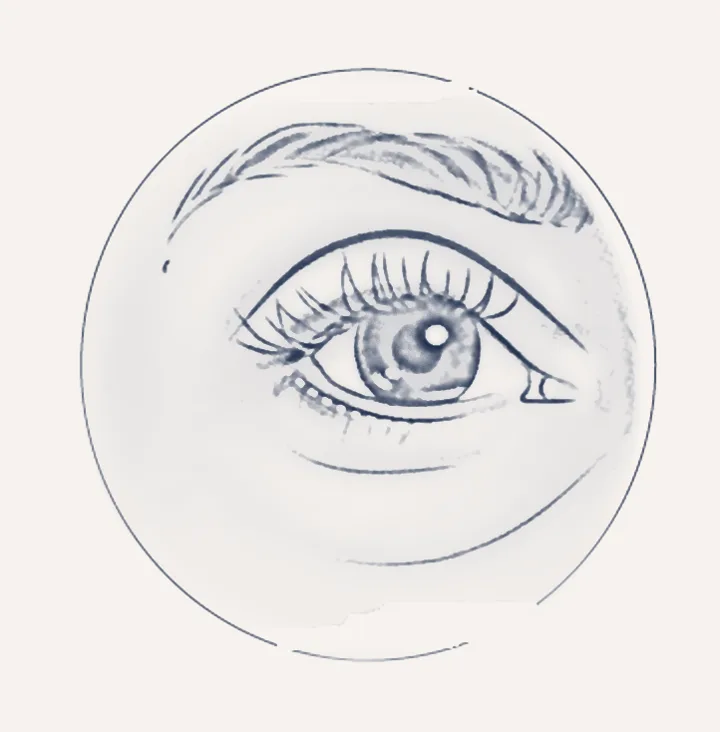
Local anaesthesia alone is enough for the lower lids; some patients choose sedation or general anaesthesia to feel more comfortable. When upper and lower blepharoplasty are done together, local anaesthesia with sedation is the better option. In every case the operation is painless and needs no hospital stay. How long it takes depends on what each eye needs.
| Technique | What it does | When I choose it |
|---|---|---|
| Transconjunctival | Reaches the fat from inside the lid, with no incision in the skin | Fat bags without excess skin |
| Open approach (subciliary) | Incision just below the lashes | When skin, muscle and fat all need work |
| Skin pinch | Minimal removal of skin only | A small excess of skin |
| Canthopexy / canthoplasty | Supports or repositions the outer corner of the eye | When indicated, e.g. a lax lower lid |
| Fat repositioning | Moves the fat into the hollow instead of removing it | A hollow along the tear trough, volume loss |
| Fat removal | Reduces the fat bags | Very prominent, enlarged bags |
Transconjunctival blepharoplasty: when there is only a bag
When there is only a bag, I remove or reposition it through a small incision on the inner surface of the lid, through the conjunctiva. This technique leaves no external scar, gives very good results and allows a faster recovery. Because the muscle and skin are not cut, the lower lid keeps its support.
Open blepharoplasty and skin pinch: when the skin is loose
When the skin is lax, a simple removal of skin (skin pinch) can be done, as in upper blepharoplasty, together with removal of the bag through the conjunctiva; or an open operation through an incision below the lashes, when skin, muscle and fat all need work. Skin removal is always measured and conservative.
Fat repositioning and the tear trough
Instead of being removed, the fat of the bag can be moved into the hollow directly below it, along the tear trough [4, 5]. This corrects the bag and the hollow at the same time and improves dark circles. As a complement, I use fat transfer to the eyelids and around the eyes, often with nanofat.
Did you know? In many facial operations I add nanofat: fat from your own body, processed into a very fine graft, which improves the quality and texture of the skin [7]. I use it to complement surgery and rarely on its own, because the share of fat that survives is not predictable.
Canthopexy and canthoplasty
When the whole eyelid structure is more markedly lax, the outer canthus is fixed again with a canthopexy or canthoplasty, together with the lid’s orbicularis muscle sling [2, 3]. A canthopexy supports the lower lid so that it is not pulled down during healing, and it can give the eye a more almond shape. I perform it only when it is indicated.
Incisions and stitches
With the transconjunctival technique the incision is inside the lid. With the open technique it lies just below the lashes and blends into the natural crease. I close it with a continuous intradermal stitch, so that no cross-marks from external stitches are left, and the stitches come out on day 5.
Combining it with other procedures
Lower blepharoplasty is often combined with upper blepharoplasty, a brow lift or a temporal lift for the so-called foxy eye or cat eye look, where the eye becomes more almond-shaped or more slanted. In patients having an extensive facelift or midface lift, it is done in the same operation, and then skin removal is justified [6]; see the deep plane facelift page. For very mild laxity, laser resurfacing or radiofrequency also gives some improvement.
Hospital stay
No hospital stay is needed. You go home the same day and can go out straight away wearing sunglasses. After sedation or general anaesthesia you need someone to accompany you, and you must not drive.
What is recovery like after lower blepharoplasty?
Swelling and bruising are strongest in the first 5 days, when the stitches also come out. You can return to work after about 1 week, wear make-up after 2 weeks and exercise after about 1 month. Swelling in the lower lids takes 2 to 6 weeks to settle completely.
For the first few days I recommend sleeping on 2 pillows, and for the first 24 hours applying cold compresses to the eyes. Your eyes work normally straight after the operation, because your vision is not affected. When you go back to work depends on two things: being able to function, and avoiding comments from people around you. Some patients choose to take 2 weeks or more off, so that the operation goes unnoticed.
| When | How you feel | What you can do |
|---|---|---|
| Day 1 | Swelling and a feeling of tightness in the lids | Cold compresses for the first 24 hours; sleep on 2 pillows; go out wearing sunglasses |
| Days 1–5 | Swelling and bruising, strongest during these days | Lubricating eye drops; if you are prone to dry eye, taping and steroid eye drops |
| Day 5 | The bruising starts to fade | Stitches removed; sunglasses no longer needed, a little concealer over the bruises |
| About 1 week | Mild swelling remains | Back to office work; 10 to 15 days for physically demanding work |
| 2 weeks | The lid looks almost normal | Eye make-up |
| About 1 month | Swelling fades gradually and is completely gone within 2 to 6 weeks | Back to exercise and normal activity |
| 1–2 months to 1 year | The scar fades and over time becomes almost invisible | Sun protection on the scar |
How long do I need to stay in Greece after lower blepharoplasty?
Lower blepharoplasty needs no hospital stay: you go home the same day. The stitches come out on day 5, and swelling and bruising are strongest during those first 5 days, so plan your stay around the stitch-removal visit: 5 to 10 days in Greece in total.
After sedation or general anaesthesia, someone must accompany you on the day and you must not drive. You can go out straight away wearing sunglasses; after day 5 you no longer need them, and a little concealer covers any bruising.
Flying home: from day 5, after the stitches are out, with no limit on flight length.
Follow-up from home: by video call at 10 days, 1 month, 6 months and 1 year.
What to arrange at home: someone to help on the first day, 2 pillows to sleep on and cold compresses for the first 24 hours, lubricating eye drops, and, if you are prone to dry eye, taping and steroid drops as we plan before surgery. Allow about 1 week off office work, or 10 to 15 days for physically demanding work; some patients take 2 weeks or more so that the operation goes unnoticed. All follow-up checks are done by me; nursing care at home can be arranged if you would like it.
What results can I expect, and how long do they last?
After lower blepharoplasty the bags and puffiness under the eyes settle and dark circles improve noticeably. Because the fat is redistributed rather than removed in large amounts, the eye does not look hollow. The result is long-lasting; in my experience, more than 15 years.
The lower lids heal very well and the scars are inconspicuous: they take 1 to 2 months to reach the point where they show little or not at all, and after about a year they are almost invisible. Fat that has been removed very rarely comes back. The skin and the midface keep ageing, and today’s aesthetic accepts slight laxity after some years as more natural. When a canthopexy is done, the eye can become more almond-shaped, depending on what you want.
What are the risks of lower blepharoplasty?
Lower blepharoplasty is a well-studied operation, but the more complex or traumatic the surgery, the more often complications such as ectropion, scleral show, scarring or poor healing can occur. My experience has shown that the lower lids call for very conservative choices, always guided by the right indications.
| Complication | How common | Prevention and management |
|---|---|---|
| Swelling and bruising | Common, temporary | Cold compresses, sleeping with the head raised; settle in 2 to 6 weeks |
| Dry eye, eye irritation | Not rare, temporary | Assessment before surgery; taping, steroid and lubricating eye drops |
| Lowered lower lid (scleral show) or rounding of the outer corner | Rare | Little skin removed, support of the canthus and the midface [3]; massage and taping, rarely a corrective operation |
| Ectropion (the lid turning outwards) | Rare | Conservative skin removal, canthopexy when indicated [2]; corrected surgically if it does not settle |
| Visible scar or discolouration | Rare | Intradermal stitches; complementary laser protocols |
| Asymmetry or residual bag | Rare | Planning each eye separately; a minor correction if needed |
| Recurrence of the bag | Very rare | A further operation may be needed |
| Bleeding behind the eye | Very rare | Checking blood thinners and blood pressure beforehand; immediate treatment if severe pain or a change in vision appears |
Smoking: stop at least 4 weeks before and 4 weeks after the operation. Smoking increases healing complications and reduces the success of fat transfer.
How much does lower blepharoplasty cost?
We do not publish prices. The cost of lower blepharoplasty differs from person to person, depending on the technique, any additional work on the outer corner of the eye or on the fat, and whether it is combined with another operation. You receive a quote after the consultation, once I have examined you and we have agreed the plan together.
What affects the cost:
- The technique: transconjunctival, skin pinch or open.
- A canthopexy or canthoplasty, when needed.
- Fat repositioning, or fat transfer and nanofat.
- The anaesthesia: local, sedation or general.
- Combining it with upper blepharoplasty, a brow lift, a temporal lift or a facelift.
Frequently asked questions
How long does swelling last after lower blepharoplasty?
In the lower lids, swelling takes 2 to 6 weeks to settle completely, while swelling and bruising are strongest in the first 5 days. To reduce it, I recommend sleeping on 2 pillows for the first few days and applying cold compresses to the eyes for the first 24 hours. You can go out straight away wearing sunglasses; after day 5 you no longer need them, and a little concealer over any remaining bruises is enough. With the transconjunctival technique, recovery is usually faster.
Will lower eyelid surgery leave a visible scar?
It depends on the technique. With transconjunctival blepharoplasty the incision is inside the lid, so there is no external scar. With the open technique the incision lies just below the lashes and blends into the natural crease. The eyelids heal faster and better than almost anywhere else on the body. In my practice the incisions are closed with an intradermal technique, so no cross-marks from external stitches are left. The scar becomes inconspicuous in 1 to 2 months and almost invisible after about a year. In the rare cases of a visible scar or discolouration, we use complementary laser protocols.
How do you get rid of under-eye bags and dark circles?
Under-eye bags are corrected mainly by surgically reducing the fat that bulges forward, with either the classic (open) or the transconjunctival lower blepharoplasty. When there is also a hollow, I do not remove the fat but move it into the hollow directly below, along the tear trough. Dark circles are treated either with this repositioning during the operation or with nanofat fat transfer. Non-surgical treatments such as injectable materials or laser cannot give the same result when there is a true bag of fat.
What is transconjunctival blepharoplasty?
Transconjunctival blepharoplasty is a technique for reducing lower lid bags through a small incision on the inner surface of the lid, through the conjunctiva. Its great advantages are the absence of an external scar and a faster recovery. Because the muscle and skin are not cut, the lower lid keeps its support. It suits a bag without significant excess skin. When the skin is also loose, it is combined with a minimal skin removal (skin pinch).
Do I need a canthopexy with lower blepharoplasty?
Only when it is indicated, for example when the lower lid is lax or the outer corner of the eye has dropped. A canthopexy fixes the outer corner of the eye in the right position and supports the lower lid, so that it is not pulled down during healing. More marked laxity needs a canthoplasty. It can also give the eye a more almond shape. I decide whether you need it at the examination, by measuring the tone of the lid in each eye separately.
When can I go back to work and wear make-up after lower eyelid surgery?
You can return to office work after about 1 week, because your eyes work normally straight away and your vision is not affected. Physically demanding jobs may need 10 to 15 days. When you go back is also a personal choice: some patients take 2 weeks or more off so that the operation goes unnoticed. The stitches come out on day 5, and eye make-up is allowed after 2 weeks.
Are the results of lower blepharoplasty permanent?
The result is long-lasting; in my experience, more than 15 years. The fat we remove to correct the bags very rarely comes back to the point of needing another operation. The skin and the midface keep ageing, so slight laxity may appear after some years. Modern blepharoplasty is less aggressive with skin removal than in the past and aims for a natural result, and today’s view of eyelid aesthetics accepts this slight laxity as more natural.
Will blepharoplasty change the shape of my eyes?
This is a very common worry. For your gaze to stay unchanged, blepharoplasty must fully respect the anatomy of the eyes and eyelids, the elasticity of the tissues and the volume loss that comes with age. That is why I remove little skin, support the canthus when it is indicated, and redistribute fat instead of removing it. The lower lid is not pulled down and the shape of your eye is preserved. If you want a deliberate change, such as a more almond-shaped eye, we plan it together with a canthopexy or a temporal lift.
When can I fly home after lower blepharoplasty?
You can fly home from day 5, after the stitches are out. Lower blepharoplasty needs no hospital stay, so you leave the hospital on the day of surgery; after sedation or general anaesthesia someone must accompany you. The stitches come out on day 5, and swelling and bruising are strongest during those first 5 days, so most patients plan their trip around the stitch-removal visit. After day 5 you no longer need sunglasses, and a little concealer covers any bruising when you travel.
Can my follow-up be done at home?
After you return home, follow-up is by video call at 10 days, 1 month, 6 months and 1 year. The stitches come out on day 5, at the practice, before you fly. After that, recovery continues at home: office work after about 1 week, eye make-up after 2 weeks, exercise after about 1 month, and swelling settles fully within 2 to 6 weeks. If you notice severe pain or a change in your vision, this needs immediate treatment: go to the nearest hospital emergency department and call us.
References
- Nahai F. The Art of Aesthetic Surgery: Principles and Techniques. 3rd ed., vol. 2: Facial Surgery. Thieme; 2020.
- Jelks GW, Glat PM, Jelks EB, et al. The inferior retinacular lateral canthoplasty: a new technique. Plast Reconstr Surg. 1997;100(5):1262–1270.
- Pascali M, Avantaggiato A, Brinci L, et al. Tarsal sling: an essential stitch to prevent scleral show in lower blepharoplasty. Aesthet Surg J. 2015;35(1):11–19. doi:10.1093/asj/sju018
- Hamra ST. Arcus marginalis release and orbital fat preservation in midface rejuvenation. Plast Reconstr Surg. 1995;96(2):354–362.
- Goldberg RA. Transconjunctival orbital fat repositioning: transposition of orbital fat pedicles into a subperiosteal pocket. Plast Reconstr Surg. 2000;105(2):743–748.
- Rohrich RJ, Ghavami A, Mojallal A. The five-step lower blepharoplasty: blending the eyelid-cheek junction. Plast Reconstr Surg. 2011;128(3):775–783.
- Tonnard P, Verpaele A, Peeters G, et al. Nanofat grafting: basic research and clinical applications. Plast Reconstr Surg. 2013;132(4):1017–1026.
Consultation
In Thessaloniki, in Athens or by video. Examination, options and a written plan.