
Face · Rejuvenation
Endoscopic midface lift in Thessaloniki and Athens, Greece
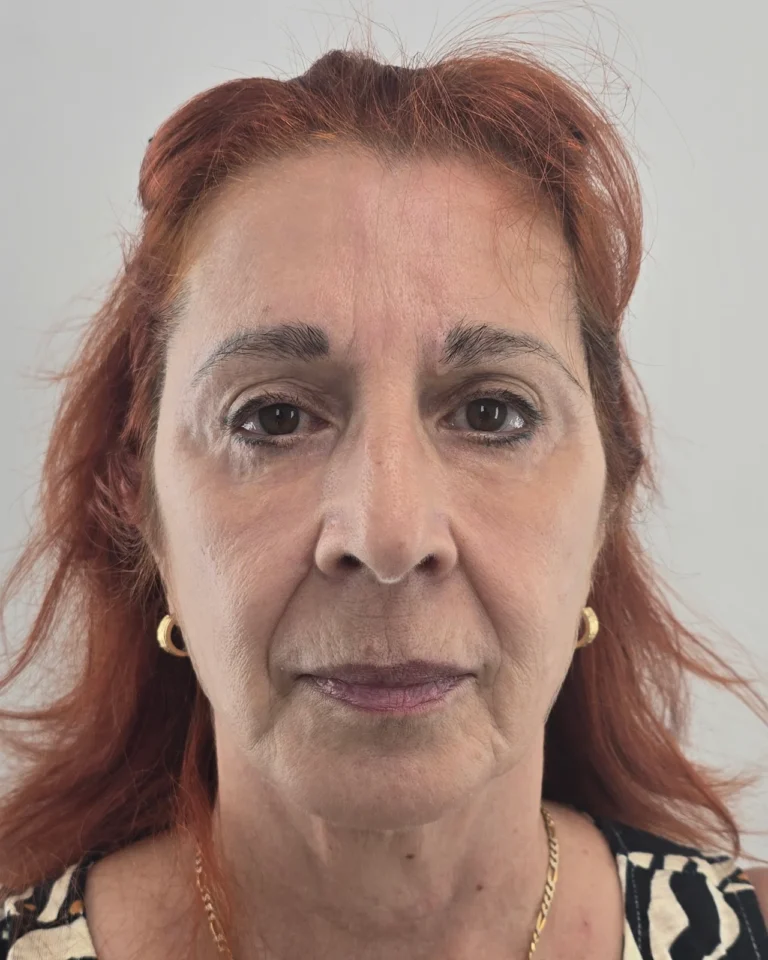
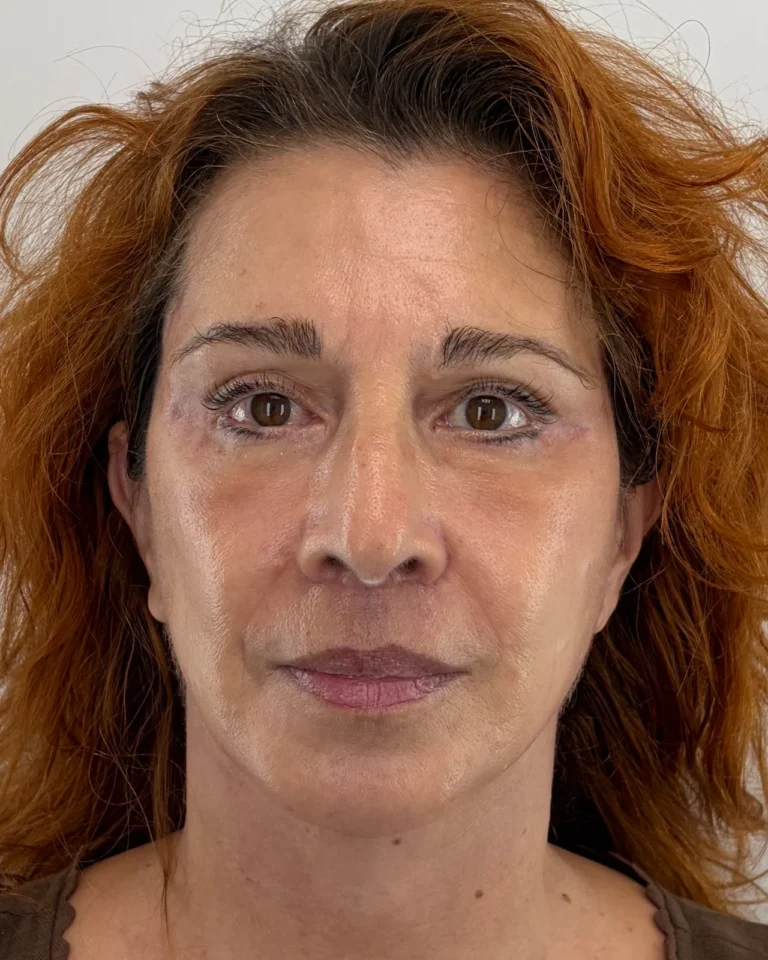
A midface lift raises the cheeks and the tissues under the eyes vertically. It treats descended cheeks, a visible tear trough and deep nasolabial folds. It does not stretch the skin. I perform it endoscopically, through the lower eyelid or through the temple, with no incision around the ear.
I have been a specialist plastic surgeon since 2012 and perform 5 to 15 endoscopic midface lifts a year. I lift the deeper tissues vertically rather than pulling the skin, so your expression stays your own.

At a glance
What it treats
Descended cheeks, tear trough, deep nasolabial folds, laxity at the corners of the mouth
Anaesthesia
General, or local with sedation
Operating time
About 1 hour (lower eyelid or temple route) · 1.5 to 2 hours (endoscopic)
Hospital stay
None; you go home the same day
Back to work
After 10 to 12 days
Exercise
Light after 2 weeks, strenuous after 4 weeks
Final result
At 12 months
Where
Interbalkan Medical Center, Thessaloniki · Athens Medical Center, Marousi (Athens)
Medically reviewed by Dr Prodromos Papaioannou, Plastic Surgeon, HESPRAS member, ASPS International Member · Last reviewed:
What is a midface lift?
A midface lift returns the soft tissues between the lower eyelid and the corners of the mouth to their earlier position. It lifts the cheeks and softens the nasolabial folds and the tear trough by raising the deeper tissues vertically, without pulling on the skin. It is also called a cheek lift.
Ageing in the midface is not only a matter of skin. The fat compartments (fat pads) of the cheek shrink and slide downwards [1], and the ligaments that support them loosen. The result is a tired look under the eyes and deeper nasolabial folds. In some people this appears earlier, because of their anatomy.
The classic facelift used to pull mainly on the skin. Today we lift the deeper tissues and, when needed, fold them on themselves to add volume to the cheeks. With no tension on the skin, scars heal better.
When might a younger patient need a midface lift?
Some people have a weaker facial skeleton and flatter cheekbones that do not support the soft tissues well, so laxity shows even before 30. In these patients an endoscopic midface lift is corrective, not only anti-ageing.
Cheek implants are an alternative. An endoscopic lift uses your own tissues instead: they are raised towards the cheekbone (zygomatic arch) and strengthen the curve of the cheek, the ogee curve [2].
Am I a good candidate for a midface lift?

A midface lift usually suits people aged 30 to 55 whose cheeks have descended, who have a hollow under the eyes and who do not have much excess skin. If the laxity is mainly along the jawline and the neck, I recommend a deep plane facelift instead, or a combination of the two.
Typical candidates
- Descended cheeks (the “apples” of the cheeks have dropped).
- A marked tear trough and a hollow under the eyes.
- Deep nasolabial folds linked to sagging cheeks.
- Naturally weak cheekbones, with laxity that shows even before 30.
- A face that no longer responds to injectable materials and needs the tissues lifted (fatigue from injectable materials).
When I do not recommend it
- When laxity is advanced and there is excess skin; I then recommend a deep plane facelift or a combination.
- When there is an uncontrolled health problem (for example uncontrolled high blood pressure or a clotting disorder) that raises the risk of haematoma (hematoma).
- When the hope is to change your facial features rather than to lift the tissues.
How do I prepare for a midface lift?
Preparation starts with a consultation, where I examine your face and we agree on the technique. Before surgery you need blood tests and, where needed, a heart check. You stop smoking 4 weeks before and 4 weeks after, and we review any blood-thinning medicines.
What happens at the consultation?
I examine the cheeks, lower eyelids, brows, jawline and neck, and check whether the laxity comes from descended fat or from excess skin. We decide whether the midface alone is enough or a combination is needed, and which technique suits you. You receive a written plan.
Tests and instructions before surgery
You will need blood tests and, where needed, a cardiology check. Stop smoking 4 weeks before and 4 weeks after surgery. If you take anticoagulants or antiplatelet medicines, tell me; you stop them only with the agreement of the doctor who prescribed them.
How is a midface lift performed?
A midface lift is performed under general anaesthesia or local anaesthesia with sedation. The endoscopic technique takes 1.5 to 2 hours; the lower eyelid and temple routes take about 1 hour. In every technique the midface tissues are released from the ligaments that hold them low and secured higher, vertically.
The reason to lift the midface is the same for every technique. The choice depends on your overall goal and on any other procedures done at the same time. Because the tissues are released widely, they rise without tension on the skin. The movement is vertical, not backwards, so it does not give a “pulled” look. Skin usually does not need to be removed: it follows the new position of the tissues and adapts. If laxity is very advanced, I combine the operation with another technique, such as a deep plane facelift.
Which technique do I choose?
| Technique | Access | When I choose it |
|---|---|---|
| Through the lower eyelid [5] | Through the lower blepharoplasty incision | The simplest option, when lower eyelid surgery is being done anyway |
| Through the temple [4] | Only through the temple hairline, with no incision inside the mouth | When the lower eyelid needs no surgery; can be combined with a canthopexy or a lift of the tail of the brow |
| Endoscopic [2–4] | Small incisions in the temple hair and inside the mouth, with a camera | When the forehead is also being corrected, together with an endoscopic brow lift |
Endoscopic midface lift
An endoscopic midface lift is performed with an endoscopic camera in the subperiosteal plane, directly on the bone, where bleeding is minimal. In essence it extends the endoscopic brow lift so that it also includes the midface (extended endoscopic brow lift) [2–4]. The steps:
- Small incisions in the temple hair and inside the mouth.
- A fine high-definition camera (endoscope) lets me see clearly the nerves and structures that must be protected.
- Through the temple and the mouth I release the midface at the level of the periosteum (on the bone), from the ligaments that hold it low.
- I lift the tissues vertically and secure them with stitches to the temporal fascia or the periosteum, and less often directly to the bone through a small channel [2–4].
The precision of the work and the stability of the result over time are why I prefer it when the forehead is also being corrected. The endoscopic brow lift is described on the forehead and brow lift page.
Midface lift through the lower blepharoplasty incision
The midface can also be lifted through the lower blepharoplasty incision, just below the lashes [5]. It is the simplest option when lower eyelid surgery is being done anyway, and it takes about 1 hour. Compared with a facelift, the improvement is more limited. The advantage is that the incisions are minimal and become almost invisible after about 3 months. See also the blepharoplasty page.
Midface lift through the temple
When the lower eyelid needs no surgery, I lift the midface through a single incision at the temple hairline, with no incision inside the mouth [4]. It takes about 1 hour. Through the same incision I can lift the outer corner of the eye (canthopexy) or the tail of the brow, as in a mini temporal lift.
Incisions and stitches
The incisions are small and, depending on the technique, hidden in the hair, inside the mouth or just below the lashes. There are no incisions in front of or behind the ear.
- Endoscopic: incisions of 1 to 2 cm in the temple hair and inside the mouth. The scalp is closed with metal clips, removed after 5 to 7 days; the incision inside the mouth is closed with absorbable stitches.
- Lower eyelid: a non-absorbable buried (intradermal) stitch, removed on day 5.
- Temple: an incision exactly at the hairline, closed with an absorbable buried stitch that does not need removing.
The tissues are secured with stitches to the temporal fascia or the periosteum, and less often directly to the bone through a small channel. Because the skin is not stretched, the scars in the hair fade within 4 to 6 months.
Combining a midface lift with other procedures
To avoid an imbalance between the upper and lower face, a midface lift is often combined with other procedures:
| Combined with | What it adds |
|---|---|
| Endoscopic forehead and brow lift | Lifts the upper face; controlled weakening of the frown muscles also softens the lines between the brows |
| Deep plane facelift | Jawline and neck, when laxity is more extensive |
| Fat transfer (nanofat, microfat) | Volume in the cheeks, the midface and around the eyes |
| Blepharoplasty (eyelid surgery) | Refreshes the eyes; corrects bags and excess skin, which a lift does not remove |
| Endoscopic mini neck and jawline lift | For younger patients, with small incisions and no incision around the ear |
In many facial operations I add nanofat: fat from your own body, prepared as a very fine graft, which improves skin texture [6]. I use it as a complement and rarely on its own, because fat survival is not predictable.
Do I need to stay in hospital?
No hospital stay is needed: you go home the same day with someone to accompany you. If thin drains are placed, they are removed after a few hours. You must not drive on the day of surgery after the anaesthetic.
What is recovery like after a midface lift?
Pain is mild. In the first week there is mild to moderate swelling and possibly mild bruising. Most people return to social and work life after 10 to 12 days. Swelling settles gradually over 3 to 6 months, and the final result shows at 12 months. Recovery is the same for all three techniques.
If a brow lift is done at the same time, you may have a mild headache for the first few days. Bruising is minimal; moderate bruising of the upper eyelids is rare. When you go back to work, a little make-up may help.
| When | How you feel | What you can do |
|---|---|---|
| Day of surgery | Mild pain; possibly a mild headache if a brow lift was also done | Go home with someone to accompany you; thin drains, if used, come out after a few hours; rest with your head raised |
| Days 1–4 | Mild to moderate swelling, possibly mild bruising | Cold compresses and ordinary painkillers; rest and gentle walking |
| Days 5–7 | Swelling starts to settle | Endoscopic: metal clips removed from the scalp and first hair wash · lower eyelid: stitch removed on day 5 · temple: absorbable stitch, no removal |
| Days 10–12 | Mild swelling remains under the eyes and in the cheeks | Back to social and work life, with a little make-up if needed |
| Weeks 2–4 | Swelling keeps going down | Light exercise after 2 weeks, strenuous exercise after 4 |
| Months 3–6 | Swelling settles gradually; scars in the hair fade over 4–6 months | Normal activity; laser resurfacing, if we have planned it |
| Month 12 | Final result | Review at your follow-up |
How long do I need to stay in Greece after a midface lift?
Plan to stay in Greece for about 5 to 10 days after a midface lift. You go home from hospital the same day, so the stay is mainly for your check-ups and for stitches or clips to come out. I usually advise waiting until at least day 5, and until the clips or stitch are out, before you fly.
You do not stay overnight in hospital; you rest at your hotel or apartment the same evening, with someone to accompany you. Timing then depends on the technique. After the endoscopic technique the metal clips in the scalp come out after 5 to 7 days. After the lower eyelid route the stitch comes out on day 5. After the temple route the stitch is absorbable and does not need removing. I see you in person for the clip or stitch removal and for a final check the day before you travel.
After you return home, follow-up continues by video call at 10 days, 1 month, 6 months and 1 year, and you can send me photos at any time if something worries you. Before you travel, arrange for someone to be with you for the first days at home, cold compresses, ordinary painkillers and a pillow to keep your head raised. Most people are back at work 10 to 12 days after surgery, so plan your time off around that.
How long do midface lift results last?
The improvement after a midface lift is long-lasting, because the tissues are secured in their new position. Your face looks more rested, without changing your features or your expression. Ageing continues, but from a younger starting point. The final result shows at 12 months, once all the swelling has settled.
I aim for subtle, natural changes that keep the harmony of the face; your expressiveness is preserved. How much is corrected always depends on your anatomy and your preferences. Unlike non-surgical lifting methods such as threads, the result is stable for many years. In a cheek and neck lift, provided your weight stays stable, I expect the result to last 15 to 20 years. Laser resurfacing can enhance the result, because it improves the fine surface lines around the mouth.
What are the risks of a midface lift?
Like any operation, a midface lift carries risks. The main ones are temporary weakness of the forehead or the smile, asymmetry, prolonged swelling and numbness. They are more common with the extended endoscopic technique and in most cases settle. I explain the risks for your own case at the consultation.
| Complication | How common | Prevention and management |
|---|---|---|
| Swelling and bruising | Common, temporary | Cold compresses, head raised; swelling settles over weeks |
| Prolonged swelling in the cheeks and under the eyes | Not rare, mainly with the extended endoscopic technique | Settles gradually over 3–6 months |
| Numbness of the cheeks or scalp | Common, temporary | Usually recovers within weeks to months |
| Temporary weakness of the forehead or the smile | Rare, temporary | The camera lets me see and protect the nerves; settles within days to weeks |
| Asymmetry | Rare | Assessed once swelling has settled; a small correction is rarely needed |
| Hair loss at the incision | Rare, usually temporary | Incision with no tension on the skin; with the temple technique the incision is at the hairline |
| Change in lower eyelid shape (lower eyelid technique) | Rare | Support of the eyelid with a canthopexy where needed |
| Haematoma (hematoma) or infection | Rare | Review of medicines that affect clotting, antibiotics; treated promptly |
Smoking. Stop at least 4 weeks before and 4 weeks after surgery; smoking increases healing problems and reduces the success of fat transfer.
Blood thinners. Tell me if you take anticoagulants or antiplatelet medicines. They are always stopped in agreement with the doctor who prescribes them.
How much does a midface lift cost?
We do not publish prices, because the cost of a midface lift differs from person to person. It depends on the technique, the length of the operation and whether it is combined with other procedures. You receive a written quote after your consultation, once I have examined you and we have agreed on your plan.
- The technique: endoscopic, through the lower eyelid or through the temple.
- The anaesthesia: general, or local with sedation.
- Combination with a brow lift, blepharoplasty, canthopexy or deep plane facelift.
- Fat transfer (nanofat, microfat), if needed.
- The hospital: Thessaloniki or Athens.
Midface lift FAQs
How long does a midface lift last?
There is no guaranteed duration, but the improvement is long-lasting. The tissues are released and secured in a new position with stitches to the temporal fascia or the periosteum. Ageing continues, but from a younger starting point. How long the result lasts is affected by your weight, smoking, sun exposure and the quality of your skin.
Will a midface lift leave visible scars?
The incisions are small and hidden: in the temple hair, inside the mouth or just below the lashes. There are no incisions around the ear. The scars in the hair fade within 4 to 6 months, and the lower blepharoplasty incision becomes almost invisible after about 3 months. Where your incisions will be depends on the technique we choose together.
Will I lose hair after an endoscopic midface lift?
Usually not. The incision is made 1 to 2 cm inside the hairline, with no tension on the skin. If there is some hair loss around the incision, it is usually temporary. Sensation in the scalp is usually not affected. You can wash your hair for the first time once the clips are removed, after 5 to 7 days.
Midface lift or deep plane facelift: what is the difference?
A deep plane facelift treats the cheeks, jawline and neck, through incisions in front of and behind the ear. A midface lift focuses on the cheekbones, the tear trough and the nasolabial folds, lifting the tissues vertically with no incisions around the ear. It suits younger patients without much excess skin. The two can be combined. See the deep plane facelift page for more.
Is a thread lift an alternative to a surgical midface lift?
For the midface I prefer surgery. Threads are anchored in the fat under the skin and, in my experience, the result lasts 5 to 6 months. In the first days the face can look uneven, and if surgery is needed later, the surgeon meets scar tissue. A surgical lift is more stable. I do not offer thread lifts.
Why do few plastic surgeons offer an endoscopic midface lift?
The endoscopic technique needs endoscopic equipment, training in working with the camera and good knowledge of the anatomy of the temple and the cheekbone, so that the nerves are protected. That is why few surgeons perform it. At your consultation I explain whether it suits you, or whether the lower eyelid or temple route is a better fit.
Is a foxy eye or cat eye lift the same as a midface lift?
No. Cat eye and foxy eye are commercial names, not medical terms. A cat eye lift usually means a canthopexy or canthoplasty with a lift of the tail of the brow; a foxy eye lift is mainly about the brow and forehead. A midface lift can be combined with a canthopexy if you would like a more lifted outer corner of the eye.
When can I fly home after a midface lift?
You leave hospital the same day, but I advise waiting until at least day 5, and until the clips or stitch are out, before you fly. By then the scalp clips (endoscopic technique) have usually come out at 5 to 7 days, or the lower eyelid stitch on day 5; the temple stitch is absorbable. Some swelling under the eyes and in the cheeks is normal on the flight. We confirm your flight date at your last check-up, the day before you fly.
Can my follow-up be done at home?
Yes. After your in-person check-ups in Greece, follow-up continues by video call at 10 days, 1 month, 6 months and 1 year, and you can send photos at any time. Mild swelling under the eyes and in the cheeks for some weeks is expected, and swelling settles over 3 to 6 months. If you notice anything unusual, such as increasing swelling on one side, contact me at once.
References
- Rohrich RJ, Pessa JE. The fat compartments of the face: anatomy and clinical implications for cosmetic surgery. Plast Reconstr Surg. 2007;119(7):2219–2227.
- Ramirez OM. Three-dimensional endoscopic midface enhancement: a personal quest for the ideal cheek rejuvenation. Plast Reconstr Surg. 2002;109(1):329–340.
- Sullivan SA, Dailey RA, Hester TR, et al. Endoscopic subperiosteal midface lift: surgical technique with indications and outcomes. Ophthalmic Plast Reconstr Surg. 2002;18(5):319–330.
- Saltz R, Ohana B. Thirteen years of experience with the endoscopic midface lift. Aesthet Surg J. 2012;32(8):927–936.
- Hester TR Jr, Codner MA, McCord CD, et al. Evolution of technique of the direct transblepharoplasty approach for the correction of lower lid and midfacial aging: maximizing results and minimizing complications in a 5-year experience. Plast Reconstr Surg. 2000;105(1):393–406.
- Tonnard P, Verpaele A, Peeters G, et al. Nanofat grafting: basic research and clinical applications. Plast Reconstr Surg. 2013;132(4):1017–1026.
Consultation
In Thessaloniki, in Athens or by video. Examination, options and a written plan.