
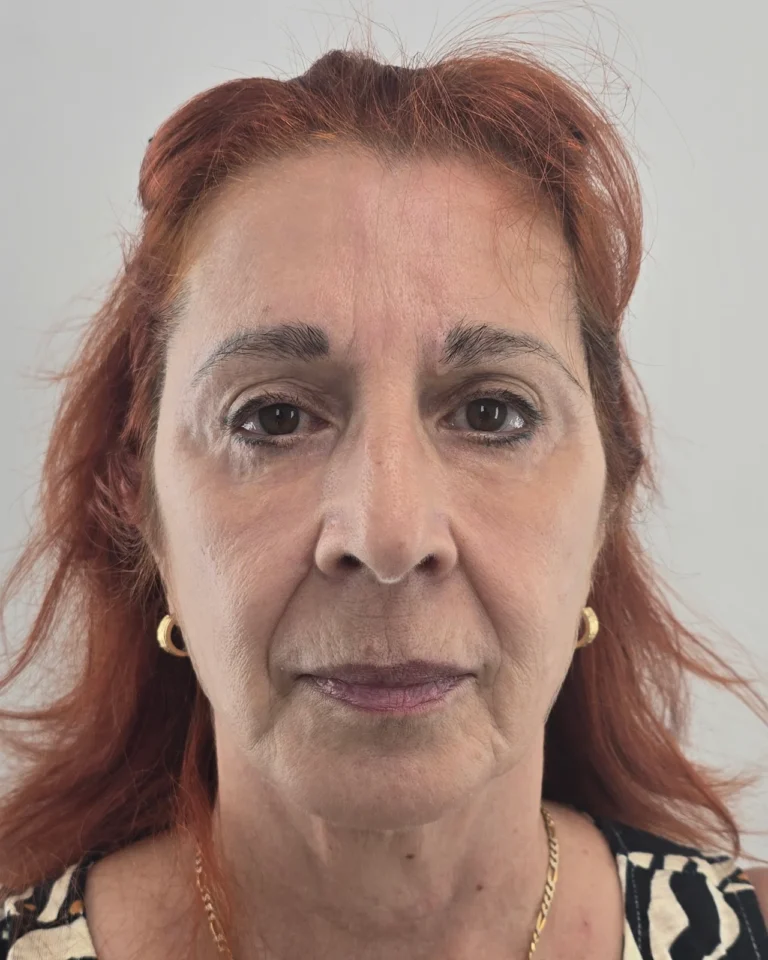
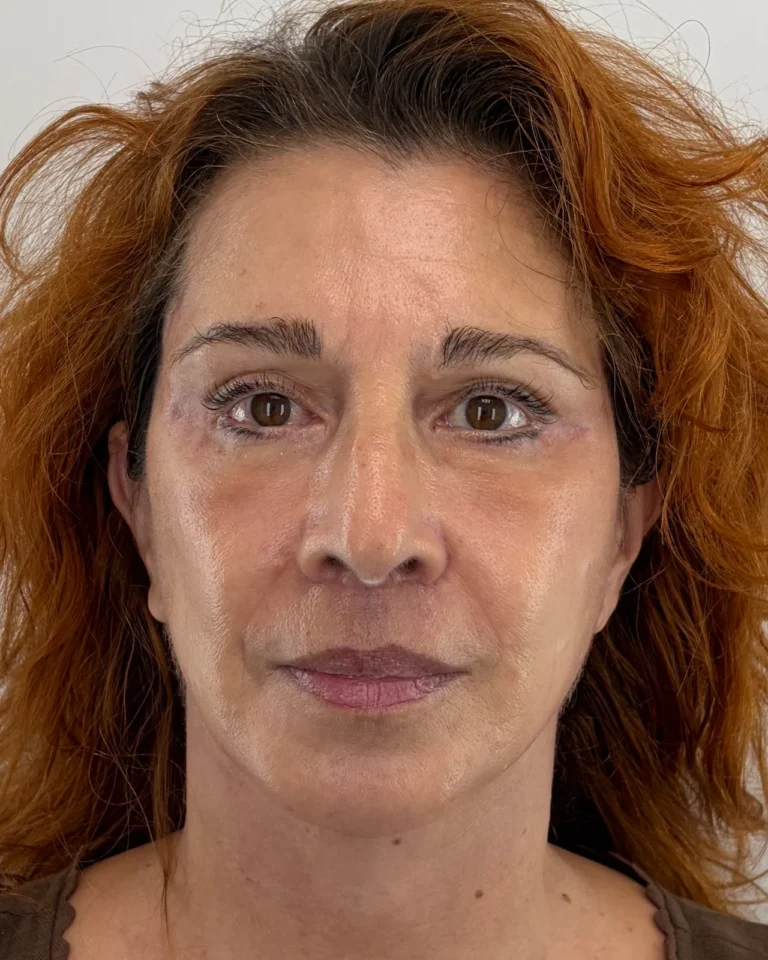
Face · Aesthetics
Facial Contouring in Thessaloniki and Athens, Greece
I perform 5 to 10 of each of these operations a year. Before I suggest anything, I look at the face as a whole (chin, cheekbones, nose and teeth), because a small change in one place alters the balance of the entire face.
Facial contouring changes the proportions of the face with targeted operations: a chin implant, cheek implants, chin reduction and buccal fat removal, with fat transfer where volume is needed. The incisions are made inside the mouth, so no scar is left on the skin of the face, and the implants are placed under local anaesthesia.
5–10
operations a year

At a glance
What it treats
Small or receding chin, large or protruding chin, flat cheekbones, full cheeks
Anaesthesia
Local for implants; local or sedation for buccal fat removal; general for chin reduction
Operating time
Chin implant about 20 minutes; the other operations up to 1 hour
Hospital stay
Usually none; you go home the same day
Back to work
10 to 15 days for office work; 3 to 4 weeks for manual work
Exercise
After 3 to 4 weeks, once cleared at your check-up
Final result
Cheeks: 1 to 3 months; implants and chin reduction: about 3 months
Where
Interbalkan Medical Center, Thessaloniki · Athens Medical Center, Marousi
Medically reviewed by Dr Prodromos Papaioannou, Plastic Surgeon, HESPRAS member, ASPS International Member · Last reviewed:
What is facial contouring?
Facial contouring is a group of operations that change the bony framework or the volume of the face at the chin, cheekbones and cheeks. I add projection with solid silicone implants, or reduce volume by burring the bone or removing fat. Incisions are made inside the mouth, so there is no scar on the skin.
Cheek and chin implants are usually ready-made, in solid silicone. In special cases I use other materials or custom-made implants.
For the chin, volume or projection can be reduced by burring the bone or by an osteotomy, again through incisions inside the mouth. In full cheeks, part of the buccal fat pad is removed.
These operations are often combined with each other, or with rhinoplasty or a facelift, because the chin and cheekbones set the proportions of the face. Where needed, I add fat transfer or nanofat.
Is facial contouring right for me?

It suits healthy adults whose facial growth is complete and who want more balanced proportions of the chin, cheekbones or cheeks. If the real problem is how the teeth meet (the bite), the answer may be orthognathic (jaw) surgery instead. Whether it suits you is decided at the examination.
Who is a good candidate?
- A small or receding chin, which makes the profile look weak and the nose look larger.
- A large or very prominent chin.
- Flat cheekbones, when the bony framework of the midface is weak.
- Full, round cheeks that come from the structure of the face, at a stable weight.
- Asymmetry of the chin or cheekbones.
- People having rhinoplasty who also want a balanced profile.
- Chin reduction as part of facial feminisation surgery (feminization).
When do I not recommend it?
- Before facial growth is complete (usually before 18).
- When a small or large chin comes with a significant problem in how the teeth meet; an orthodontist or jaw surgeon should assess this first.
- When there is active inflammation of the teeth, gums or mouth.
- For buccal fat removal, when the face is already thin or the fullness is due to body weight.
What happens at the consultation and how do I prepare?
At the consultation I examine your chin, cheekbones and cheeks from the front and side, together with their relationship to your nose and teeth, and take photographs. Preparation is simple: blood tests, healthy teeth and gums, no smoking for 4 weeks before and after, and a word with me about any blood thinners.
What happens at the consultation?
I examine the chin, cheekbones and cheeks from the front and in profile, together with their relationship to the nose and teeth, and photograph the face. I explain the choice between an implant and an osteotomy, and between cheek implants and a midface lift. You receive a written plan and cost.
What tests and instructions apply before surgery?
You will need blood tests and, where needed, a heart check; for chin reduction under general anaesthesia, an assessment by the anaesthetist as well. The incisions are inside the mouth, so your teeth and gums must be free of inflammation. Stop smoking 4 weeks before and after surgery. If you take blood thinners, tell me; only the doctor who prescribed them decides whether to stop them.
How is facial contouring surgery done?
Chin and cheek implants are placed under local anaesthesia (anesthesia), fat transfer is done under local anaesthesia or sedation, and chin reduction under general anaesthesia. Operating time ranges from 20 minutes to 1 hour. Incisions are inside the mouth and the stitches dissolve; fat transfer also needs a few tiny incisions on the skin.
Implants are usually ready-made, in solid silicone; in special cases I use another material or a custom shape. The table summarises the four operations.
| Operation | What it does | Incision | Anaesthesia | Operating time |
|---|---|---|---|---|
| Chin implant | Adds projection to a small or receding chin | Inside the mouth | Local | About 20 minutes |
| Cheek implants | Defines the cheekbones | Inside the mouth | Local | 45 minutes – 1 hour |
| Chin reduction | Reduces volume and projection by burring or osteotomy | Inside the mouth | General | About 1 hour |
| Fat transfer | Adds volume to the face in a natural way | With a cannula | Local or sedation | 45 minutes – 1 hour |
Chin implant (chin augmentation)
For a small or receding chin, I place a solid silicone implant through a small incision inside the mouth, in a pocket on the chin bone. The result is permanent and stable [1]. The operation takes about 20 minutes under local anaesthesia. I usually prefer an implant to an osteotomy (a genioplasty that moves the bone itself), because most patients prefer to avoid cutting the bone when it can be avoided [2]. A chin implant is often planned together with rhinoplasty, because the nose and chin shape the profile together; see the rhinoplasty page.
Cheek implants (cheek augmentation)
When the bony framework of the midface is weak, I place solid silicone implants, ready-made or custom-made, through an incision inside the mouth above the upper teeth [1]. The operation takes 45 minutes to 1 hour under local anaesthesia. Alternatively, the cheekbones can be enhanced with your own tissues through a midface lift; see the midface lift page.
Chin reduction
When the chin is large or very prominent, I reduce the volume and projection of the bone by burring or, when a bigger change is needed, by an osteotomy [2]. The incision is inside the mouth; the operation takes about 1 hour under general anaesthesia. The same technique is used in facial feminisation surgery; see the facial feminisation page.
Fat transfer to the face (fat grafting)
Fat transfer adds volume to areas of the face that have hollowed, or fills a deep, marked wrinkle so that it shows much less. The fat is taken by liposuction from another part of the body and injected through incisions a few millimetres long. The drawback is that an unpredictable part of the fat is absorbed by the body, so we cannot predict exactly how much correction will remain after 9 months [6]. For this reason I use it mainly as an addition to other operations, and it may need repeating.
Did you know? In many facial operations I add nanofat: fat from your own body, processed into a very fine graft, which improves the quality and texture of the skin [5]. I use it as an addition to the operation and rarely on its own, because the share of fat that survives is unpredictable.
Incisions and stitches
All incisions are inside the mouth, so no scar is left on the skin of the face. The stitches dissolve and do not need removing. In fat transfer, the harvesting and injection incisions are made with a cannula and are hard to see from the first day.
Combinations
A chin implant is often combined with rhinoplasty, and cheek implants or buccal fat removal with a facelift or eyelid surgery (blepharoplasty). Fat transfer and nanofat complement many facial operations. For thin lips there is a surgical option; see the lip lift page.
Hospital stay
You do not need to stay in hospital for implants or buccal fat removal; you go home the same day. After chin reduction under general anaesthesia, most patients also go home the same day. After sedation or general anaesthesia you must not drive that day and you need someone to accompany you.
How long is recovery after facial contouring?
Most people return to office work 10 to 15 days after facial contouring, once the swelling has settled, and to manual work after 3 to 4 weeks. The incisions are inside the mouth and the stitches dissolve. For the first few days you eat liquids and soft food and take particular care with mouth hygiene.
| When | How you feel | What you can do |
|---|---|---|
| Days 1–3 | Swelling and tightness; mild pain controlled with ordinary painkillers | Liquids and soft food; mouthwash after meals; cold compresses; sleep with your head raised |
| Days 4–10 | Swelling settles gradually; there may be bruising | Soft food, no hard chewing; gentle walking |
| Days 10–15 | Most of the swelling has gone | Back to office work |
| Weeks 3–4 | Sensation almost normal | Manual work and a gradual return to exercise, once cleared at your check-up |
| About 1 month | The result in the cheeks (buccal fat) is visible; final within about 3 months | Normal activity |
| About 3 months | The last swelling around the implants settles | Final assessment of the implants |
| About 9 months | The correction from fat transfer can be judged | We decide whether a second session is needed |
How long do I need to stay in Greece after facial contouring?
Plan to stay in Greece for 5 to 10 days after facial contouring. Implants and buccal fat removal need no hospital stay, so you leave the hospital the same day; after chin reduction under general anaesthesia, most patients also go home the same day.
After sedation or general anaesthesia you cannot drive that day, so someone should collect you from the hospital. The stitches inside the mouth dissolve on their own, so there is no appointment to remove them. The swelling settles over 10 to 15 days, which is also when most people go back to office work.
You can fly home from day 5, after your final check the day before the flight. Your check-ups after you leave Greece are by video call at 10 days, 1 month, 6 months and 1 year, and clearance to return to exercise at 3 to 4 weeks is given at a check-up.
Before you travel, arrange things at home for the first days: liquids and soft food, mouthwash for use after meals, cold compresses, and pillows to sleep with your head raised. If you take blood thinners, speak to the doctor who prescribes them well before your trip, and stop smoking 4 weeks before and after surgery.
How long do the results of facial contouring last?
Chin and cheek implants and chin reduction give a stable, lasting result. The effect of buccal fat removal is visible at about 1 month and final within about 3 months. With fat transfer, part of the fat is absorbed unpredictably, so the result is judged at 9 months. Your face will keep ageing naturally around any implant.
Facial silicone implants have no set replacement date; they are removed or changed only if a problem arises or if you want a different size. The face, however, keeps ageing, and over the years you may need a facelift or another operation for loose skin. Fat transfer is not permanent in the same way, because the fat that survives follows changes in your weight.
What are the risks of facial contouring?
Complications are few, but they exist: implant shift or infection, numbness, asymmetry and, with buccal fat removal, injury to a nerve. Swelling and bruising are common and temporary. I explain your own risk at the consultation; the table shows how often each complication occurs and how it is prevented and treated.
| Complication | How common | Prevention and treatment |
|---|---|---|
| Swelling and bruising | Common, temporary | Cold compresses and head raised; settle in 10 to 15 days |
| Numbness of the lower lip or chin | Rare, usually temporary | Careful handling of the nerve; sensation returns within weeks to months |
| Numbness of the cheek or upper lip (cheek implants) | Rare, usually temporary | Careful placement of the implant; sensation returns within weeks to months |
| Implant shift | Very rare | A pocket of the right size; corrected by repositioning |
| Implant infection | Very rare | Antibiotics and good mouth hygiene; with persistent infection the implant is removed |
| Asymmetry | Very rare | Careful planning; corrected with a minor procedure |
| Injury to a branch of the facial nerve (buccal fat removal) | Very rare | A careful anatomical approach |
| Too little or uneven correction (fat transfer) | Not rare, as absorption cannot be predicted | A second session, after the result is judged at 9 months |
Smoking. Stop for at least 4 weeks before and 4 weeks after surgery. Smoking raises the risk of infection, slows the healing of the incisions inside the mouth and lowers the success of fat transfer.
Blood thinners. Tell me if you take anticoagulants or antiplatelet medicines. Stopping them is always agreed with the doctor who prescribes them.
How much does facial contouring cost?
The cost of facial contouring differs from person to person, depending on the operation or combination of operations, the type of implant and the anaesthesia. Prices are not published: you receive a written quote after the consultation, once I have examined you and we have agreed together on the plan that suits you.
- Which operation is done, and in how many areas.
- The type of implant: ready-made or custom-made.
- The anaesthesia: local, sedation or general.
- Combination with another operation, such as rhinoplasty or a facelift.
- Adding fat transfer or nanofat.
Frequently asked questions
Will chin or cheek implants leave a visible scar?
No scar is left on the skin of the face. All incisions for chin and cheek implants, chin reduction and buccal fat removal are made inside the mouth, in its lining. The stitches dissolve on their own and do not need removing. An incision inside the mouth heals quickly and, once healed, is hard to find even when someone looks for it. For the first few days you take particular care with mouth hygiene so that it heals well. If fat transfer is added, the harvesting and injection incisions are only a few millimetres long.
Chin implant or genioplasty: which is better?
Both correct a small or receding chin; they differ in their complications and in how predictably the soft tissues follow the change [2]. A solid silicone implant is placed in about 20 minutes under local anaesthesia, through the mouth, and gives a permanent result. An osteotomy (genioplasty) moves the chin bone itself and is a bigger operation. I usually choose an implant, because most patients prefer to avoid cutting the bone when it can be avoided. The final choice is made at the consultation, depending on how much change is needed and on how your teeth meet.
Is chin implant surgery painful?
The pain is usually mild and controlled with ordinary painkillers. For the first few days you mainly feel tightness and swelling in the chin or cheeks, and hard chewing is difficult, so you eat liquids and soft food. Cold compresses and sleeping with your head raised help the swelling settle faster. Chin reduction, which is done under general anaesthesia and works on the bone, may be a little more uncomfortable than an implant. Most people return to office work in 10 to 15 days.
Are chin and cheek implants permanent?
Yes. Solid silicone implants are not absorbed and give a permanent, stable result. Unlike some other implants, they have no set replacement date; they are removed or changed only if a problem arises, such as shifting or infection, which are very rare, or if you later want a different size. The face around them keeps ageing naturally, so over the years you may need another operation for loose skin, such as a facelift.
Can a large chin be made smaller?
Yes. When the chin is large or very prominent, its volume and projection can be reduced either by burring the bone or by osteotomies. The operation is done through incisions inside the mouth, takes about 1 hour under general anaesthesia and gives a very good result. Burring is enough for smaller corrections; an osteotomy is used when a bigger change is needed. The same technique is part of facial feminisation surgery; see the facial feminisation page.
How long does fat transfer to the face last?
The fat that survives in its new place stays, but part of it is absorbed by the body, and how much cannot be predicted exactly. For this reason the correction that remains is judged after about 9 months, and a second session may be needed. The fat is taken by liposuction from another part of your body, so there is no risk of rejection. In facial operations I use fat transfer and nanofat mainly as an addition, for volume and for better skin quality.
Can I have a chin implant at the same time as rhinoplasty?
Yes, and I often suggest it. The nose and chin shape the profile together: a small chin makes the nose look larger, even when it is not. When we plan them together, the change is more balanced and you recover only once. The implant adds about 20 minutes to the operation and is placed through an incision inside the mouth, with no scar on the skin. We look at this at the consultation, using photographs in profile; see also the rhinoplasty page.
When can I fly home after facial contouring?
You can usually fly home from day 5. Implants and buccal fat removal need no hospital stay, and after chin reduction under general anaesthesia most patients also go home the same day. The stitches are inside the mouth and dissolve on their own, so you do not need to wait for a removal appointment. Swelling settles over 10 to 15 days, so allow for some swelling while you travel, and keep to soft food, mouthwash after meals and cold compresses during the first days.
Can my follow-up be done at home?
Yes. After you return home, follow-up is by video call at 10 days, 1 month, 6 months and 1 year. Because the stitches dissolve, no visit is needed to remove them. The main milestones are return to office work at 10 to 15 days, clearance to exercise at a check-up at 3 to 4 weeks, final assessment of implants at about 3 months and, after fat transfer, judging the correction at about 9 months. Once home, message the practice on WhatsApp and you receive a reply the same day; in an emergency, call us, and for an acute problem go to the nearest hospital emergency department.
References
- Oliver JD, Eells AC, Saba ES, et al. Alloplastic facial implants: a systematic review and meta-analysis on outcomes and uses in aesthetic and reconstructive plastic surgery. Aesthetic Plast Surg. 2019;43(3):625–636. doi:10.1007/s00266-019-01370-0
- Kauke-Navarro M, Knoedler L, Allam O, Heiland M, Knoedler S, Klimitz FJ, et al. Implant-based chin augmentation vs osseous genioplasty: a systematic review of indications and outcomes. Aesthet Surg J Open Forum. 2025;7:ojaf048. PMID: 40666078. doi:10.1093/asjof/ojaf048.
- Matarasso A. Managing the buccal fat pad. Aesthet Surg J. 2006;26(3):330–336.
- Matarasso A. Buccal fat pad excision: aesthetic improvement of the midface. Ann Plast Surg. 1991;26(5):413–418.
- Tonnard P, Verpaele A, Peeters G, et al. Nanofat grafting: basic research and clinical applications. Plast Reconstr Surg. 2013;132(4):1017–1026.
- Coleman SR. Structural fat grafting: more than a permanent filler. Plast Reconstr Surg. 2006;118(3 Suppl):108S–120S.
Consultation
In Thessaloniki, in Athens or by video. Examination, options and a written plan.