
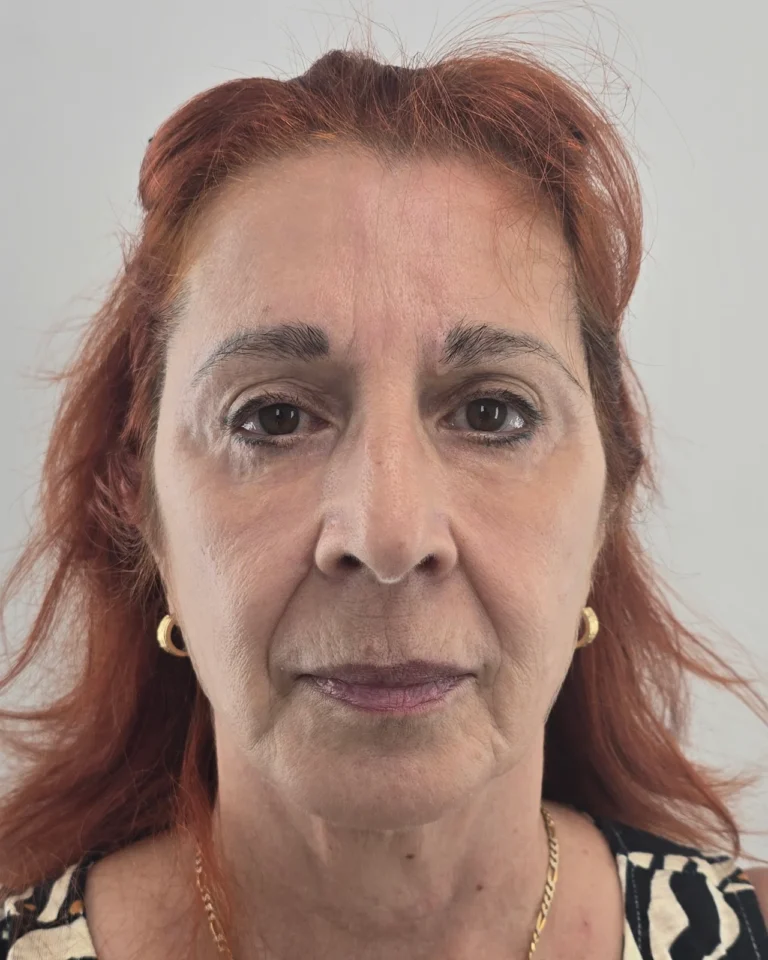
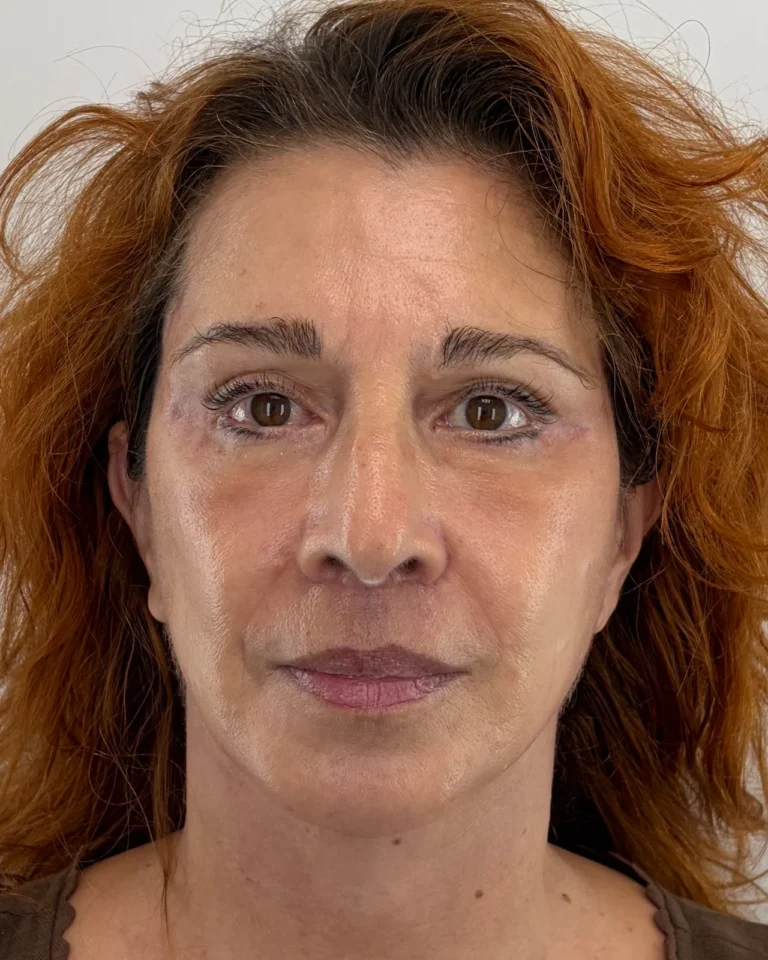
Face · Aesthetics
Buccal fat removal in Thessaloniki and Athens, Greece
I perform 5 to 10 buccal fat removals a year and have been a specialist plastic surgeon since 2012. I always remove only part of the fat pad, conservatively, and I select patients strictly, so that the face does not look hollow as the years go by.
Buccal fat removal takes out part of the buccal fat pad, which sits deep between the chewing muscles, through a small incision inside the mouth. It is for women and men whose cheeks are full because of the natural build of the face. The incision leaves no scar on the skin.
5–10
operations a year

At a glance
What it treats
Full, round cheeks due to the natural build of the face
Anaesthesia
Local anaesthesia or sedation
Duration
45 minutes to 1 hour
Hospital stay
A few hours; you go home the same day, with someone to accompany you
Back to work
Office work in 10–15 days · manual work in 3–4 weeks
Exercise
Light exercise after 2 weeks, strenuous exercise after 3–4 weeks
Final result
Gradually over 1 to 3 months, as the swelling settles
Where
Interbalkan Medical Center, Thessaloniki · Athens Medical Center, Marousi
Medically reviewed by Dr Prodromos Papaioannou, Plastic Surgeon, HESPRAS member, ASPS International Member · Last reviewed:
What is buccal fat removal?
Buccal fat removal (buccal fat pad removal) is a minor facial operation in which I remove part of the buccal fat pad through an incision inside the mouth. The aim is a slimmer look below the cheekbones. It does not involve any cut on the skin, and it is not a way to lose weight.
The buccal fat pad, also called Bichat’s fat pad, is an anatomical structure that lies very deep beneath the cheeks, between the chewing muscles [1, 2]. In some people it is naturally large and gives the face a round, “puffy” look even at a normal weight. Removing part of it makes the area below the cheekbones cleaner and gives the face more sculpted angles.
It is not a weight-loss method. It does not remove the fat under the skin of the face or neck, and it does not correct sagging. It is also different from facial liposuction, which suctions fat from under the skin with a cannula and does not reach the deep buccal fat.
Am I a good candidate for buccal fat removal?

Good candidates are healthy women and men whose cheeks are full because of the natural build of the face, not recent weight gain, with a stable weight and realistic expectations. The fat removed does not grow back, so in a thin or mature face I usually advise against it.
Who are typical candidates?
- Women and men with full, round cheeks because of the shape of their face, who want to change its proportions.
- People who want a slimmer line below the cheekbones and more defined angles in the face.
- People whose weight is stable and whose cheeks stay full despite a normal weight.
- People planning to improve the contour of the face, for example with a chin or cheek implant, who want a more balanced result.
When do I not recommend it?
- During pregnancy or while you are dieting: it is best to wait until your weight is stable before going ahead.
- When the fullness of the cheeks is due to recent weight gain.
- In a thin face with cheeks that are already hollow, where removal would make the face look tired or older.
- In a mature face with sagging, where volume needs to be kept; there we discuss other options, such as a facelift.
- When there is an active infection of the mouth, teeth or gums, until it has been treated.
What happens at the consultation and how do I prepare?
At the consultation I examine your face and decide with you whether removal, another procedure or a combination suits you; you leave with a written plan and cost. Before surgery you need blood tests, healthy teeth and gums, no smoking for 4 weeks before and after, and a review of any blood thinners.
What happens at the consultation?
I examine your face from the front and in profile, looking at the shape of the cheeks, the amount of fat and the cheekbones. I ask about any recent change in weight, dieting or plans for pregnancy. We talk about exactly what bothers you and how your face will look in 10 or 20 years, because the face naturally loses volume with age. We decide together whether you need removal, a different procedure or a combination. You receive a written plan and cost.
What tests and instructions apply before surgery?
You need pre-operative blood tests and, where needed, a cardiac check. If you have a problem with your teeth or gums, it is best treated before the operation. You stop smoking at least 4 weeks before and 4 weeks after. If you take anticoagulants or antiplatelet medicines, let me know; they are only stopped in agreement with the doctor who prescribes them. The date is set after the examination.
How is buccal fat removal performed?
Buccal fat removal is done under local anaesthesia or sedation and takes 45 minutes to 1 hour. Through a small incision inside the mouth I remove part of the fat pad, which lies very deep beneath the cheeks. No visible scar is left on the face, and you go home the same day, after a few hours.
The incision is made in the lining of the mouth, on the inside of the cheek. Through it I reach the fat pad, between the chewing muscles, and with gentle handling remove only the part that protrudes. The area is rich in blood vessels and nerves, and branches of the facial nerve and the parotid duct, which drains the salivary gland, run close by. This is why the operation calls for skill and experience from the plastic surgeon [2, 3].
How much fat is removed?
The amount is judged for each face individually. I take a relatively conservative approach and remove only part of the fat pad, because the face naturally loses volume over the years. Over-removal may look good at 25 but can make the face look hollow and aged (gaunt) later on [5]. Conservative removal and strict patient selection are how this is avoided.
Incisions and stitches
The incision is intraoral, inside the mouth, so there is no visible scar on the face. It is closed with stitches that dissolve quickly and easily, with no need to remove them.
Can it be combined with other procedures?
Buccal fat removal can be combined with other procedures that shape the face, such as a chin or cheek implant, for a more balanced result. See the facial contouring page. If a combination suits you, we discuss it at the consultation.
Hospital stay
Your stay is no more than a few hours. You go home the same day, with someone to accompany you. After sedation you must not drive on the same day.
What is recovery like after buccal fat removal?
Recovery is smooth and mild. For the first few days you eat only liquids and soft foods, so the area is not put under pressure. Swelling usually lasts 10 to 15 days, when you can return to office work; manual work follows in 3 to 4 weeks. The new look is visible at about 1 month, and the final result within about 3 months.
The stitches are inside the mouth and dissolve. Discomfort is usually mild and controlled with ordinary painkillers. Cold compresses and sleeping with your head raised for the first few days help the swelling go down. Everyday activities are not restricted.
| When | How you feel | What you can do |
|---|---|---|
| Days 1–3 | Swollen cheeks, mild discomfort, perhaps some difficulty opening the mouth | Liquids and soft foods only; cold compresses, head raised, rinse your mouth after eating |
| Days 4–10 | The swelling goes down gradually and generally does not noticeably distort the face | Soft foods; everyday activities and walking |
| Days 10–15 | In most cases the swelling has settled | Office work; gradual return to a normal diet |
| Weeks 3–4 | Almost normal sensation | Manual work; strenuous exercise |
| About 1 month | The angles of the face look natural, as if they had always been there | Normal activity |
How long do I need to stay in Greece after buccal fat removal?
Buccal fat removal is a day procedure: you go home a few hours after the operation, with someone to accompany you, and you must not drive that day after sedation. Plan to stay in Greece for 5 to 10 days in total before flying home.
Hospital: no overnight stay. You leave the hospital the same day, a few hours after surgery.
Flying: from day 5, with no limit on flight length.
Stitches: the stitches are inside the mouth and dissolve on their own, so there is no appointment to have them removed.
Check-up before you leave: at the practice, the day before your flight.
Follow-up from home: by video call at 10 days, 1 month, 6 months and 1 year.
At home, have liquids and soft foods ready for the first few days, cold compresses, and an extra pillow so you can sleep with your head raised. Rinse your mouth after every meal. Office work, including working remotely, can usually resume within 10 to 15 days, once the swelling has settled; manual work in 3 to 4 weeks.
What results can I expect, and how long do they last?
The change shows from the start and becomes clearer as the swelling goes down. At about 1 month the change in your face is visible and the angles look natural; the final result settles within about 3 months. The result is permanent, because the fat removed does not grow back, but your face will keep changing with age.
The buccal fat pad is an anatomical structure that cannot reappear once it has been removed. Removal does not stop natural ageing, though: over the years the face loses volume, which is why I remove fat conservatively. A large gain or loss of weight can also change how the cheeks look. If volume is needed in the area later, the result can be partly reversed with fat transfer (micro fat).
What are the risks of buccal fat removal?
Buccal fat removal is a minor operation, but it is performed in an area with many blood vessels and nerves. Asymmetry and injury to a branch of the facial nerve are very rare. The most important long-term risk is a hollow face in later years, which is avoided by conservative removal and strict patient selection.
| Complication | How common | Prevention and management |
|---|---|---|
| Swelling and bruising | Common, temporary | Cold compresses, head raised; usually settles in 10–15 days |
| Difficulty opening the mouth | Not uncommon, temporary | Liquids and soft foods; settles within a few days |
| Haematoma (hematoma) | Rare | Review of medicines that affect clotting; if it occurs, it is drained |
| Infection | Rare | Good oral hygiene and rinsing after meals; treated with antibiotics |
| Asymmetry | Very rare | Careful assessment of the amount on each side; corrected with a minor procedure or fat transfer |
| Injury to a branch of the facial nerve | Very rare | Knowledge of the anatomy and careful handling; usually recovers gradually |
| Injury to the parotid duct | Rare | Knowledge of the anatomy; needs specific treatment, often surgical |
| Hollow face over the years | Rare, with correct patient selection | Conservative removal of only part of the fat pad; corrected with fat transfer (micro fat) |
Smoking. Stop at least 4 weeks before and 4 weeks after the operation; smoking delays healing of the incision inside the mouth and increases the risk of infection.
Anticoagulants and antiplatelet medicines: let me know before the operation. Stop them only with the agreement of the doctor who prescribed them.
What affects the cost of buccal fat removal?
We do not publish prices. The cost depends on the anaesthesia, the hospital and whether buccal fat removal is combined with another procedure, such as a chin or cheek implant. You receive a written quote after the consultation and your examination, so you know what is included before you decide.
- The anaesthesia: local or sedation.
- Post-operative check-ups and medicines.
Frequently asked questions
How long does swelling last after buccal fat removal?
Swelling usually lasts 10 to 15 days and is strongest in the first 2 to 3 days. Cold compresses, sleeping with your head raised and eating soft foods all help it settle. The new shape of your face is visible at about 1 month and final within about 3 months, while office work can usually be resumed within 10 to 15 days, once most of the swelling has gone down.
Will buccal fat removal make my face look older later on?
The risk exists, and it is the most important one with this operation. I keep it low by removing only part of the fat pad and by selecting patients strictly. The face loses volume with age; in a thin face, or one that is already losing volume, removal can lead to a hollow, tired (gaunt) look. In those cases I do not recommend the operation, and we discuss whether another approach suits you better.
Is buccal fat removal permanent?
Yes, the result is permanent: the fat that is removed does not come back, which is why the decision needs to be made carefully. Your face will still change with age and with changes in weight. If volume is needed again in the future, the result can be partly reversed with fat transfer (micro fat), using your own fat to restore fullness in the cheeks.
Does buccal fat removal leave a scar?
No. The incision is made inside the mouth, on the inside of the cheek, so there is no visible scar on the skin of the face. It is closed with stitches that dissolve quickly and do not need to be removed. For the first few days you may feel the stitches with your tongue, which is normal. Rinse your mouth after every meal so the incision stays clean and heals without problems.
Is buccal fat removal painful?
You feel no pain during the operation, because it is done under local anaesthesia or sedation. Afterwards the discomfort is usually mild, more a feeling of pressure and swelling in the cheeks than pain, and it is controlled with ordinary painkillers. For the first few days you may find it a little hard to open your mouth and chew, so you eat only liquids and soft foods to avoid pressure on the treated area. The discomfort fades as the swelling goes down.
When can I go back to work after buccal fat removal?
It depends on your job. You usually return to office work in 10 to 15 days, once the swelling has gone down. The operation does not stop your everyday activities, and you can work from home sooner if you wish. For manual work, or a job with heavy physical strain, you return in 3 to 4 weeks. At your check-up after the operation I give you personal instructions.
Can men have buccal fat removal?
Yes. Buccal fat removal is not limited to women. Many men with a round face and cheeks that are full because of the natural build of the face want a slimmer line below the cheekbones and a more defined contour. The criteria are the same: a stable weight, full cheeks that are not due to recent weight gain, and a face that will not look hollow over the years. Where needed, it can be combined with a chin implant for a more balanced result.
When can I fly home after buccal fat removal?
You leave the hospital a few hours after the operation, on the same day, and you must not drive that day after sedation. You can usually fly home from day 5. The stitches are inside the mouth and dissolve on their own, so you do not need to wait in Greece for them to be removed. Before you leave, I see you at the practice the day before your flight. On the flight, carry liquids or soft food and rinse your mouth after eating.
Can my follow-up be done at home?
Yes, in large part. The stitches dissolve on their own, so no visit is needed to remove them. After you return home, follow-up is by video call at 10 days, 1 month, 6 months and 1 year. You can send photos so I can see how the swelling is settling and how the incision inside the mouth is healing. If anything concerns you, such as more swelling on one side, fever or increasing pain, contact me straight away and we arrange the next step together.
References
- Stuzin JM, Wagstrom L, Kawamoto HK, et al. The anatomy and clinical applications of the buccal fat pad. Plast Reconstr Surg. 1990;85(1):29–37.
- Zhang HM, Yan YP, Qi KM, et al. Anatomical structure of the buccal fat pad and its clinical adaptations. Plast Reconstr Surg. 2002;109(7):2509–2518.
- Matarasso A. Buccal fat pad excision: aesthetic improvement of the midface. Ann Plast Surg. 1991;26(5):413–418.
- Matarasso A. Managing the buccal fat pad. Aesthet Surg J. 2006;26(3):330–336.
- Benjamin M, Reish RG. Buccal fat pad excision: proceed with caution. Plast Reconstr Surg Glob Open. 2018;6(10):e1970.
- Moura LB, Spin JR, Spin-Neto R, et al. Buccal fat pad removal to improve facial aesthetics: an established technique? Med Oral Patol Oral Cir Bucal. 2018;23(4):e478–e484.
Consultation
In Thessaloniki, in Athens or by video. Examination, options and a written plan.