









Breast
Breast lift in Thessaloniki and Athens, Greece
I have been a plastic surgeon since 2012 and I perform 20 to 30 breast lifts a year. I choose the technique according to how far the nipple has dropped, so that the scar is the shortest each case allows.
A breast lift raises the breast and nipple to a higher position and removes excess skin after pregnancy, breastfeeding, weight loss or with age. It does not add volume; when volume is needed, it is combined with an implant. There is no overnight hospital stay: you go home the same day.
20–30
operations a year

At a glance
What it treats
A dropped nipple, loose skin and loss of breast support
Anaesthesia
General; local only for the periareolar lift
Duration
About 1.5 hours; up to 2.5 hours with an implant
Hospital stay
None; you go home the same day, with someone to accompany you
Back to work
About 5 days for desk work
Exercise
After 4 to 6 weeks
Final result
Final shape at about 6 months
Where
Interbalkan Medical Center, Thessaloniki · Athens Medical Center, Marousi (Athens)
Medically reviewed by Dr Prodromos Papaioannou, Plastic Surgeon, HESPRAS member, ASPS International Member · Last reviewed:
What is a breast lift (mastopexy)?
A breast lift (mastopexy) brings the breast and nipple back to a higher position. It removes excess skin, supports the breast gland from inside and, when needed, makes the areola smaller. It does not add volume; if the breast has emptied, the lift is combined with an implant or fat transfer.
Breast sagging (ptosis) progresses over the years and appears earlier because of the anatomy of the breast or large changes in breast size, as in pregnancy and breastfeeding. Often the two breasts have not dropped equally, so there is also asymmetry.
Sagging has three causes, which often occur together: volume loss in the upper pole (pseudoptosis), loose skin with stretch marks and excess skin, and loss of support of the gland. A lift deals with the skin and the support; volume is added with an implant.
The degree of sagging is judged by the position of the nipple relative to the inframammary fold (the crease under the breast), using the Regnault classification, and it largely decides the technique:
| Grade | Nipple position | What it means |
|---|---|---|
| I (mild) | Above the inframammary fold | Mild sagging; an implant or a periareolar lift is often enough |
| II (moderate) | Level with the inframammary fold | Moderate laxity with volume loss in the upper pole |
| III (severe) | Below the inframammary fold | The whole nipple complex has dropped below the fold; a lift is needed |
| IV (very severe) | Below the fold, at the lowest point of the breast | Most of the breast lies below the fold |
Am I a good candidate for a breast lift?

A breast lift suits healthy adults with a stable weight whose nipple has dropped close to or below the inframammary fold, or whose skin has loosened after pregnancy, breastfeeding or weight loss. In mild sagging, an implant alone may be enough. Whether a lift suits you is always decided at the examination.
Who are typical candidates?
- Sagging after pregnancy and breastfeeding.
- Sagging after weight loss.
- Early sagging caused by the weight of a large breast.
- Breast asymmetry or breast deformities.
- A very large areola.
- Making the breasts symmetrical after a mastectomy on one side.
When do I not recommend it?
- During pregnancy or breastfeeding, and less than 6 months afterwards; ideally we wait 12 months.
- When your weight has not settled or you are planning to lose a lot of weight.
- In heavy smokers, unless they stop smoking 4 weeks before and 4 weeks after the operation.
- When the sagging is mild and an implant alone gives a good result without the scars of a lift.
- When you are planning another pregnancy soon; we discuss this, because it may change the result.
Is an implant enough, or do I need a lift?
Many women come to the consultation asking for breast surgery in general. Even with fairly large breasts, the main problem is often volume loss in the upper pole and the décolletage. In mild or moderate sagging we can often achieve a satisfactory lift with an implant alone, with no extra scar. In grade 3 and 4 sagging, where the nipple and the gland lie below the inframammary fold, a lift is needed. The difficulty lies in the in-between cases, for example after pregnancies, when a once full breast has shrunk but the tissue quality is good. There, experience decides whether an implant is enough; when we can achieve a good result without the scars of a lift, that is always the ideal. For augmentation with implants, see the breast augmentation page.
What happens at the consultation, and how do I prepare?
At the consultation I examine your breasts, assess the degree of sagging and agree with you whether a lift alone is enough or should be combined with an implant, fat or a reduction. You leave with a written plan and quote. Before surgery you need blood tests and a check for general anaesthesia.
What happens at the consultation?
I examine the position of the nipple, the quality of the skin, the volume of the gland and the symmetry of the two breasts. I measure the distance from the nipple to the inframammary fold and assess the degree of sagging. We discuss your goal and any future pregnancy or breastfeeding, and decide together whether a lift alone is enough or whether it should be combined with an implant, fat or a reduction, which incision suits you and what scars to expect. You receive a written plan and quote.
What tests and instructions apply before surgery?
You need pre-operative blood tests and a check for general anaesthesia. Smoking directly affects the blood supply to the nipple and the incisions: for a breast lift I do not operate on heavy smokers unless they stop 4 weeks before and 4 weeks after. If you take anticoagulants or antiplatelet medicines, let me know; they are stopped only in agreement with the doctor who prescribes them. The date of surgery is set once the tests are complete.
How is a breast lift performed?
A breast lift is usually performed under general anaesthesia and takes about 1.5 hours, or up to 2.5 hours when combined with an implant. The incision is chosen according to the degree of sagging and the excess skin, and the gland is supported from inside, so that the result does not rely on the skin alone.
All lifts are performed under general anaesthesia, except the periareolar lift, which can also be done under local anaesthesia. Each technique is chosen with one aim: adequate correction of the sagging with the shortest possible scar. Because some loosening inevitably occurs in the first months, I always slightly overcorrect.
Periareolar lift
This is chosen for mild to moderate sagging, with an incision around the nipple. The whole breast is mobilised and its projection is moved upwards with special stitches. I then use a special Gore-Tex suture, which provides the support for a long-lasting result. It is preferable when augmentation is done at the same time. It does, however, have limits: mechanically it cannot hold much weight, and in unsuitable cases it can lead to enlargement of the areola or widening of the scar. For this reason I prefer it only when a small degree of lift is needed. It can also be done under local anaesthesia.
Vertical (lollipop) incision and the Lejour technique
When the sagging is more marked, the incision around the nipple is not enough and is extended downwards with a vertical scar, which in the end looks like a lollipop. The method combines the periareolar lift with tightening of the central and lower pole of the breast. When more skin has to be removed, the vertical scar is extended further down with the Lejour technique, a different but equally effective option. The vertical incision also suits augmentation mastopexy.
Keyhole and T (anchor) incision
In the keyhole pattern, the incision goes around the nipple and runs downwards in an inverted T. When there is more excess skin, the T or anchor incision (Wise pattern) extends further to the left and right, within the inframammary fold, as in a breast reduction. The choice depends on how we will manage the excess skin and on the position of the nipple relative to the fold.
Internal support of the gland and biocompatible mesh
The techniques above mainly decide the shape of the scars. Sagging, however, affects not only the skin but mainly the deeper tissues; if a lift relied on the skin alone, the result would be poor within a few months. That is why I fix the breast gland in a higher position on the chest wall and support it from inside: by folding the central part of the gland upwards, by removing part of the gland, or with an internal bra-type support (inner bra).
In selected cases I reinforce the support with a biocompatible mesh, which holds the gland in its new position and helps the result last. The use of mesh is discussed at the consultation, depending on the quality of your tissues.
Augmentation mastopexy: a lift with an implant
In every lift I assess how much volume the upper pole has lost and whether it needs to be restored. In augmentation mastopexy we do not necessarily aim for a large increase: I use fairly small, lower-profile implants, mainly to restore the upper pole and the décolletage. I can also remove part of the gland in the lower pole, where the sagging is greatest, so that the shape and the distribution of weight change completely. A major advantage is that the result lasts longer than a lift without an implant. When an implant is not wanted or not possible, I can transfer fat to the upper pole in the same operation, with a similar but less predictable result. For implants, see also the breast augmentation page.
Incisions and stitches
The scar follows the technique: around the nipple in the periareolar lift; around the nipple and vertically down to the fold in the lollipop and Lejour techniques; and also within the inframammary fold in the T incision. No drains are placed. The stitches are internal and dissolve on their own, so they do not need to be removed.
Combinations
A lift is often combined with an implant (augmentation mastopexy) or with fat transfer. In a large breast with marked sagging, the lift is done together with a breast reduction, so that the breast becomes lighter, for functional and aesthetic reasons; this is done with a T incision or the Lejour technique, depending on how much skin is left over.
Hospital stay
No hospital stay is needed. You go home the same day, with someone to accompany you, wearing an elastic bandage or the special post-operative bra. You must not drive after general anaesthesia.
What is recovery like after a breast lift?
After a breast lift, pain is minimal, except in augmentation mastopexy, where there may be some pain for 3 to 4 days. You can return to desk work in about 5 days and to exercise in 4 to 6 weeks. The final shape develops over about 6 months, and the scars keep maturing up to a year.
| When | How you feel | What you can do |
|---|---|---|
| Days 1–4 | Almost no pain; with augmentation mastopexy, some pain for 3–4 days | Elastic bandage or special bra; walking at home; no lifting |
| Day 5 | Mild tenderness and swelling | Back to desk work |
| Weeks 2–4 | Swelling settles; the breast looks deliberately higher (overcorrection) | Daily activities; no exercise or heavy lifting |
| Weeks 4–6 | Almost normal feeling | Gradual return to exercise, with a good sports bra |
| Months 1–2 | The scars turn red and thicken slightly | Normal activity; scar care following my instructions |
| Months 4–6 | The scars fade considerably; the breast takes its final shape | Final assessment of the result at your check-up |
| Month 12 | The scars mature; in some places they are barely visible | Normal life |
How long do I need to stay in Greece after a breast lift?
A breast lift needs no overnight hospital stay: you go home the same day. Plan to stay in Greece for about 5 to 10 days, so that I can check the breasts before you fly. There are no stitches to remove, because they are internal and dissolve on their own.
What to plan for your stay:
- Hospital: no nights in hospital. You leave on the day of surgery with someone to accompany you, wearing an elastic bandage or the special post-operative bra. You must not drive after general anaesthesia, so arrange a transfer to your hotel or flat.
- First days: there is almost no pain, except after augmentation mastopexy, where there may be some pain for 3 to 4 days. You walk around at home and avoid lifting.
- Check-up before you fly: at the practice, the day before your flight.
- Flying home: from day 5, with no limit on flight length.
- Stitches and drains: no drains are placed, and the internal stitches do not need to be removed, so there is nothing to take out before you leave.
- Follow-up from home: by video call at 10 days, 1 month, 6 months and 1 year.
- At home: about 5 days off desk work, no exercise or heavy lifting for 4 to 6 weeks, and a good sports bra when you start exercising again.
What results can I expect, and how long do they last?
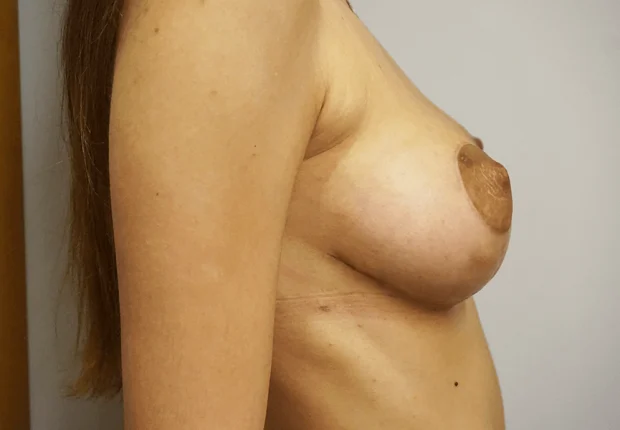
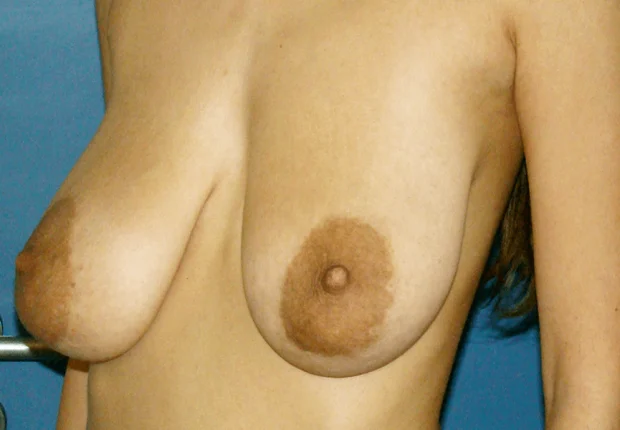
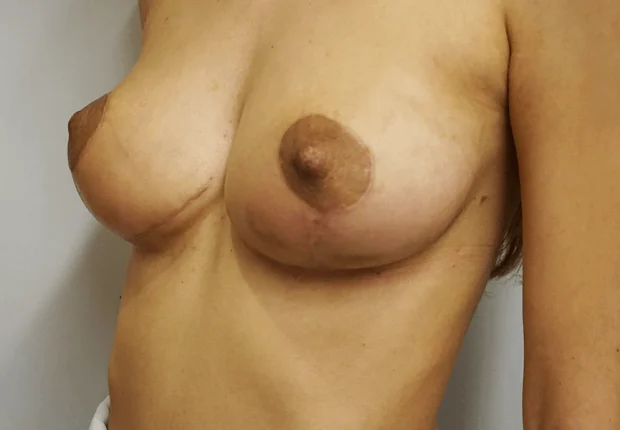
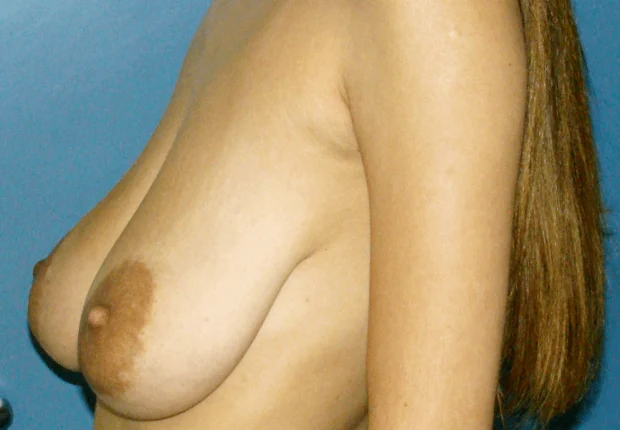
The final shape after a breast lift develops over about 6 months. The result is long-lasting, not permanent: the breast keeps changing with weight, age and any new pregnancy. With augmentation mastopexy the change is more visible and the result lasts longer, because the implant also restores the upper pole.
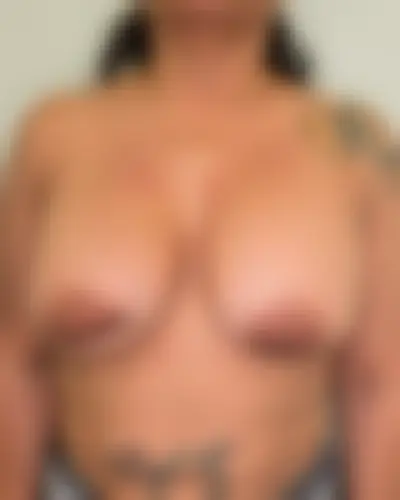
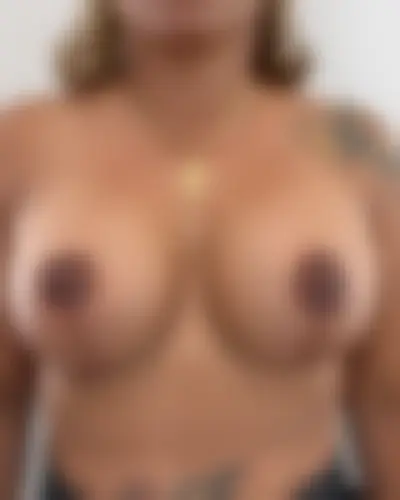
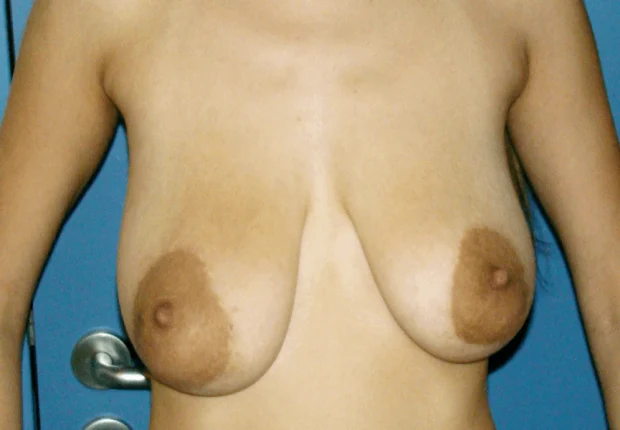 Before
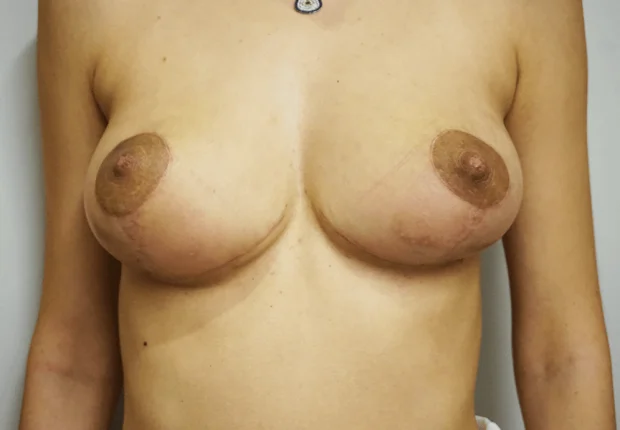 After
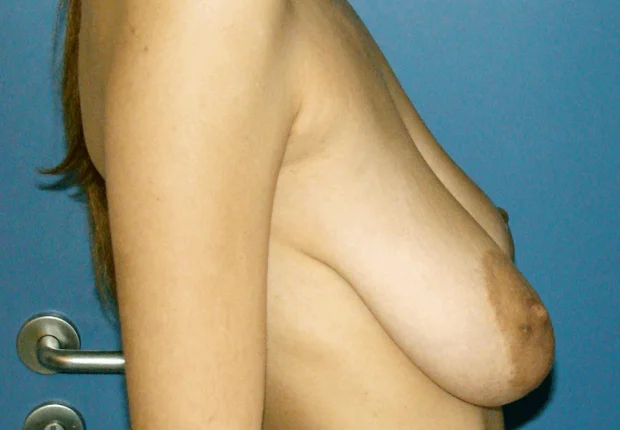 Before
 After
 Before
 After
 Before
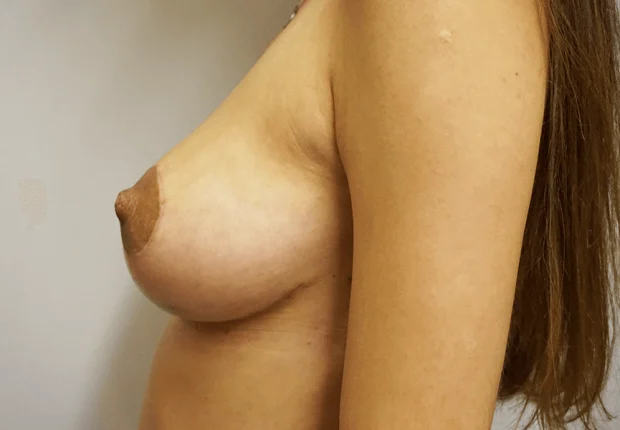 After
These photos include nudity.
Breast lift
Woman, 28 · 6 months after
Front
Results vary from patient to patient.
Because some loosening inevitably occurs over time, I always overcorrect, so that after six months the result is satisfying and natural. Without an implant, your bra size stays the same, but the breast stays firm, even without a bra. With augmentation mastopexy, especially after major weight loss, the implant fills the upper pole and improves shape and size, while the lift corrects the loose skin, the nipples and the gland. Sagging may partly return over time, especially after large weight changes or a new pregnancy.
What are the risks of a breast lift?
A breast lift is a common operation, but like any operation it carries risks, related to the anaesthesia and to the incisions. Most are rare and can be treated. Scars are unavoidable, and sagging may partly return over time. I explain the risks for your own case at the consultation, before you decide.
| Complication | How common | Prevention and management |
|---|---|---|
| Haematoma | Rare, in the first days | Checking medicines that affect clotting; if it occurs, it is drained |
| Wound infection | Rare | Antibiotics and wound care |
| Delayed healing where the incisions meet | Uncommon; more likely in smokers and in augmentation mastopexy | Stopping smoking; usually heals with simple dressings |
| Wide or hypertrophic scars | Uncommon | Right choice of technique and scar care; scar revision if needed |
| Change in nipple sensation | Usually temporary; more likely in a major lift | Usually returns within the first six months |
| Nipple or skin necrosis | Rare | Good blood supply to the nipple, no smoking; treated with wound care or corrective surgery |
| Asymmetry of the breasts or nipples | Slight asymmetry is often present before surgery too | Planning before surgery; minor correction if needed |
| Areola or scar widening (periareolar) | A limit of the technique when the sagging is not mild | Used only in mild sagging, with a permanent support suture |
| Effect on breastfeeding | Usually none; the chance of breastfeeding is reduced in major lifts | We discuss future breastfeeding before choosing the technique |
| Recurrence of sagging | Some loosening over time is expected | Internal support of the gland, stable weight |
Smoking. Smoking reduces the blood supply to the nipple and the incisions and increases healing complications. I do not operate on smokers unless they stop smoking 4 weeks before and 4 weeks after the operation.
Blood thinners. Let me know if you take anticoagulants or antiplatelet medicines. They are always stopped in agreement with the doctor who prescribes them.
How much does a breast lift cost?
The cost depends on the technique, how much skin is removed and whether the lift is combined with an implant, fat or a reduction. We do not publish prices; you receive a written quote after the consultation, once I have examined you and we have agreed the plan.
- The technique: periareolar, vertical, keyhole or T incision.
- The amount of skin removed.
- Combination with an implant (augmentation mastopexy), fat transfer or a breast reduction.
- The use of biocompatible mesh for internal support.
- The anaesthesia, general or local.
Frequently asked questions
Will a breast lift leave scars?
Yes, a breast lift always leaves scars; an adequate lift cannot be done without them. How long they are depends on the technique: around the nipple, vertically down to the inframammary fold, or also within the fold. At first the scar is a thin line. At 1 to 2 months it turns red and thickens slightly. After the sixth month it starts to whiten, and up to the twelfth month it may be darker than the surrounding skin. After a year, in some places it is barely visible, while in others it remains faintly visible.
What incisions are used: lollipop or anchor?
The incision depends on the position of the nipple relative to the inframammary fold and on how much excess skin there is. A periareolar incision, around the nipple, is used for mild sagging. A vertical incision (lollipop or Lejour) is used for moderate sagging or augmentation mastopexy. A T or anchor incision is used for severe sagging or when the lift is combined with a breast reduction. We choose the incision together at the consultation.
Is a breast lift painful?
Pain is usually mild and is controlled with ordinary painkillers. In augmentation mastopexy, that is, a lift together with an implant, it may last 3 to 4 days. No drains are placed, and the stitches are internal and dissolve on their own, so nothing needs to be removed. You usually return to desk work in about 5 days, and to exercise after 4 to 6 weeks.
When can I fly home after a breast lift?
You can usually fly home from day 5 after surgery, once I have checked the breasts. You go home from hospital on the day of surgery, with someone to accompany you, and there are no stitches to remove, because they are internal and dissolve on their own. No drains are placed. Bring the special post-operative bra for the journey, avoid lifting your luggage yourself, and plan about 5 days before returning to desk work.
Can my follow-up be done at home?
Yes, after the check-up in Greece the day before your flight, follow-up continues by video call at 10 days, 1 month, 6 months and 1 year. There are no stitches to remove at home, because the stitches are internal and dissolve on their own. The scars turn red and thicken slightly at 1 to 2 months and fade considerably by 4 to 6 months; the final assessment of the result takes place at around 6 months, by video or in person.
Can I breastfeed after a breast lift?
Usually yes, but it is not guaranteed. With most techniques the nipple is moved without being detached from the gland. In major lifts, or when part of the gland is removed, the ability to breastfeed may be reduced. If you plan to breastfeed, tell me at the consultation, so that we take it into account. It is often better to complete your family first, because a pregnancy can change the result.
How long after pregnancy can I have a breast lift?
A safe interval is at least 6 months after giving birth or after breastfeeding ends. It is better to wait 12 months, because by then your weight and breasts have settled and we can safely choose the right technique. If you are planning another pregnancy or significant weight loss, it is usually worth waiting, because both change the shape and sagging of the breast and a further operation may be needed. There is no ideal age; suitability is judged by anatomy and health, not by years.
Do I need implants with a breast lift?
Not always. A lift deals with the position of the nipple and the excess skin, and does not add volume. If you also want a fuller breast, especially in the upper pole and the décolletage, an implant or fat transfer is added in the same operation. I also recommend an implant when sagging is advanced and the breast’s supporting ligaments have weakened significantly, as after very large weight loss or marked shrinkage after breastfeeding, because a lift alone then does not give a stable result. If you are happy with your size, an implant is not needed. We decide together at the consultation.
Do I need a breast lift or just breast augmentation?
Augmentation alone can satisfactorily correct pseudoptosis, that is, sagging caused by volume loss, or improve mild grade 1 sagging, raising the nipple by 1 to 2 centimetres. In practice, when sagging is grade 2 or higher, some form of lift is also needed together with the implant, that is, augmentation mastopexy. The grade is assessed at the consultation from the position of the nipple relative to the inframammary fold. For augmentation without a lift, see the breast augmentation page.
Is a breast lift the same as a boob job?
No. In everyday language, “breast surgery” or a “boob job” usually means breast augmentation, that is, an implant. A breast lift corrects sagging: it raises the nipple, removes excess skin and supports the gland from inside, without adding volume. The two operations can be combined, but a lift does not always need an implant. At the examination we clarify together which one solves your own problem.
How long does a breast lift last?
The result is long-lasting, but not permanent: the breast keeps changing with weight, age, gravity and any new pregnancy. Sagging may partly return, faster after large weight fluctuations or in smokers. With augmentation mastopexy the result lasts longer. A stable weight and not smoking help to keep it. Because some loosening is inevitable, I always slightly overcorrect, so that the result is natural once the breast has settled at about six months.
Why do breasts sag?
Sagging depends mainly on the quality of the ligaments and collagen that hold the breast, on the size and weight of the breast, and on age. Pregnancy, breastfeeding and large weight changes speed it up. A bra slows it down only slightly. Sagging is judged by the position of the nipple relative to the inframammary fold, which also decides whether a lift, an implant or both are needed.
Will I lose nipple sensation after a breast lift?
Nipple sensation may be partly reduced, temporarily or permanently. In a small lift it is barely affected; the further the nipple is moved, the more likely a reduction becomes. The skin around the nipple usually recovers within the first six months. At the consultation I explain what to expect with the technique that suits your case, so that you can weigh it before you decide.
What happens if I get pregnant after a breast lift?
A new pregnancy changes the breast again and a minor correction may be needed later, but a significant part of the result remains. With most techniques, breastfeeding is not affected. For the longest-lasting result, I advise that you have completed your family and that your weight is stable before the operation. If you are planning a pregnancy, tell me at the consultation so that we can plan the timing together.
References
- Regnault P. Breast ptosis: definition and treatment. Clin Plast Surg. 1976;3(2):193–203.
- Wise RJ. A preliminary report on a method of planning the mammaplasty. Plast Reconstr Surg. 1956;17(5):367–375.
- Benelli L. A new periareolar mammaplasty: the “round block” technique. Aesthetic Plast Surg. 1990;14(2):93–100.
- Lejour M. Vertical mammaplasty and liposuction of the breast. Plast Reconstr Surg. 1994;94(1):100–114.
- Graf R, Biggs TM. In search of better shape in mastopexy and reduction mammoplasty. Plast Reconstr Surg. 2002;110(1):309–317.
- Khavanin N, Jordan SW, Rambachan A, et al. A systematic review of single-stage augmentation-mastopexy. Plast Reconstr Surg. 2014;134(5):922–931.
- Adams WP Jr, Moses AC. Use of poly-4-hydroxybutyrate mesh to optimize soft-tissue support in mastopexy: a single-site study. Plast Reconstr Surg. 2017;139(1):67–75.
- Atiyeh B, Ghieh F, Chahine F, et al. Ptosis and bottoming out following mastopexy and reduction mammoplasty. Is synthetic mesh internal breast support the solution? A systematic review of the literature. Aesthetic Plast Surg. 2022;46(1):25–34.
Consultation
In Thessaloniki, in Athens or by video. Examination, options and a written plan.