




























Body
Thigh and Buttock Lift in Thessaloniki and Athens, Greece
I perform 10-15 thigh and buttock lifts a year and have been a specialist plastic surgeon since 2012. Before I suggest removing skin, I check whether liposuction or adding volume could solve the problem without long scars.
A thigh and buttock lift removes excess skin and fat from the thighs and buttocks. It is mainly for people who have lost a lot of weight and have true skin laxity. It leaves scars, which I place where they are as hidden as possible.
10–15
operations a year

At a glance
What it treats
Loose skin on the inner and outer thighs and the buttocks, mainly after major weight loss
Anaesthesia
General
Operating time
About 2 to 3 hours for the inner thighs; longer for a lower body lift
Hospital stay
2 nights
Back to work
1 to 2 weeks
Exercise
After 6 to 8 weeks
Final result
Shape settles in 3 to 6 months; scars mature in 12 to 18 months
Where
Interbalkan Medical Center, Thessaloniki · Athens Medical Center, Marousi
Medically reviewed by Dr Prodromos Papaioannou, Plastic Surgeon, HESPRAS member, ASPS International Member · Last reviewed:
What is a thigh and buttock lift?
A thigh and buttock lift is the surgical removal of excess skin and fat from the thighs and buttocks, so that the skin is tightened and the contour lifted. It is usually combined with liposuction. Because it leaves scars, I choose it only when there is no other way to improve the problem.
Looseness in the thighs can come from cellulite, fat, loose skin or deep tissue laxity, and each cause needs a different solution. On the inner thighs the “sagging” is often caused by the weight of the fat, and then I choose liposuction instead. See the liposuction page.
On the buttocks, what looks like sagging is often loss of volume at the top and sides, cellulite lower down, or a hollow in the fold under the buttock. These are corrected by adding volume (fat transfer or an implant), not by removing skin.
True laxity of the skin and connective tissue, which needs a surgical lift, is seen mainly after major weight loss, when the structure of the connective tissue has broken down. In these cases a thigh and buttock lift is very useful and is often part of a wider plan, as I describe on the page on body contouring after major weight loss.
Am I a good candidate for a thigh and buttock lift?

Good candidates are healthy adults with a stable weight and true skin laxity after major weight loss. When the main issue is fat, cellulite or loss of volume, I first suggest liposuction or adding volume. The final decision is made at your examination, once I have seen what is causing the looseness.
Who is a typical candidate?
- People who have lost a lot of weight, through diet or bariatric (weight loss) surgery, and have loose skin on the inner thighs.
- Looseness that extends towards the middle or lower third of the thigh and the knee.
- Loose skin on the buttocks and the outer and back of the thighs, often together with a loose tummy.
- Chafing and skin irritation between the thighs that does not improve with liposuction.
- Less often, true skin laxity without weight loss, when other methods are not enough.
When do I not recommend it?
- When the “sagging” is mainly fat, cellulite or loss of volume; liposuction or adding volume is enough there, without long scars.
- When your weight has not been stable for at least 6 to 12 months.
- For mild looseness due to age or genetics, where the scars would create a bigger problem than the one they correct.
- For smokers who cannot stop smoking before and after surgery.
- With uncontrolled diabetes, serious illness, or a history of blood clots that has not been fully investigated.
How do I prepare for a thigh and buttock lift?
Preparation starts with a consultation, where I examine you and decide whether liposuction is enough or skin needs to be removed. You then have blood tests and a check for general anaesthesia, stop smoking for 4 weeks before and after, and we set a date once your weight is stable.
What happens at the consultation?
I examine your thighs and buttocks standing and lying down, and separate what is due to fat, cellulite or loss of volume from true skin laxity. I check how far down the looseness reaches, the quality of your skin and your weight history. We discuss whether liposuction is enough, whether skin needs to be removed and where the scars will be. I mark the incision lines on your body so you can see them. You receive a written plan and quote.
What tests and instructions apply before surgery?
You need blood tests and a check for general anaesthesia; after bariatric surgery I also check your nutrition (iron, protein). Smoking increases wound healing problems: stop 4 weeks before and 4 weeks after, otherwise I do not operate. Blood thinners are stopped only with the doctor who prescribed them. I set the date once the tests are complete and your weight is stable.
How is a thigh and buttock lift performed?
The operation is done under general anaesthesia. On the inner thighs I remove skin and fat from the top of the thigh and, if the looseness reaches lower, along the length of the thigh. On the outer thighs and buttocks the incision is placed high, along the underwear line. It takes about 2 to 3 hours for the inner thighs.
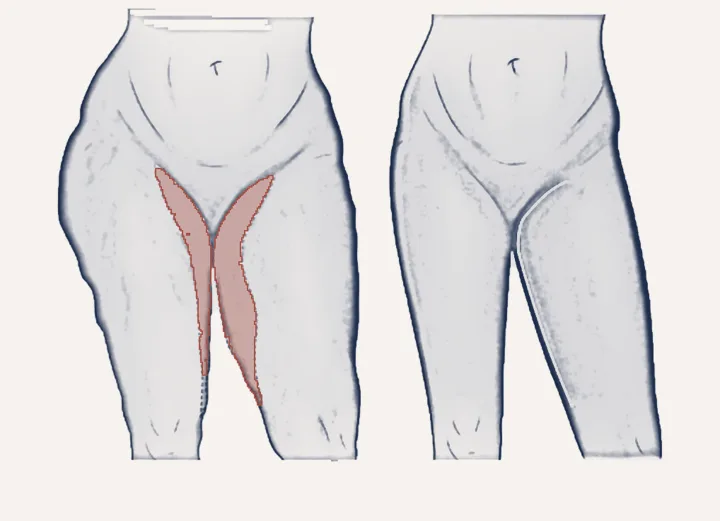
The length of the operation depends on the areas treated: about 2 to 3 hours for the inner thighs, longer for a lower body lift. Liposuction usually comes first, which reduces the weight of the tissue. Internal stitches anchor the deeper tissues, so that the scar is not pulled down.
Horizontal inner thigh lift (incision in the groin crease)
For mild to moderate looseness I remove skin and fat from the top of the thigh, usually after liposuction. The tissue is anchored to a firm deep point in the groin crease, so that the scar stays high, in a crescent shape, and is hidden by underwear. It mainly corrects the upper third of the thigh.
Vertical inner thigh lift (incision along the thigh)
After even greater weight loss, when the looseness extends towards the middle of the thigh or down to the knee, I also remove a strip of skin and fat along the length of the thigh. This adds a second scar on the inner side of the thigh, at right angles to the first. It tightens the skin in two directions and works better for the lower third of the thigh and the knee. The scar is longer and shows in shorts or a short skirt.
Two-stage lift
When the problem is very marked, I prefer to correct it in two stages. First comes extensive liposuction, and 6 months later the lift. The first operation is less demanding, and once the fat is out and the swelling has gone down, the tissue to be lifted is lighter, which clearly improves the final result.
Outer thigh and buttock lift (lower body lift)
When, after major weight loss, the looseness involves the buttocks and the outer and back of the thighs, the incision is placed high, along the underwear line (“tanga lift”). It is often combined with a tummy tuck (abdominoplasty) as an all-round operation, the lower body lift, which lifts the skin down to the knee. I describe it in detail on the page on body contouring after weight loss.
When the lower half of the buttock is flat, I prefer not to remove tissue but to move it upwards, to add volume where it is missing. The incision usually lies along the upper edge of the buttock, so that it is hidden by underwear.
Incisions and stitches
In the horizontal lift the scar lies in the groin crease and the fold under the buttock. In the vertical lift a scar on the inner thigh is added. In a lower body lift the scar runs all the way round, along the underwear line. The skin stitches are removed at 5 to 7 days. Scars mature slowly and never become completely invisible, which is why I place them where they are as hidden as possible.
Combinations
Liposuction is almost always done at the same time, because it lightens the thigh and reduces complications. A buttock lift is often combined with a tummy tuck, and after major weight loss it can be planned together with an arm lift or a breast lift, in one or more operations. For adding volume to the buttocks with fat or implants, see the buttock surgery page.
Hospital stay
You stay in hospital for about 2 nights and wear a compression garment.
How long is recovery after a thigh and buttock lift?
You stay in hospital for about 2 nights and wear a compression garment. Most people return to work in 1 to 2 weeks and to exercise in 6 to 8 weeks. The incisions need care for 10 to 15 days, and the scars mature over 12 to 18 months.
| When | How you feel | What you can do |
|---|---|---|
| Days 1–2 | Pain and tightness at the incisions, controlled with painkillers | In hospital; you get up and walk a little early on, for your circulation |
| Days 3–15 | Swelling and bruising; discomfort when sitting or opening your legs | Wound care and compression garment; avoid opening your legs wide and sitting for long periods |
| Weeks 1–2 | Discomfort eases | Back to office or light work, depending on your job |
| Weeks 4–6 | Almost normal movement | Daily activities without limits; no strenuous exercise yet |
| Weeks 6–8 | Scars are still red and firm | Gradual return to exercise |
| Months 3–6 | Swelling has gone and the shape is settling | Normal activity |
| Months 12–18 | Scars mature, becoming paler and softer | We review the final result together |
How long do I need to stay in Greece after a thigh and buttock lift?
Plan to stay in Greece for 10 to 15 days after a thigh and buttock lift. This covers 2 nights in hospital, the first wound checks and the days before you are fit to fly. Your skin stitches are removed at 5 to 7 days, before you leave.
You spend about 2 nights in hospital, then rest nearby in Thessaloniki or Athens. I see you for checks at the practice to look at the incisions and the compression garment, the last one the day before your flight. You can usually fly home from day 10, with flights of 3 hours at most in the first weeks. On a long flight, wear your compression garment, walk in the aisle regularly, as walking early helps prevent blood clots; depending on your risk, I may also prescribe blood-thinning protection.
Once home, the incisions still need care until day 10 to 15, and you keep wearing the garment until 4 to 6 weeks after surgery. Follow-up continues by video call at 10 days, 1 month, 6 months and 1 year.
Before you travel, arrange for:
- someone to travel with you and help in the first days at home;
- 1 to 2 weeks off work, depending on your job;
- nursing care at home for dressing changes, if you would like it; all follow-up checks are done by me.
What results can I expect, and how long do they last?
A thigh and buttock lift gives firmer skin and a cleaner contour to the thighs and buttocks, visible once the swelling settles, within a few months. The result lasts as long as your weight stays stable. The scars mature slowly, over 12 to 18 months, and never become completely invisible.
My main aim is a balance between the result and the scars. The results of a surgical lift are often striking, but the scars take a long time to fade and lie in places that, although fairly hidden, are not invisible. The scar in the groin crease can move down a little over time, which is why anchoring it to the deep tissues matters. Age and another large change in weight can bring back some looseness.
What are the risks of a thigh and buttock lift?
A thigh and buttock lift involves long incisions, so wound healing problems, such as small wound openings and fluid collections, are more common than after other cosmetic operations. Most are minor and are treated without another operation. Liposuction at the same time and a stable weight make them less likely.
| Complication | How common | Prevention and treatment |
|---|---|---|
| Small wound openings | The most common complication, especially with the vertical technique | No tension on the incisions, no smoking; they heal with dressings |
| Fluid collection (seroma or lymphocele) | Not rare | Liposuction instead of extensive undermining, compression garment; drained with a needle |
| Infection | Rare | Keeping the incisions near the groin and buttock fold clean; antibiotics |
| Haematoma (hematoma) | Rare, in the first days | Checking medicines that affect clotting; drained if it occurs |
| Wide or raised (hypertrophic) scar, scar moving downwards | Not rare | Anchoring to the deep tissues, scar care; corrected with a minor procedure |
| Leg swelling (lymphoedema) | Rare, usually temporary | Careful technique in the groin; compression and legs raised when resting |
| Blood clots in the veins | Rare | Walking early, compression stockings and blood-thinning prevention where needed |
| Change in skin sensation | Common, temporary | Usually returns within months |
Smoking. Stop at least 4 weeks before and 4 weeks after surgery. In operations that remove a lot of skin, such as a thigh and buttock lift, smoking clearly increases wound openings and skin loss (necrosis); I do not operate on heavy smokers unless they stop.
Blood thinners. Tell me if you take anticoagulants or antiplatelet medicines. Stopping them, and any blood-thinning prevention after surgery, is always agreed with the doctor who prescribes them.
How much does a thigh and buttock lift cost?
We do not publish prices. The cost of a thigh and buttock lift differs from patient to patient, depending on the areas treated, the technique, whether it is combined with liposuction or another operation, and the nights in hospital. You receive a quote after the consultation, once I have examined you and we have agreed the plan together.
- The areas treated: inner thighs, outer thighs, buttocks or all of them.
- The technique: horizontal or vertical thigh lift, lower body lift.
- Combination with liposuction or a tummy tuck, and whether the correction is done in one or two stages.
- The length of the operation and the nights in hospital.
- The compression garment and follow-up checks.
Frequently asked questions
Will the scars show after a thigh lift?
Yes, a thigh lift leaves scars, and they never become completely invisible. With the horizontal technique the scar lies in the groin crease and may extend into the fold under the buttock, so it is usually hidden by underwear or a swimsuit. With the vertical technique there is also a scar on the inner thigh, which shows in shorts or a short skirt. The scars are red for the first months and mature slowly, over 12 to 18 months. This is why I choose a surgical lift only when liposuction or adding volume is not enough.
Can saggy inner thighs be fixed with liposuction alone?
Often, yes. In many women the “sagging” on the inner thighs is mainly fat, whose weight pulls the skin down. Once the fat is removed with liposuction, the skin recovers to a large extent, without long scars and with an easier recovery: back to daily activities and the gym in 2 to 3 weeks. Done correctly, liposuction does not cause more sagging. Skin removal is needed when there is true skin laxity, usually after major weight loss. At your examination I tell you which applies to you.
How long is the hospital stay for a thigh and buttock lift?
Usually about 2 nights in hospital. After discharge, the incisions need care for 10 to 15 days and you wear a special compression garment, which reduces swelling and supports the result. Most people return to work in 1 to 2 weeks, depending on the type of job. When a buttock lift is done together with a tummy tuck, as a lower body lift, the stay may be longer, usually 2 to 3 nights.
When can I exercise after a thigh lift?
Exercise is allowed after 6 to 8 weeks. Walking starts in the first days, because it helps circulation and lowers the risk of blood clots. Until the incisions have closed and settled, avoid exercises that open your legs wide or stretch the groin, such as deep squats, cycling and running, because they make it more likely that the wound opens. The return is gradual, based on the instructions I give you at your check-ups.
How long after weight loss surgery can I have a thigh lift?
Once your weight has stabilised, usually after at least 6 to 12 months at a stable weight, and your nutrition is adequate. If you have surgery while you are still losing weight, the skin will loosen again and the result will not last. After bariatric surgery we check your nutrition in the blood tests, because it affects healing. A thigh lift is often part of a plan with several operations, as I describe on the page on body contouring after major weight loss.
What is the difference between a buttock lift and buttock augmentation?
A buttock lift removes or moves loose skin and fat and is needed mainly after major weight loss. Buttock augmentation adds volume, with fat transfer (Brazilian butt lift, BBL) or implants, and lifts the buttocks indirectly, with much smaller scars. In most women without major weight loss, the “droopy” look of the buttock comes from loss of volume, not excess skin, so adding volume is the better solution. For these techniques, see the buttock surgery page.
When can I fly home after a thigh and buttock lift?
You can usually fly home from day 10, with flights of 3 hours at most in the first weeks. Before that you spend about 2 nights in hospital and have your wound checks in Greece, the last one the day before your flight. Your skin stitches are removed at 5 to 7 days, so this is done before you leave. On the flight, wear your compression garment and get up to walk regularly, because walking early lowers the risk of blood clots. Blood-thinning prevention, where you need it, is agreed in advance.
Can my follow-up be done at home?
Yes, for the most part. After your checks in Greece, I follow you up by video call at 10 days, 1 month, 6 months and 1 year. At home, the incisions need care until day 10 to 15 and you keep wearing the compression garment. Wound openings are the most common complication of this operation; most are minor and heal with dressings, which nursing care at home can help with, if needed. We review the final result together once the scars have matured, at 12 to 18 months.
References
- Lockwood TE. Fascial anchoring technique in medial thigh lifts. Plast Reconstr Surg. 1988;82(2):299–304.
- Lockwood T. Lower body lift with superficial fascial system suspension. Plast Reconstr Surg. 1993;92(6):1112–1122.
- Aly AS, Cram AE, Chao M, et al. Belt lipectomy for circumferential truncal excess: the University of Iowa experience. Plast Reconstr Surg. 2003;111(1):398–413.
- Armijo BS, Campbell CF, Rohrich RJ. Four-step medial thighplasty: refined and reproducible. Plast Reconstr Surg. 2014;134(4):717e–725e.
- Gusenoff JA, Coon D, Nayar H, et al. Medial thigh lift in the massive weight loss population: outcomes and complications. Plast Reconstr Surg. 2015;135(1):98–106.
- Schmidt M, Pollhammer MS, Januszyk M, et al. Concomitant liposuction reduces complications of vertical medial thigh lift in massive weight loss patients. Plast Reconstr Surg. 2016;137(6):1748–1757.
- Albanese R, Blessent CGF, Tomaselli F, et al. A comprehensive review of medial thighplasty: the role of liposuction in reducing complications and optimizing patient outcomes. J Clin Med. 2025;14(7):2426.
Consultation
In Thessaloniki, in Athens or by video. Examination, options and a written plan.